
The Writing of News A Handbook with Chapters on Newspaper Correspondence and Copy Reading
Charles G. (Charles Griffith) Ross
THE CLASSIC COLLECTION · 1887
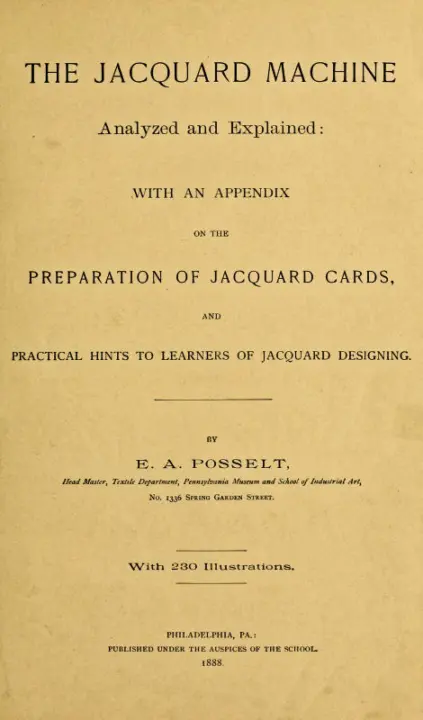
"The Jacquard Machine Analyzed and Explained" by E. A. Posselt is a scientific publication written in the late 19th century. This detailed work focuses on the Jacquard machine, a significant invention in textile manufacturing, exploring its mechanisms, applications, and operational techniques. It aims to provide practical insights into the machine's design, operation, and the preparation of Jacquard cards necessary for weaving complex fabrics. The opening portion introduces the Jacquard machine and its historical context, outlining its inventor Joseph Marie Jacquard's early life and challenges. Posselt emphasizes the machine's mechanical functions, such as the role of hooks, leashes, and needles in weaving, as well as the importance of punching cards for controlling the warp threads. The preface also mentions the lack of literature on this topic, positioning the book as a crucial resource for students and practitioners in the field of textile arts.
Introduction adapted from the source catalogue; source summaries may be automatically generated.
Free to read · English · 38,829 words · No account needed
MAKE TIME FOR A GOOD BOOK
On by default. Untick to stop anonymous reading totals. Each page counts after 10 seconds in view. How this works.
Anonymous counting is on unless you have switched it off.
=Skipper=, technical name for a part of the Piano Card-stamping machine, 88
=Spools.= This technical term applies to a barrel, having a head on
each end.
=Spring Frame=, a part of the Jacquard machine, 14
=Springs=, as used in connection with the needles in the Jacquard machine, 9, 10, 15
=Squaring-off=, a process employed for enlarging and reducing figures in sketches, 110
---- A process employed in the construction of original sketches, 111
---- A process employed in transferring the sketch to the [O] designing paper, 112, 115
=Straight-through Tie-up.= The Jacquard harness threaded on the machine in the direction from front to rear, 23
---- The Jacquard harness threaded on the machine in the direction from rear to front, 26
---- On the English system, 28
---- For repeating effects in one repeat of the design, 29
---- For two-ply ingrain carpets, 74
---- In four sections, 57
---- In three sections, 53
---- In two sections (for double cloth), 48, 50, 51
---- Of a Jacquard harness, having front harness attached, 32
---- Single and double sections combined, 51
=Straight-through Tie-up and Point Tie-up=, combined, 35, 39, 42, 43, 46
---- Applied to a double-lift double-cylinder Jacquard machine, 70
=Stop Motions=, for looms, are attachments for stopping the loom when the filling breaks or runs out. The Protector, an additional attachment to the loom, might also be classified as a stop motion, as it stops the loom in case the shuttle fails to reach its box.
=Super=, a two-ply ingrain carpet constructed with 960 threads warp (36 inch wide fabric), exclusive of the selvedge, 76
=Tail-cords=, the substitutes of the regular hooks used in the ingrain carpet machine, 71
=Temples=, attachments to the loom on each side of the selvedge, for holding the last woven part of the fabric in even width, with the width of the fabric in its reed, thus preventing as much useless chafing of the warp as possible.
=Terry=, a loop; an uncut pile fabric.
=Textile=, a woven fabric.
=Texture=, changing, for fabrics using a Jacquard harness threaded in the solid comber-board, 21
---- Number of warp and filling-ends in one inch; there are two
textures:
a, for the fabric in the loom (reed).
b, for the finished fabric.
=Twills= are frequently employed as ground-weaves for Jacquard
designs.
---- A weave running diagonally across the fabric. They are divided into even-sided, uneven-sided, broken, and fancy twills.
=Twist.= The amount and the direction of the twist in yarns of any kind of material is very important; thus it should never be overlooked in the preparation of a design for textile fabrics.
=Tying-up of Jacquard Looms=, with compound harness attached, 58
=Vaucanson=, the inventor of the griffe, 7
=Velvet=, a cut pile fabric.
=Warp=, the threads running lengthwise in a cloth; the yarn which passes through the Jacquard harness and the reed.
Your reading position is saved on this browser. Take it to another device with a library code. Reading pages adapt to text, rather than matching a printed edition.
BEHIND THE BOOK
This eBook is for the use of anyone anywhere in the United States and most other parts of the world at no cost and with almost no restrictions whatsoever. You may copy it, give it away or re-use it under the terms of the Project Gutenberg License included with this eBook or online at www.gutenberg.org. If you are not located in the United States, you will have to check the laws of the country where you are located before using this eBook. Read the source licence.
The original source file, including credits and licence, is retained by this library. Request an original-format copy at no charge. Please include the book title and Project Gutenberg identifier #54193.
KEEP YOUR CURIOSITY GOING
Charles G. (Charles Griffith) Ross
Hannah Webster Foster

Emily Lawless
Edwin Hamlin Carr

Charles De Lano Hine
Andrew Ure