
The Writing of News A Handbook with Chapters on Newspaper Correspondence and Copy Reading
Charles G. (Charles Griffith) Ross
THE CLASSIC COLLECTION · 1887
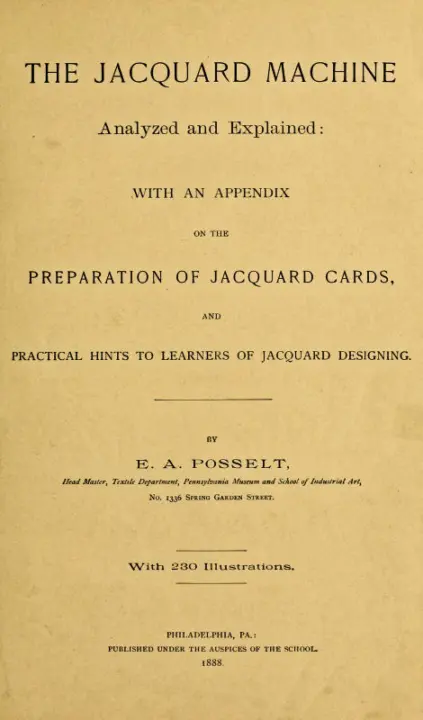
"The Jacquard Machine Analyzed and Explained" by E. A. Posselt is a scientific publication written in the late 19th century. This detailed work focuses on the Jacquard machine, a significant invention in textile manufacturing, exploring its mechanisms, applications, and operational techniques. It aims to provide practical insights into the machine's design, operation, and the preparation of Jacquard cards necessary for weaving complex fabrics. The opening portion introduces the Jacquard machine and its historical context, outlining its inventor Joseph Marie Jacquard's early life and challenges. Posselt emphasizes the machine's mechanical functions, such as the role of hooks, leashes, and needles in weaving, as well as the importance of punching cards for controlling the warp threads. The preface also mentions the lack of literature on this topic, positioning the book as a crucial resource for students and practitioners in the field of textile arts.
Introduction adapted from the source catalogue; source summaries may be automatically generated.
Free to read · English · 38,829 words · No account needed
MAKE TIME FOR A GOOD BOOK
On by default. Untick to stop anonymous reading totals. Each page counts after 10 seconds in view. How this works.
Anonymous counting is on unless you have switched it off.
=Reserve Rows.= Nearly every Jacquard machine contains two extra rows of needles in addition to the number as classified, 10
=Satin-weaves= are characterized by a smooth face. The stitch of the threads is opposite to that of the twill weaves. The foundations for designing a satin-weave are, in the first place, to arrange as much as possible distributed stitching; in the second, to have this as regular as possible. The satin-weaves commence with the five-harness, and can after this be made on any number of harness. To find the run of stitching in the easiest way, use the following rule: Divide the number of harness into two parts, which must neither be equal, nor the one a multiple of the other. Afterwards take one result and add it, commencing to count from 1 until all threads or harnesses are taken up, as example: Five harness--5 = 2 + 3. Commencing with one and adding two points, we have as follows: 1 + 2 = 3 + 2 = 5 + 2 = 7, or 2 + 2 = 4. This will give the stitch as: 1, 3, 5, 2, 4, which means: the first pick stitches in the first warp-thread, the second pick stitches in the third warp-thread, the third pick stitches in the fifth warp-thread, the fourth pick stitches in the second warp-thread, the fifth pick stitches in the fourth warp-thread.
---- Are frequently employed for ground-weaves in Jacquard designs.
=Section= of the comber-board, dividing the comber-board in its
depth.
=Sectional Harness Arrangement=, 26
=Selecting Needle=, used in the Repeating machine, 94
=Selvedge=, the edge of cloth, woven in such a manner as to prevent ravelling, and often closed by complicating the threads; also called List, Listing.
=Setting of Figures= in a sketch, 108
=Setting of the Cylinder=, 18
=Shading= of textile fabrics by the weave, 118
---- Rules for, 119
=Shed=, the separation of the warp to allow the shuttle to pass
through.
=Shot-about=, the alternate exchange (filling ways) of figure up and ground up in two-ply ingrain carpet, 72, 117
=Shuttles= are the means for carrying the filling into and through
the shed.
=Shuttle-box Mechanism=, for carpet hand-looms, 80
=Shuttle-raceway=, the part of the lay on which the shuttle travels
to and fro.
=Silk= consists of the pale yellow, buff colored, or white fibre, which the silk worm spins around about itself when entering the pupa or chrysalis state. Spun Silks are calculated as to size of the thread on the same basis as cotton. The adopted custom of specifying the size of raw silk is by giving the weight of 1000 yards in drams, avoirdupois.
=Single Cloth=, selection of designing paper, 105
=Single-lift Jacquard Machine.= By it warp-threads, as called for, according to the Jacquard cards, are raised and lowered each pick.
=Sizes of Jacquard Machines=, 10
=Sketches=, enlarging and reducing figures for, 110
=Sketch=, principles for, 108
---- Size required, 109
---- Transferring to the [O] designing paper, 112, 115
Your reading position is saved on this browser. Take it to another device with a library code. Reading pages adapt to text, rather than matching a printed edition.
BEHIND THE BOOK
This eBook is for the use of anyone anywhere in the United States and most other parts of the world at no cost and with almost no restrictions whatsoever. You may copy it, give it away or re-use it under the terms of the Project Gutenberg License included with this eBook or online at www.gutenberg.org. If you are not located in the United States, you will have to check the laws of the country where you are located before using this eBook. Read the source licence.
The original source file, including credits and licence, is retained by this library. Request an original-format copy at no charge. Please include the book title and Project Gutenberg identifier #54193.
KEEP YOUR CURIOSITY GOING
Charles G. (Charles Griffith) Ross
Hannah Webster Foster

Emily Lawless
Edwin Hamlin Carr

Charles De Lano Hine
Andrew Ure