THE CLASSIC COLLECTION✦Ruben and Ivy SênCLASSIC FREE BOOKS
Ruben and Ivy Sên
Louise Jordan Miln
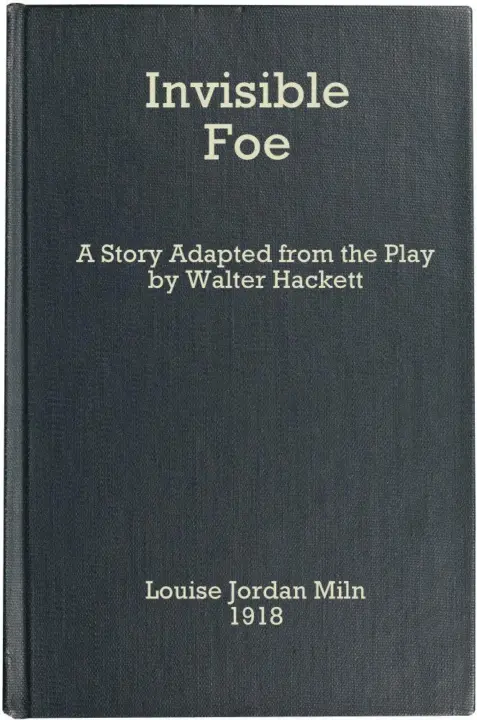
THE CLASSIC COLLECTION · 1918
"The Invisible Foe" by Louise Jordan Miln and Walter Hackett is a novel written in the early 20th century. The story centers around three children: Stephen, an orphan who is ambitious and masterful in nature; Hugh, who is more stolid and devoted; and Helen, the pretty, imaginative daughter of their guardian, Richard Bransby. As they navigate their childhood at Deep Dale, the dynamics of their relationships foreshadow deeper themes of power, longing, and the struggles of growing up. At the start of the novel, Stephen is depicted as a curious and observant boy, captivated by the flight of birds, while Hugh engages in simple play and Helen entertains herself with imaginary friends. Their interrelations are nuanced: Stephen's desire for power often clashes with his affection for Helen, who appears seraphic yet firmly controls her surroundings. Richard Bransby, their uncle and guardian, is portrayed as a stern and complex character, burdened by the loss of loved ones and the responsibility of caring for the children. The beginning sets the stage for a narrative that explores themes of love, ambition, and the burdens of inheritance against the backdrop of a seemingly idyllic childhood.
Introduction adapted from the source catalogue; source summaries may be automatically generated.
Free to read · English · 65,109 words · No account needed
MAKE TIME FOR A GOOD BOOK
On by default. Untick to stop anonymous reading totals. Each page counts after 10 seconds in view. How this works.
Anonymous counting is on unless you have switched it off.
“But surely she won’t interfere with your management,” said Latham.
And Angela cried, “Oh no, she must never do that.”
“No—she must never do that,” Pryde said, more to himself than to them, stirring his tea musingly and gazing wistfully, stubbornly into the fire. He looked up and caught Mrs. Hilary’s eye, and spoke to them both, and more lightly. “I dare say I shall find a way to persuade her to let me go on as I have.”
Their hostess sprang up with a cry. Latham just saved her cup, and an almonded eclair tumbled into the fire—past all saving. “Oh! it is lovely, perfectly lovely!”
“What?” the men both asked.
“To fly like a bird. I used to dream I was flying when I was a child. It was perfectly sweet. I used to dream it, too, sometimes when I first came out and went to Germans (cotillions, you call ’em) and things every night—oh!”
“Perhaps that came from your dancing,” Pryde said gallantly. Angela
danced well.
“More probably it was the midnight supper she’d eaten,” laughed Latham, pointing a rueful professional finger at the tea-table.
“Perhaps it was both,” the hostess said cheerfully. “And my, it was beautiful. But oh, we never had supper at midnight. No fear! Two or three was nearer the hour. But such good suppers. You don’t know how to eat over here,” she added sadly. “For one thing, you simply don’t know how to cook a lobster—not one of you.”
“How should a lobster be cooked?” Pryde said lazily.
“Hot—hot—hot. Or it’s good in a mayonnaise. But who ever saw a mayonnaise in London? No one.”
“I am not greatly surprised that you dreamed at some height, if you regularly supped off lobster, Mrs. Hilary, at three in the morning, either frappé or sizzling hot,” Latham told her.
“And champagne with it,” Stephen ventured.
“Never! I detest champagne with shellfish.”
“Stout?” Pryde quizzed.
Angela made a face.
“What, then, was the beverage? If one is permitted to ask,” Stephen
persisted meekly.
“Cream—when I could get it. I do love cream.”
The physician groaned. “I wonder,” he said severely, “that instead of dreaming of flying you did not in reality fly.”
She giggled, and helped herself to a macaroon, still standing on the hearthrug, facing them. “Oh, I knew a lovely poem once—we all had to learn it by heart at school—probably you did too?”
“I think it highly improbable,” Latham protested.
“I am positive I did not,” Pryde asserted.
Your reading position is saved on this browser. Take it to another device with a library code. Reading pages adapt to text, rather than matching a printed edition.
Louise Jordan Miln
Roi Cooper Megrue & Walter Hackett
Louise Jordan Miln & Harold Owen & Harry M. Vernon
Louise Jordan Miln
BEHIND THE BOOK
This eBook is for the use of anyone anywhere in the United States and most other parts of the world at no cost and with almost no restrictions whatsoever. You may copy it, give it away or re-use it under the terms of the Project Gutenberg License included with this eBook or online at www.gutenberg.org. If you are not located in the United States, you will have to check the laws of the country where you are located before using this eBook. Read the source licence.
The original source file, including credits and licence, is retained by this library. Request an original-format copy at no charge. Please include the book title and Project Gutenberg identifier #50188.
KEEP YOUR CURIOSITY GOING
Coulson Kernahan

Maurice Baring
Frances Wright
Cécile Tormay

Frederic Jesup Stimson

W. H. P. (William Henry Pope) Jarvis