THE CLASSIC COLLECTION✦Ruben and Ivy SênCLASSIC FREE BOOKS
Ruben and Ivy Sên
Louise Jordan Miln
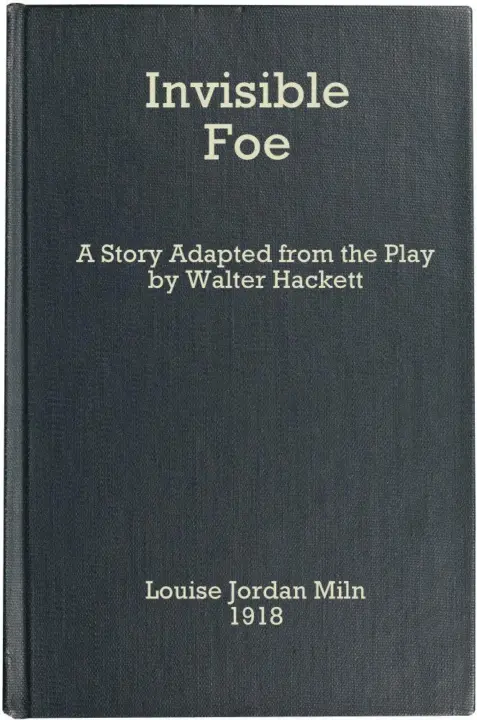
THE CLASSIC COLLECTION · 1918
"The Invisible Foe" by Louise Jordan Miln and Walter Hackett is a novel written in the early 20th century. The story centers around three children: Stephen, an orphan who is ambitious and masterful in nature; Hugh, who is more stolid and devoted; and Helen, the pretty, imaginative daughter of their guardian, Richard Bransby. As they navigate their childhood at Deep Dale, the dynamics of their relationships foreshadow deeper themes of power, longing, and the struggles of growing up. At the start of the novel, Stephen is depicted as a curious and observant boy, captivated by the flight of birds, while Hugh engages in simple play and Helen entertains herself with imaginary friends. Their interrelations are nuanced: Stephen's desire for power often clashes with his affection for Helen, who appears seraphic yet firmly controls her surroundings. Richard Bransby, their uncle and guardian, is portrayed as a stern and complex character, burdened by the loss of loved ones and the responsibility of caring for the children. The beginning sets the stage for a narrative that explores themes of love, ambition, and the burdens of inheritance against the backdrop of a seemingly idyllic childhood.
Introduction adapted from the source catalogue; source summaries may be automatically generated.
Free to read · English · 65,109 words · No account needed
MAKE TIME FOR A GOOD BOOK
On by default. Untick to stop anonymous reading totals. Each page counts after 10 seconds in view. How this works.
Anonymous counting is on unless you have switched it off.
“Can’t you think why Grant came here on Monday?”
“No. How could I?”
“Why did he come, sir?” Stephen interposed.
“A shortage has been discovered in the accounts at the office.”
“A shortage in our accounts?” Stephen spoke incredulously. “Impossible.”
“I’m most awfully sorry, sir,” Hugh said sympathetically, taking a step
nearer his uncle.
“Some one has stolen ten thousand pounds.”
“Who?” Stephen asked quickly.
“The money was taken from the African trading account.”
“From the African trading account?” Stephen echoed. “But that’s impossible—Hugh has always had charge of that.”
“I know,” Bransby said dully.
“Uncle Dick,” Hugh cried, suddenly realizing that he was being accused—“Uncle Dick, you don’t mean that you think that I——” The passionate voice choked and almost broke.
Stephen stopped him. “Quiet, Hugh; of course he can’t mean anything so absurd as that. Besides, you’ve not been at the office for months.”
Helen threw toward Stephen a look full of gratefulness.
But her father said despairingly, “The money was taken while he was
still at the office.”
“How do you know that, sir?” Stephen spoke almost sternly to his uncle.
But the older man did not resent that. “Certain alterations were made in the ledger during the time he had charge of it,” he explained drearily.
Hugh broke in hotly, “I know nothing of them.”
“Of course not,” his brother said cordially. “You see, sir——” turning
to Bransby.
“The alterations are in Hugh’s handwriting.”
“Impossible,” Hugh cried indignantly—contemptuously too.
Stephen said very quietly, “I don’t believe it.”
“I can convince you.” Their uncle opened the ledger, one hand on its pages, the other on the jade weight.
Helen sat proudly apart, but the brothers hurried to him. Hugh threw himself in a chair at the table where the book lay, Stephen stood behind his brother, his hand on his shoulder.
There was a significant pause.
Stephen shook his head. “It is very like,” he said slowly.
Bransby turned to another page. “And this?”
“Oh, yes, it is. It is very like too.” Stephen’s reluctance was apparent and deep. And a hint of conviction escaped him.
“There is no need to go further,” Bransby said wearily. “These were made when the money was taken.”
Hugh sat gazing at the open ledger in bewilderment. “It—it,” he stammered—“it seems to be my handwriting—but”—he was not stammering now—“I swear I never wrote it.”
“I believe you, Hugh,” Stephen said simply.
Your reading position is saved on this browser. Take it to another device with a library code. Reading pages adapt to text, rather than matching a printed edition.
Louise Jordan Miln
Roi Cooper Megrue & Walter Hackett
Louise Jordan Miln & Harold Owen & Harry M. Vernon
Louise Jordan Miln
BEHIND THE BOOK
This eBook is for the use of anyone anywhere in the United States and most other parts of the world at no cost and with almost no restrictions whatsoever. You may copy it, give it away or re-use it under the terms of the Project Gutenberg License included with this eBook or online at www.gutenberg.org. If you are not located in the United States, you will have to check the laws of the country where you are located before using this eBook. Read the source licence.
The original source file, including credits and licence, is retained by this library. Request an original-format copy at no charge. Please include the book title and Project Gutenberg identifier #50188.
KEEP YOUR CURIOSITY GOING
Coulson Kernahan

Maurice Baring
Frances Wright
Cécile Tormay

Frederic Jesup Stimson

W. H. P. (William Henry Pope) Jarvis