THE CLASSIC COLLECTION✦Ruben and Ivy SênCLASSIC FREE BOOKS
Ruben and Ivy Sên
Louise Jordan Miln
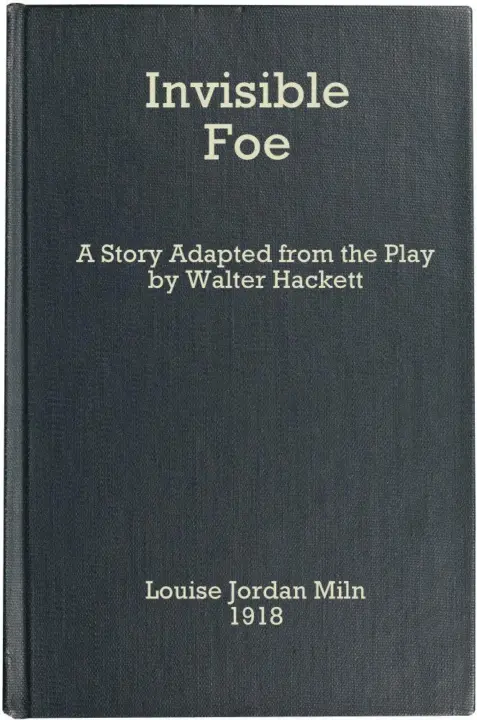
THE CLASSIC COLLECTION · 1918
"The Invisible Foe" by Louise Jordan Miln and Walter Hackett is a novel written in the early 20th century. The story centers around three children: Stephen, an orphan who is ambitious and masterful in nature; Hugh, who is more stolid and devoted; and Helen, the pretty, imaginative daughter of their guardian, Richard Bransby. As they navigate their childhood at Deep Dale, the dynamics of their relationships foreshadow deeper themes of power, longing, and the struggles of growing up. At the start of the novel, Stephen is depicted as a curious and observant boy, captivated by the flight of birds, while Hugh engages in simple play and Helen entertains herself with imaginary friends. Their interrelations are nuanced: Stephen's desire for power often clashes with his affection for Helen, who appears seraphic yet firmly controls her surroundings. Richard Bransby, their uncle and guardian, is portrayed as a stern and complex character, burdened by the loss of loved ones and the responsibility of caring for the children. The beginning sets the stage for a narrative that explores themes of love, ambition, and the burdens of inheritance against the backdrop of a seemingly idyllic childhood.
Introduction adapted from the source catalogue; source summaries may be automatically generated.
Free to read · English · 65,109 words · No account needed
MAKE TIME FOR A GOOD BOOK
On by default. Untick to stop anonymous reading totals. Each page counts after 10 seconds in view. How this works.
Anonymous counting is on unless you have switched it off.
“I had no idea, Latham,” joined in Bransby, playing up to Helen (he always did play up to Helen), “that you were so attractive to the opposite sex.”
Latham groaned.
“Oh!” Helen said with almost judicial gravity, “I don’t know that it is entirely due to Dr. Latham’s charm that the present crisis has come about. I think Angela’s sense of duty is equally to blame.”
“Mrs. Hilary’s sense of duty!” Latham muttered.
“Really?” quizzed Bransby.
“Yes, Daddy, she feels that bachelorhood is an unfit state for a physician; and because she has a high regard for Dr. Latham she has nobly resolved to cure him of it.”
“But I don’t wish to be cured.”
“Nonsense!” Bransby rebuked him, adding dryly, “what would you say to a patient of yours who talked like that?”
Latham turned to Helen desperately. “I say, Miss Bransby, does she know I am staying with you?”
“No—I think not. I think she’s still in town.”
“That’s a relief.”
“But she’ll find out,” Helen assured him, nodding sagely her naughty red
head.
But respite was at hand. “Can we come in?” asked a voice at which Richard Bransby winced again.
“Yes, Hugh, come along,” Helen said cheerfully. “Dr. Latham will be glad to see you; he has finished his delicate confidences.”
“It’s all right, Stephen, we won’t be in the way,” Hugh called over his shoulder as he strolled through the doorway, a boyish, soldierly young figure, sunny-faced, frank-eyed. He wore the khaki of a second lieutenant. He went up to his uncle. Bransby’s fingers tightened at the throat of the green god, and imperiled the delicately cut pink lotus leaves.
“I suppose Helen told you that she beat us,” the young fellow said, laying a coin near Bransby’s hand. “There’s the shilling I owe you, sir—the last of an ill-spent fortune.”
“Thanks,” Bransby spoke with difficulty. But the boy noticed nothing. He already was moving to the back of the room where Helen was sitting.
“Have you told him?” Hugh said in a low voice as he sat down beside her.
“No, not yet.”
Stephen Pryde threw one quick glance to where they sat as he came quickly in, but only one, and he went at once to his uncle. “I hope Grant didn’t bring you any bad news, sir?” he said.
Bransby was sharply annoyed. He answered quickly, with a swift furtive look at his nephew. “How did you know Grant was here?”
“Barker told me. I hope there is nothing wrong, sir?”
“Wrong? What could be wrong?” The impatience of Bransby’s tone brooked no further questioning.
Your reading position is saved on this browser. Take it to another device with a library code. Reading pages adapt to text, rather than matching a printed edition.
Louise Jordan Miln
Roi Cooper Megrue & Walter Hackett
Louise Jordan Miln & Harold Owen & Harry M. Vernon
Louise Jordan Miln
BEHIND THE BOOK
This eBook is for the use of anyone anywhere in the United States and most other parts of the world at no cost and with almost no restrictions whatsoever. You may copy it, give it away or re-use it under the terms of the Project Gutenberg License included with this eBook or online at www.gutenberg.org. If you are not located in the United States, you will have to check the laws of the country where you are located before using this eBook. Read the source licence.
The original source file, including credits and licence, is retained by this library. Request an original-format copy at no charge. Please include the book title and Project Gutenberg identifier #50188.
KEEP YOUR CURIOSITY GOING
Coulson Kernahan

Maurice Baring
Frances Wright
Cécile Tormay

Frederic Jesup Stimson

W. H. P. (William Henry Pope) Jarvis