THE CLASSIC COLLECTION✦Towards democracyCLASSIC FREE BOOKS
Towards democracy
Edward Carpenter
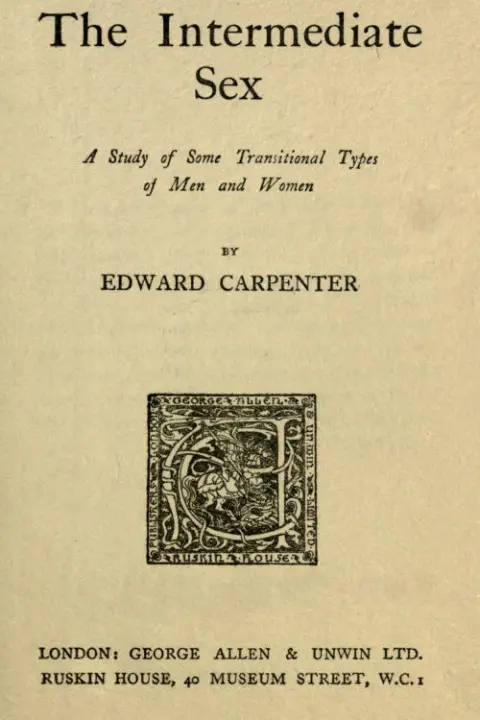
THE CLASSIC COLLECTION · 1907
"The Intermediate Sex: A Study of Some Transitional Types of Men and Women" by Edward Carpenter is a scientific publication written in the early 20th century. This work examines the complexities of gender and sexuality, specifically focusing on individuals who embody traits from both masculine and feminine spectra. Carpenter aims to illuminate the experiences and challenges faced by these "intermediate" types, advocating for a deeper understanding and acceptance of their presence in society. The opening of the book introduces the concept of transitional types in relation to gender, suggesting that strict binaries of male and female are insufficient to describe the full range of human diversity. Carpenter discusses how societal progress has led to a growing acknowledgment of these intermediate traits, encouraging readers to approach this subject with open minds. He notes that throughout history, individuals with mixed gender traits have played significant roles in society, though often misunderstood or marginalized. The author sets the stage for a critical exploration of these intermediate types, addressing both their unique emotional capacities and the implications of their existence in contemporary society.
Introduction adapted from the source catalogue; source summaries may be automatically generated.
Free to read · English · 35,627 words · No account needed
MAKE TIME FOR A GOOD BOOK
On by default. Untick to stop anonymous reading totals. Each page counts after 10 seconds in view. How this works.
Anonymous counting is on unless you have switched it off.
“From thy fair face I learn, O my loved lord, That which no mortal tongue can rightly say: The soul, imprisoned in her house of clay, Holpen by thee to God hath often soared: And though the vulgar, vain, malignant horde Attribute what their grosser wills obey, Yet shall this fervent homage that I pay, This love, this faith, pure joys for us afford, Lo, all the lovely things we find on earth, Resemble for the soul that rightly sees, That source of bliss divine which gave us birth: Nor have we first-fruits or remembrances Of heaven elsewhere. Thus, loving loyally, I rise to God, and make death sweet by thee.”
The labours of von Scheffler, followed by J. A. Symonds, have now pretty conclusively established the pious frauds of the nephew, and the fact that the love-poems of the elder Michel Angelo were, for the most part, written to male friends.
[23] See an interesting paper in W. Pater’s “Renaissance.”
[24] For a fuller collection of instances of this Friendship-love in the history of the world, see “Ioläus: an Anthology,” by E. Carpenter (George Allen, London. 3/- net). Also “Liebling-minne und Freundesliebe in der Welt-literatur,” von Elisar von Kupffer (Adolf Brand, Berlin, 1900).
[25] As in the case, for instance, of Tennyson’s “In Memoriam,” for which the poet was soundly rated by the Times at the time of its publication.
[26] Jowett’s “Plato,” 2nd ed., vol. ii., p. 30.
[27] Jowett, vol. ii., p. 130.
[28] One ought also to mention some later writers, like Dr. Magnus Hirschfeld and Dr. von Römer, whose work though avowedly favourable to the Urning-movement, is in a high degree scientific and reliable in character.
[29] From Uranos--see, for derivation, p. 20, supra--also Plato’s “Symposium,” speech of Pausanias.
[30] See, for estimates, Appendix, pp. 134-136.
[31] Though there is no doubt a general tendency towards femininity of type in the male Urning, and towards masculinity in the female.
[32] “Gli amori degli uomini.”
[33] “Psychopathia Sexualis,” 7th ed., p. 227.
[34] Ibid, pp. 229 and 258. See Appendix, p. 160.
[35] “How deep congenital sex-inversion roots may be gathered from the fact that the pleasure-dream of the male Urning has to do with male persons, and of the female with females.”--Krafft-Ebing, “P.S.,” 7th ed., p. 228.
[36] “Conträre Sexualempfindung,” 2nd ed., p. 269.
[37] See “Love’s Coming-of-Age,” p. 22.
[38] Pub.: F. A. Davis, Philadelphia, 1901.
[39] Otto Weininger even goes further, and regards the temperament as a natural intermediate form (“Sex and Character,” ch. iv.) See also Appendix, infra, p. 169.
Your reading position is saved on this browser. Take it to another device with a library code. Reading pages adapt to text, rather than matching a printed edition.
Edward Carpenter
Edward Carpenter
Edward Carpenter
Edward Carpenter
BEHIND THE BOOK
This eBook is for the use of anyone anywhere in the United States and most other parts of the world at no cost and with almost no restrictions whatsoever. You may copy it, give it away or re-use it under the terms of the Project Gutenberg License included with this eBook or online at www.gutenberg.org. If you are not located in the United States, you will have to check the laws of the country where you are located before using this eBook. Read the source licence.
The original source file, including credits and licence, is retained by this library. Request an original-format copy at no charge. Please include the book title and Project Gutenberg identifier #53763.
KEEP YOUR CURIOSITY GOING

Charles G. (Charles Griffith) Ross
Hannah Webster Foster

Emily Lawless
Edwin Hamlin Carr

Charles De Lano Hine
Andrew Ure