THE CLASSIC COLLECTION✦Towards democracyCLASSIC FREE BOOKS
Towards democracy
Edward Carpenter
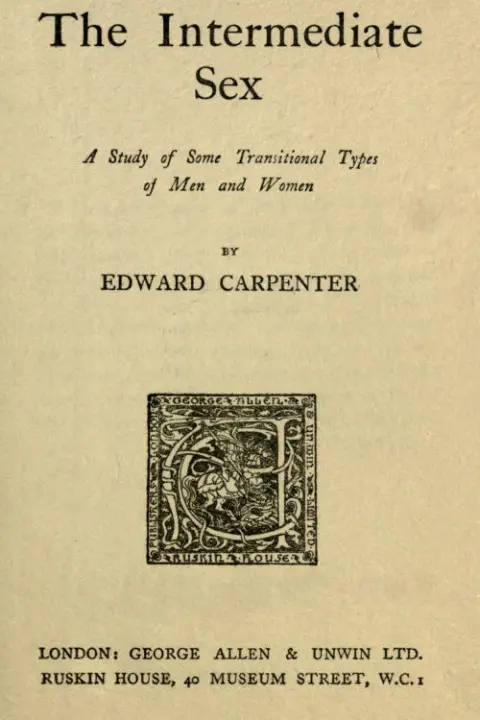
THE CLASSIC COLLECTION · 1907
"The Intermediate Sex: A Study of Some Transitional Types of Men and Women" by Edward Carpenter is a scientific publication written in the early 20th century. This work examines the complexities of gender and sexuality, specifically focusing on individuals who embody traits from both masculine and feminine spectra. Carpenter aims to illuminate the experiences and challenges faced by these "intermediate" types, advocating for a deeper understanding and acceptance of their presence in society. The opening of the book introduces the concept of transitional types in relation to gender, suggesting that strict binaries of male and female are insufficient to describe the full range of human diversity. Carpenter discusses how societal progress has led to a growing acknowledgment of these intermediate traits, encouraging readers to approach this subject with open minds. He notes that throughout history, individuals with mixed gender traits have played significant roles in society, though often misunderstood or marginalized. The author sets the stage for a critical exploration of these intermediate types, addressing both their unique emotional capacities and the implications of their existence in contemporary society.
Introduction adapted from the source catalogue; source summaries may be automatically generated.
Free to read · English · 35,627 words · No account needed
MAKE TIME FOR A GOOD BOOK
On by default. Untick to stop anonymous reading totals. Each page counts after 10 seconds in view. How this works.
Anonymous counting is on unless you have switched it off.
[1] For the derivation of these terms see ch. ii., p. 20, infra.
[2] See Appendix, pp. 139 and 140.
[3] From Uranos, heaven; his idea being that the Uranian love was of a higher order than the ordinary attachment. For further about Ulrichs and his theories see Appendix, pp. 157-159.
[4] Charles G. Leland (“Hans Breitmann”) in his book “The Alternate Sex” (Wellby, 1904), insists much on the frequent combination of the characteristics of both sexes in remarkable men and women, and has a chapter on “The Female Mind in Man,” and another on “The Male Intellect in Woman.”
[5] Some late statistical inquiries (see “Statistische Untersuchungen,” von Dr. M. Hirschfeld, Leipzig, 1904) yield 1.5 to 2.0 per cent. as a probable ratio. See also Appendix, pp. 134-136.
[6] For instances, see Appendix, pp. 149-153.
[7] See De Joux, “Die Enterbten des Liebesglückes” (Leipzig, 1893), p. 21.
[8] “Psychopathia Sexualis,” 7th ed., p. 276.
[9] See Appendix, pp. 153-156.
[10] A good deal in this description may remind readers of history of the habits and character of Henry III. of France.
[11] Perhaps, like Queen Christine of Sweden, who rode across Europe, on her visit to Italy, in jack-boots and sitting astride of her horse. It is said that she shook the Pope’s hand, on seeing him, so heartily that the doctor had to attend to it afterwards!
[12] “Homosexual,” generally used in scientific works, is of course a bastard word. “Homogenic” has been suggested, as being from two roots, both Greek, i.e., “homos,” same, and “genos,” sex.
[13] “Athenæus” xiii., ch. 78.
[14] See Plutarch’s “Eroticus,” §xvii.
[15] See “Natural History of Man,” by J. G. Wood. Vol: “Africa,” p. 419.
[16] See also Livingstone’s “Expedition to the Zambesi” (Murray, 1865) p.
148.
[17] Though these two plays, except for some quotations, are lost.
[18] Mantegazza and Lombroso. See Albert Moll, “Conträre
Sexualempfindung,” 2nd ed., p. 36.
[19] Though in translation this fact is often by pious fraudulence
disguised.
[20] W. Pater’s “Renaissance,” pp. 8-16.
[21] Among prose writers of this period, Montaigne, whose treatment of the subject is enthusiastic and unequivocal, should not be overlooked. See Hazlitt’s “Montaigne,” ch. xxvii.
[22] I may be excused for quoting here the sonnet No. 54, from J. A. Symonds’ translation of the sonnets of Michel Angelo:--
Your reading position is saved on this browser. Take it to another device with a library code. Reading pages adapt to text, rather than matching a printed edition.
Edward Carpenter
Edward Carpenter
Edward Carpenter
Edward Carpenter
BEHIND THE BOOK
This eBook is for the use of anyone anywhere in the United States and most other parts of the world at no cost and with almost no restrictions whatsoever. You may copy it, give it away or re-use it under the terms of the Project Gutenberg License included with this eBook or online at www.gutenberg.org. If you are not located in the United States, you will have to check the laws of the country where you are located before using this eBook. Read the source licence.
The original source file, including credits and licence, is retained by this library. Request an original-format copy at no charge. Please include the book title and Project Gutenberg identifier #53763.
KEEP YOUR CURIOSITY GOING

Charles G. (Charles Griffith) Ross
Hannah Webster Foster

Emily Lawless
Edwin Hamlin Carr

Charles De Lano Hine
Andrew Ure