THE CLASSIC COLLECTION✦Towards democracyCLASSIC FREE BOOKS
Towards democracy
Edward Carpenter
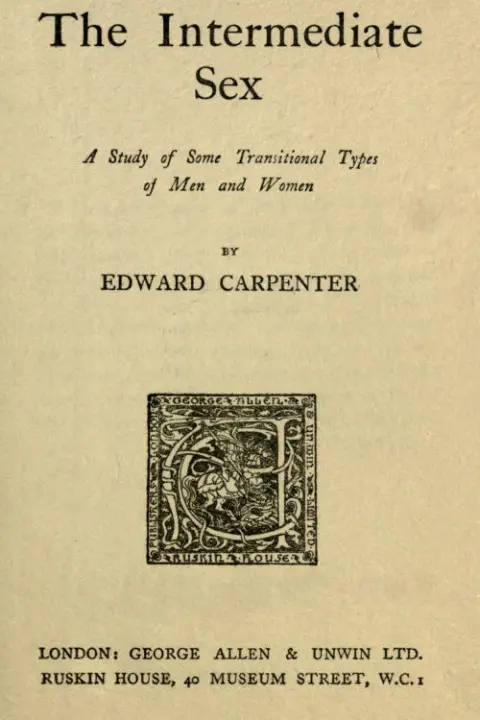
THE CLASSIC COLLECTION · 1907
"The Intermediate Sex: A Study of Some Transitional Types of Men and Women" by Edward Carpenter is a scientific publication written in the early 20th century. This work examines the complexities of gender and sexuality, specifically focusing on individuals who embody traits from both masculine and feminine spectra. Carpenter aims to illuminate the experiences and challenges faced by these "intermediate" types, advocating for a deeper understanding and acceptance of their presence in society. The opening of the book introduces the concept of transitional types in relation to gender, suggesting that strict binaries of male and female are insufficient to describe the full range of human diversity. Carpenter discusses how societal progress has led to a growing acknowledgment of these intermediate traits, encouraging readers to approach this subject with open minds. He notes that throughout history, individuals with mixed gender traits have played significant roles in society, though often misunderstood or marginalized. The author sets the stage for a critical exploration of these intermediate types, addressing both their unique emotional capacities and the implications of their existence in contemporary society.
Introduction adapted from the source catalogue; source summaries may be automatically generated.
Free to read · English · 35,627 words · No account needed
MAKE TIME FOR A GOOD BOOK
On by default. Untick to stop anonymous reading totals. Each page counts after 10 seconds in view. How this works.
Anonymous counting is on unless you have switched it off.
[40] “Though then before my own conscience I cannot reproach myself, and though I must certainly reject the judgment of the world about us, yet I suffer greatly. In very truth I have injured no one, and I hold my love in its nobler activity for just as holy as that of normally disposed men, but under the unhappy fate that allows us neither sufferance nor recognition I suffer often more than my life can bear.”--Extract from a letter given by Krafft-Ebing.
[41] See “In the Key of Blue,” by J. A. Symonds (Elkin Mathews, 1893).
[42] See Appendix, pp. 162 and 163.
[43] See also “Love’s Coming-of-Age,” 5th ed., pp. 173, 174.
[44] See “Das Conträre Geschlechtsgefühl,” von Havelock Ellis und J. A. Symonds (Leipzig, 1896).
[45] “Symposium,” Speech of Socrates.
[46] It is interesting in this connection to notice the extreme fervour, almost of romance, of the bond which often unites lovers of like sex over a long period of years, in an unfailing tenderness of treatment and consideration towards each other, equal to that shown in the most successful marriages. The love of many such men, says Moll (p. 119), “developed in youth lasts at times the whole life through. I know of such men, who had not seen their first love for years, even decades, and who yet on meeting showed the old fire of their first passion. In other cases, a close love-intimacy will last unbroken for many years.”
[47] Though, inconsistently enough, making no mention of females.
[48] Dr. Moll maintains (2nd ed., pp. 314, 315) that if familiarities between those of the same sex are made illegal, as immoral, self-abuse ought much more to be so made.
[49] Though it is doubtful whether the marriage-laws even do this.
[50] In France, since the adoption of the Code Napoleon, sexual inversion is tolerated under the same restrictions as normal sexuality; and according to Carlier, formerly Chief of the French Police, Paris is not more depraved in this matter than London. Italy in 1889 also adopted the principles of the Code Napoleon on this point. For further considerations with regard to the Law, see Appendix, pp. 164 and 165.
[51] For further instances, see Appendix, pp. 143-148.
[52] See Müller’s “History and Antiquities of the Doric Race.”
[53] Müller.
[54] Cf. the incident at the end of Plato’s “Lysis,” when the tutors of Lysis and Menexenus come in and send the youths home.
[55] For a useful little manual on this subject, see “How We are Born,” by Mrs. N. J. (Daniel, London, price 2/-). For a general argument in favour of sex-teaching see “The Training of the Young in Laws of Sex,” by Canon Lyttelton, Headmaster of Eton College (Longmans, 2/6).
Your reading position is saved on this browser. Take it to another device with a library code. Reading pages adapt to text, rather than matching a printed edition.
Edward Carpenter
Edward Carpenter
Edward Carpenter
Edward Carpenter
BEHIND THE BOOK
This eBook is for the use of anyone anywhere in the United States and most other parts of the world at no cost and with almost no restrictions whatsoever. You may copy it, give it away or re-use it under the terms of the Project Gutenberg License included with this eBook or online at www.gutenberg.org. If you are not located in the United States, you will have to check the laws of the country where you are located before using this eBook. Read the source licence.
The original source file, including credits and licence, is retained by this library. Request an original-format copy at no charge. Please include the book title and Project Gutenberg identifier #53763.
KEEP YOUR CURIOSITY GOING

Charles G. (Charles Griffith) Ross
Hannah Webster Foster

Emily Lawless
Edwin Hamlin Carr

Charles De Lano Hine
Andrew Ure