THE CLASSIC COLLECTION✦Eline VereCLASSIC FREE BOOKS
Eline Vere
Louis Couperus
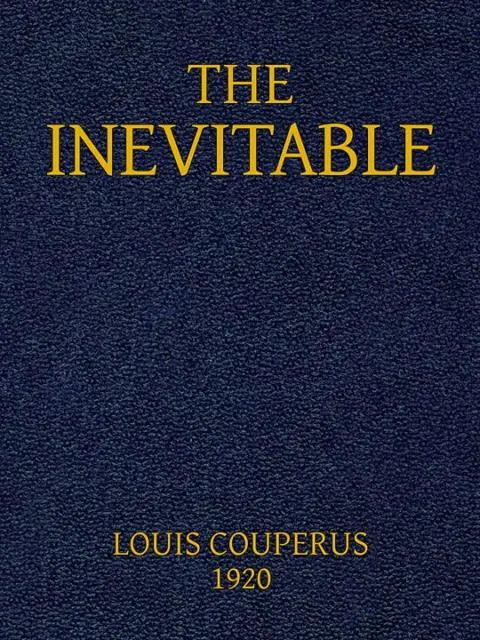
THE CLASSIC COLLECTION · 1920
"The Inevitable" by Louis Couperus is a novel written in the late 19th century. The story unfolds in a boarding house in Rome, focusing on the life of Cornélie de Retz van Loo, a young Dutch woman recovering from a recent divorce. As she navigates her new reality, the novel explores themes like loneliness, societal expectations, and the search for identity in a foreign city. The opening of the novel introduces the Marchesa Belloni's boarding house, where Cornélie arrives, filled with a mix of excitement and an undercurrent of foreboding. She is greeted by various characters, including the friendly porter and the boisterous marchesa, each representing different facets of life in the pension. While Cornélie attempts to settle into her new environment, she grapples with feelings of displacement and anticipates the arrival of new experiences. The foundation is laid for her introspective journey as she begins to confront not just the loneliness of travel but also the complexities of her past and the uncertain future that lies ahead.
Introduction adapted from the source catalogue; source summaries may be automatically generated.
Free to read · English · 85,880 words · No account needed
MAKE TIME FOR A GOOD BOOK
On by default. Untick to stop anonymous reading totals. Each page counts after 10 seconds in view. How this works.
Anonymous counting is on unless you have switched it off.
"It's amusing, isn't it?"
Cornélie raised her eyebrows:
"What do you mean?"
"A cosmopolitan company like this."
"Oh, yes!"
"You are Dutch?"
"How do you know?"
"I saw your name in the visitors' book, with 'la Haye' after it."
"I am Dutch, yes."
"There are some more Dutch ladies here, sitting over there: they
are charming."
Cornélie asked the major-domo for some vin ordinaire.
"That wine is no good," said the stout gentleman, vivaciously. "This is Genzano," pointing to his fiasco. "I pay a small corkage and drink my own wine."
The major-domo put a pint bottle in front of Cornélie: it was included in her pension without extra charge.
"If you like, I will give you the address where I get my wine. Via
della Croce, 61."
Cornélie thanked him. The pock-marked gentleman's uncommon ease and
vivacity diverted her.
"You're looking at the major-domo?" he asked.
"You are a keen observer," she smiled in reply.
"He's a type, our major-domo, Giuseppe. He used to be major-domo in the palace of an Austrian archduke. He did I don't know what. Stole something, perhaps. Or was impertinent. Or dropped a spoon on the floor. He has come down in the world. Now you behold him in the Pension Belloni. But the dignity of the man!"
He leant forward:
"The marchesa is economical. All the servants here are either old or
very young. It's cheaper."
He bowed to two German ladies, a mother and daughter, who had come
in and sat down beside him:
"I have the permit which I promised you, to see the Palazzo Rospigliosi and Guido Reni's Aurora" he said, speaking in German.
"Is the prince back then?"
"No, the prince is in Paris. The palace is not open to visitors,
except yourselves."
This was said with a gallant bow.
The German ladies exclaimed how kind he was, how he was able to do anything, to find a way out of every difficulty. They had taken endless trouble to bribe the Rospigliosi porter and they had not succeeded.
A little thin Englishwoman had taken her seat beside Cornélie.
"And for you, Miss Taylor, I have a card for a low mass in His
Holiness' private chapel."
Miss Taylor was radiant with delight.
"Have you been sight-seeing again?" the pock-marked gentleman
continued.
"Yes, Museo Kircheriano," said Miss Taylor. "But I am tired out. It
was most exquisite."
"My prescription, Miss Taylor, is that you stay at home this afternoon
and rest."
"I have an engagement to go to the Aventino...."
"You mustn't. You're tired. You look worse every day and you're losing flesh. You must rest, or you sha'n't have the card for the low mass."
Your reading position is saved on this browser. Take it to another device with a library code. Reading pages adapt to text, rather than matching a printed edition.
Louis Couperus
Louis Couperus
Louis Couperus
Louis Couperus
BEHIND THE BOOK
This eBook is for the use of anyone anywhere in the United States and most other parts of the world at no cost and with almost no restrictions whatsoever. You may copy it, give it away or re-use it under the terms of the Project Gutenberg License included with this eBook or online at www.gutenberg.org. If you are not located in the United States, you will have to check the laws of the country where you are located before using this eBook. Read the source licence.
The original source file, including credits and licence, is retained by this library. Request an original-format copy at no charge. Please include the book title and Project Gutenberg identifier #43005.
KEEP YOUR CURIOSITY GOING
Coulson Kernahan

Maurice Baring
Frances Wright
Cécile Tormay

Frederic Jesup Stimson

W. H. P. (William Henry Pope) Jarvis