THE CLASSIC COLLECTION✦An outlaw’s diary: the CommuneCLASSIC FREE BOOKS
An outlaw’s diary: the Commune
Cécile Tormay
THE CLASSIC COLLECTION · 1915
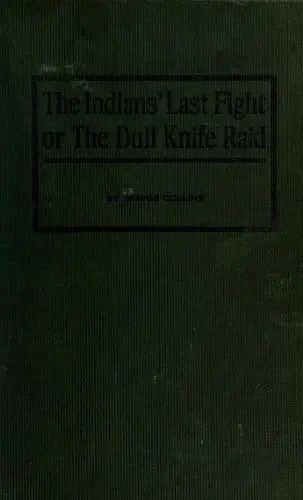
"The Indians' Last Fight; Or, The Dull Knife Raid" by Dennis Collins is a historical account written in the late 19th century. The book aims to shed light on the life of cowmen and Native Americans in the American West, particularly focusing on the events surrounding the Dull Knife Raid. Collins emphasizes the significance of accurate representation of Western life, challenging the prevalent misconceptions about both cow-punchers and Native Americans. The opening of the narrative establishes Collins as both the author and a participant in the events he describes. He introduces the challenging conditions faced by early settlers in the Western frontier, detailing their struggles with harsh environments, scarce resources, and interactions with Native American tribes. The author’s personal anecdotes provide insight into the daily lives of these pioneers, illustrating their perseverance and the camaraderie that developed among them as they sought to establish homes amidst adversity. The tone is reflective, capturing the complexities of frontier life while preparing the reader for deeper explorations of conflict and resilience in the chapters to follow.
Introduction adapted from the source catalogue; source summaries may be automatically generated.
Free to read · English · 111,601 words · No account needed
MAKE TIME FOR A GOOD BOOK
On by default. Untick to stop anonymous reading totals. Each page counts after 10 seconds in view. How this works.
Anonymous counting is on unless you have switched it off.
In the autumn of the year of 1878, a gentleman by the name of John Joplin was sent out from Zanesville, Ohio, to select a suitable place in Western Kansas for the purpose of locating a colony. The intention was to start a co-operative business in farming. After surveying the country at large, he came to the conclusion that the Crooked Creek valley, Meade County, where I was living at the time, was the most desirable for the purpose. He returned home and gave a glowing report of what he had done, and his efforts and report received the approval of the future colonists. They made their arrangements and moved westward in the following spring. When they had reached their destination, they learned that Chief Dull Knife, a leader of a band of northern Chyenne Indians, had left the reservation at Ft. Reno where he and his followers were held as prisoners of war. Followed by a numerous retinue of tribesmen he started for the Black Hills and had passed through the Crooked Creek Valley, killing the settlers. They continued on their way, killing, burning, and destroying everything and everybody in sight until they were re-captured at Ft. Robinson, Nebraska. From there they were brought back and placed on the reservation once more.
The particulars of the Dull Knife Raid will be given in another chapter.
Needless to say, these reports caused considerable excitement in the valley. Every few days rumors were circulated that the Indians were returning, or would return as soon as the grass had begun to sprout again. Hardly had one rumor died until another was put into circulation. Excitement reached such a degree that all deemed it necessary to organize for protection. A meeting was called which all the settlers were invited, or requested, to attend. The Colonists assembled at the dug-out of a Mr. M. B. Wilson, one of the leading spirits of the movement, to devise ways and means for protection in case the Indians should return. After a general discussion of the prevailing conditions, it was unanimously agreed that we should appeal to the Governor of Kansas for fire arms, as there were few of us that had any, many had none, and some had no money to purchase them, and some that did have them, had very little knowledge of their use. Our secretary was instructed to write to the governor, explain the conditions of affairs, and request him to send us the necessary guns and ammunition with which to protect ourselves against the Indians in case they should make another descent on the valley, which they would likely do as they were threatening to leave the reservation and go on the warpath a second time. After a good deal of correspondence and red tape we succeeded in getting the governor's attention, and he kindly informed us, after several week's delay, that if we wanted any assistance from the state, we should join the militia. He informed us that when we were duly sworn in, he would send the necessary arms for protection of our homes and families. To the disinterested reader this action on the part of the governor may seem magnanimous, but to the settler whose family was living in a dug-out with nothing to protect them but a fire shovel or a hatchet in case of an Indian raid, it looked very much like a case of criminal neglect. Another meeting was called, and it was well attended. There were many women present who seemed anxious to organize a company for the protection of their homes. After some discussion it was decided to organize and join the militia. Among those present was a veteran of the Civil war. He was elected Captain on his war record--one of the home-made kind, as none of his comrades of the war recollected any time or place where he performed any deed of valor--as he would most likely know the best thing to do at the proper time. To hear the Captain tell of his numerous exploits, the number of men took prisoners of war, how he had on several occasions leaped over the breastworks of some beleagured fort in the midst of a shower of grape and canister, and tore down the Confederate flag, one would think that he, Capt. Milligan, bore a charmed life. It seemed strange to me that such a thoughtful man as Abe Lincoln did not send somebody down south to assist the Captain as he seemed to be doing all the heavy fighting himself. Such was our captain, the last and the greatest of the Milligans up to that time, and it would require a remarkable scion to eclipse his record, if one hundredth part of what he said was true.
Your reading position is saved on this browser. Take it to another device with a library code. Reading pages adapt to text, rather than matching a printed edition.
BEHIND THE BOOK
This eBook is for the use of anyone anywhere in the United States and most other parts of the world at no cost and with almost no restrictions whatsoever. You may copy it, give it away or re-use it under the terms of the Project Gutenberg License included with this eBook or online at www.gutenberg.org. If you are not located in the United States, you will have to check the laws of the country where you are located before using this eBook. Read the source licence.
The original source file, including credits and licence, is retained by this library. Request an original-format copy at no charge. Please include the book title and Project Gutenberg identifier #37922.
KEEP YOUR CURIOSITY GOING
Cécile Tormay

Moritz Busch
John L. Ransom
Frances Wright
Cécile Tormay

Mabel Potter Daggett