THE CLASSIC COLLECTION✦An outlaw’s diary: the CommuneCLASSIC FREE BOOKS
An outlaw’s diary: the Commune
Cécile Tormay
THE CLASSIC COLLECTION · 1915
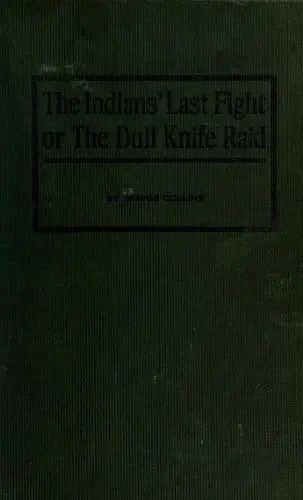
"The Indians' Last Fight; Or, The Dull Knife Raid" by Dennis Collins is a historical account written in the late 19th century. The book aims to shed light on the life of cowmen and Native Americans in the American West, particularly focusing on the events surrounding the Dull Knife Raid. Collins emphasizes the significance of accurate representation of Western life, challenging the prevalent misconceptions about both cow-punchers and Native Americans. The opening of the narrative establishes Collins as both the author and a participant in the events he describes. He introduces the challenging conditions faced by early settlers in the Western frontier, detailing their struggles with harsh environments, scarce resources, and interactions with Native American tribes. The author’s personal anecdotes provide insight into the daily lives of these pioneers, illustrating their perseverance and the camaraderie that developed among them as they sought to establish homes amidst adversity. The tone is reflective, capturing the complexities of frontier life while preparing the reader for deeper explorations of conflict and resilience in the chapters to follow.
Introduction adapted from the source catalogue; source summaries may be automatically generated.
Free to read · English · 111,601 words · No account needed
MAKE TIME FOR A GOOD BOOK
On by default. Untick to stop anonymous reading totals. Each page counts after 10 seconds in view. How this works.
Anonymous counting is on unless you have switched it off.
The night of the battle, Custer started for Camp Supply and very nearly overtook his scout, California Joe, as the latter had to hide so much on the way to avoid being caught by the Indians; and I believe that Custer made a record trip, as he was afraid of the same thing. When he returned and Major Elliot's absence was not satisfactorily explained, General Sheridan showed great dissatisfaction. He issued an order to get everything in readiness at once and decided to take a hand in that business himself to see if he could not discover what had become of Elliot. The Kansas volunteers having lost most of their horses in the snow banks on the Cimmaron River, with the remainder unfit for service, were organized as infantry and taken along. In fact, every available man was taken from Camp Supply except those who were required to guard the provisions and look after the stock. Although Sheridan was a graduate of West Point, he never encumbered himself with any West Point tactics in fighting Indians. He just put on his fighting clothes and set out to whip them into subjection regardless of any military parade, and usually accomplished what he set out to do. There was one feature of all his expeditions which he never neglected, and that was that he never failed to keep in touch with the best and most reliable scouts and guides to be found, and once he had secured them he never failed to be governed by their instructions, as he was well aware that such men understood the topography of the country much better than some titled professor of a military academy. Such scouts he found on this occasion. He took along as his guide and chief of scouts, one Ben Clark, because Ben was married into the Cheyenne tribe and understood and spoke the tribal languages fluently. He also took along California Joe, as he was a good scout and was familiar with all the customs and habits of the Indians, having lived and dealt with them all the way from California to Texas. He was invaluable as a scout and guide, but had one fault, of which I shall speak later on, that tried the patience of the general sorely at times, but still Sheridan could not afford to part with him. Those two, with the addition to two Osage Indian scouts, were all that he brought into service. When everything was in readiness the general set out with the firm determination to settle the Indian trouble for once and for all time to come, if possible. He took General Custer with him, as he was familiar with the route and also with the locality of the recent battle. He took as his ambulance driver Johnny Murphy, a lad scarcely out of his teens and who acted in that capacity until the close of the campaign. The first night out they camped on the south bank of Wolf Creek where they found an abundance of timber and living water, two essentials at that time as the weather was hovering around the zero mark. The men were becoming accustomed to the cold and stood up in it like Esquimaux. Next morning they were up and away to cross the divide to the South Canadian. The snow was still quite deep on the flats and the moisture had softened the soil which had not frozen sufficiently to hold up the heavy freight wagons, which made it a tedious and toilsome trip to reach the river. Clark being acquainted with the country guided them down a canyon where they found timber and a fair shelter. There they went into camp for the night. Next morning one of the real trials of the journey confronted them. The river had to be forded and they were forced to repeat the labors that Custer had performed on the former occasion and as the ice was not thick enough to bear a heavy weight. They had to cut a channel and remove the ice from it and trample the quicksand with the cavalry to make it fordable for the wagons. They accomplished the crossing with a great deal of difficulty and hardships, as most of them were wet from trampeling through the stream or assisting the lumbering wagons on their way. When the last team had crossed they were glad to know that this difficulty had been overcome. (The reader sitting on a balcony, viewing troops of cavalry prancing along the paved streets seems to enjoy the spectacle and can easily come to imagine that the cavalry man's life is one continual round of pleasure, but let him change his location and go and sit with me on the south porch of a snow bank and see those same soldiers fording a treacherous stream in the winter season and his impressions of the gay and happy life will be suddenly changed.) When out of the brakes and the canyons they were on the last lap of their journey to the battle ground where Custer had wound up the wild and turbulent career of Black Kettle and his band of Cheyenne warriors. This day was but a repetition of the day before except that at noon they camped long enough to feed the stock some grain, as the mules were becoming tired and jaded from the bad condition of the prairie. After dinner they resumed their journey and that evening went into camp about two miles from the scene of Custer's fight with the Cheyennes a few days previous. Next morning they set out and in a short time arrived at the battle ground. They stopped to examine the place which gave every evidence of a severe conflict. After Sheridan had examined the field he sent out scouts and squads of soldiers to scour the surrounding country in search of Major Elliott and the fifteen missing men. They were found about two miles from the battle ground, dead, and stripped of their clothing and mutilated in the most horrible manner. The mutilation was the work of the squaws. They had not been scalped and their bodies lay not very far apart and the number of empty shells lying near each body showed the desperate defense they had made. It was learned afterward that Major Elliott had followed a band of fugitives and captured them, and when returning was met and overpowered by a large band of Kiowas and their dead bodies were left there for the squaws to mutilate. When this discovery was made and the news brought to Gen. Sheridan, he was in no frame of mind to adopt any conciliatory measures towards the Indians, besides it had a strong tendency to lessen his respect for Gen. Custer for not making some effort to learn what had become of Major Elliot and his fifteen companions. Sheridan was now in the right humor for a fight. He wanted to fight and was going to have a fight or a footrace with the first Indians he met. He started down the Washita, where the Kiowas and the Comanches had their headquarters. His progress was closely watched by the Indians. They pulled up everything and moved on in advance of him, but well out of his reach. They were certainly in a predicament as they could not cover up their trail by scattering out over the plain, as they would do in summer time, as the snow on the prairie gave evidence of every move they made and things were in such a shape that it was either fight or surrender. Gen. Sheridan did not seem to care which. They continued to move down stream with Sheridan in pursuit until the third day when they sent a messenger back carrying a white flag and a letter from Gen. Hazen, chairman of the peace committee, asking for a conference with the General. The reader can readily see about how Sheridan felt on the subject. He sent back word to them that there was but one way in which he would recognize Hazen's request for a conference and that was that he would give them twenty-four hours to surrender and come in as prisoners of war, or a fight would start at the expiration of that time. He was compelled to acknowledge the flag of truce and the Indians were well aware of that fact. Reluctantly he gave them the 24 hours to surrender or prepare for battle, as the recent outrages on the settlers on the Saline and Solomon Rivers, the barbarous treatment of Major Elliot and his companions were fresh in the mind of Sheridan. The Indian, aware of the value of the flag of truce used it always to his advantage when in a tight place, though they had no respect for it in their own dealings with others. Sheridan was waiting anxiously for the expiration of the time of truce, but the Indians forestalled the allotted time by about four hours. If the thing was to be done over again, I do not believe that Sheridan would have paid any attention to the flag of truce, as the first sight that met the General's eye after he had marched into their camp and taken Chief Lone Wolf and Chief Satanta prisoners, was the body of a white woman who had been kidnapped from near Fort Lyon by Satanta and kept to gratify his savage lust. When he found escape impossible, he shot her to avoid giving her up to her rescuers and took her white child by the feet and dashed its brains out against a tree. When the fiend shot the woman, whose name was Mrs. Blynn, he held the gun so close to her that her face was powder-burned. In her death, I imagine that there was relief brought to one poor tortured soul.
Your reading position is saved on this browser. Take it to another device with a library code. Reading pages adapt to text, rather than matching a printed edition.
BEHIND THE BOOK
This eBook is for the use of anyone anywhere in the United States and most other parts of the world at no cost and with almost no restrictions whatsoever. You may copy it, give it away or re-use it under the terms of the Project Gutenberg License included with this eBook or online at www.gutenberg.org. If you are not located in the United States, you will have to check the laws of the country where you are located before using this eBook. Read the source licence.
The original source file, including credits and licence, is retained by this library. Request an original-format copy at no charge. Please include the book title and Project Gutenberg identifier #37922.
KEEP YOUR CURIOSITY GOING
Cécile Tormay

Moritz Busch
John L. Ransom
Frances Wright
Cécile Tormay

Mabel Potter Daggett