THE CLASSIC COLLECTION✦An outlaw’s diary: the CommuneCLASSIC FREE BOOKS
An outlaw’s diary: the Commune
Cécile Tormay
THE CLASSIC COLLECTION · 1915
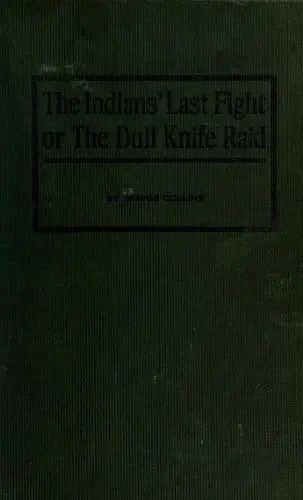
"The Indians' Last Fight; Or, The Dull Knife Raid" by Dennis Collins is a historical account written in the late 19th century. The book aims to shed light on the life of cowmen and Native Americans in the American West, particularly focusing on the events surrounding the Dull Knife Raid. Collins emphasizes the significance of accurate representation of Western life, challenging the prevalent misconceptions about both cow-punchers and Native Americans. The opening of the narrative establishes Collins as both the author and a participant in the events he describes. He introduces the challenging conditions faced by early settlers in the Western frontier, detailing their struggles with harsh environments, scarce resources, and interactions with Native American tribes. The author’s personal anecdotes provide insight into the daily lives of these pioneers, illustrating their perseverance and the camaraderie that developed among them as they sought to establish homes amidst adversity. The tone is reflective, capturing the complexities of frontier life while preparing the reader for deeper explorations of conflict and resilience in the chapters to follow.
Introduction adapted from the source catalogue; source summaries may be automatically generated.
Free to read · English · 111,601 words · No account needed
MAKE TIME FOR A GOOD BOOK
On by default. Untick to stop anonymous reading totals. Each page counts after 10 seconds in view. How this works.
Anonymous counting is on unless you have switched it off.
"Say, Jack," said Slim, "you remember what you told me in the camphouse in Dodge City the day I left you. You recollect saying what a consarned fool I was about that young lady, and what you thought of the old man? Say, I hope to die and go to heaven if every word of what you told me was not true. I have ridden for two days to tell you what kind of a durn fool I am. You are a fortune teller, a prophet, a prognosticator. I had not ridden out to Five Mile Creek until he got to soliloquizing with myself. You know all cow-punchers do that out on the prairie! Well, I got to fixing up how to act, what to do and say when I got out there where the young lady lives. I had read a society book that some fellow from back East had left at the ranch once. There was some of it torn out, but there was a lot of it left and I learned a whole lot out of it, and I was going to govern myself accordingly. It said that a young man in company after taking his seat, should sit erect and throw his head back, keep his knees close together, and that chewing tobacco or smoking cigarettes was not good form. Under no circumstances should the young man wear spurs, carry a gun, especially in the company of the young lady with whom he is anyways intimate. I guess that book was written for the Texas trade, as there was a proviso that gun-wearing would be permissible if there were other gentlemen present. If there was anything about the disposal of the hands, it must have been torn out or I forgot it. It was most likely torn out, as that crowd of boys at the ranch would tear the leaves out of their mother's Bible to make a cigarette. I can ride a horse or throw a rope, but what to do with my hands when I entered the house was beyond me. I knew how to hold my head, chest, and knees, but I could not for the life of me figure out what to do with those hands. I felt as if each hand was as big as a ham and the nearer I approached the house, the larger they seemed to grow. I felt pretty much like a Hottentot. He is usually pictured with a very depleted wardrobe. He has no books of instruction on the art of going into society, and I am of the opinion he had just as much trouble with his hands as I had. I guess he just folded his hands across his manly chest and backed in. By the time I arrived at the Mulberry Ranch I had decided to do all I knew and trust to luck for the rest. When I had staked out my pony, I went in and slicked up some. I washed, combed my hair, brushed my clothes, and then took about three fingers of old Tom Duggan's best bourbon, not as a stimulant, but to put some color in my cheeks. As soon as the bourbon began to show some of its efficacy, I put on a couple of rings I had bought in Dodge and headed for the old man's ranch, letting my hands take care of themselves. In my generosity of feeling I pictured myself being invited to supper and perhaps even being requested to spend the night at the old man's. With an eye to putting an appearance on things I was going to try to trade some long-horned stock for some of his short-horns. I was in terror lest the young lady I was yet to choose, would smell my breath, and if the old man and his family were prohibitionists, I knew it would be all up with my chances. However, I was encouraged in the knowledge of the fact that this was to be my first call and I was not likely to get within breath-smelling distance of the lady of my choice. Regardless of consequences, I turned in and rode up to the hitching post, dismounted, took off my spurs and my gun, and then set out for the house. It seemed miles from that hitching-post to the front door. I finally covered the distance and rapped gently on the panel as I did not want them to think I was one of those rough, roaring, cow-punchers--the kind you mentioned. I listened attentively for one of those gentle footfalls, or the sound of an angelic voice bidding me to enter. I imagined once I heard the rustle of a silk dress but I am satisfied now that I was mistaken as I believe the sound was caused by the girls husking roasting ears for supper. You know that husking green corn makes a kind of squeaking noise. I did not have long to wait as I heard the sound of footsteps--the kind a bull moose makes when in trouble. The door was thrown open savagely and I was confronted by an old man who weighed about two hundred and fifty pounds. He had a face like a full moon with side whiskers to match and a moustache that resembled a second-hand shoe brush. He wore a white shirt with a home-made collar that reached to his ears. I tell you he was a fierce looking object. He stared me straight in the eye and said, "What can I do for you?" Now, Jack, you know that I am a fairly good talker, but right there my voice failed me. I could not utter a word if my life depended upon it. To make matters worse, he kept those two big eyes on me just like a dog setting a quail. My throat became all tied up in a knot, but after a pause I pulled myself together and asked him if he was bothered by any range cattle breaking through his fences. I thought I would get him into conversation in that way, and said that the range foreman had asked me to make the inquiry. He turned and slammed the door in my face. My love that a few moments before threatened to burn a hole in my shirt, was turned to hate. I detest that old man, and what makes my hatred more intense is the fact that when I was riding away I saw the girls laughing and making fun of me. I have come to the conclusion that I had better stick to the ranching as I never did care much for farming anyway. As for society and things like that, I abominate them."
Your reading position is saved on this browser. Take it to another device with a library code. Reading pages adapt to text, rather than matching a printed edition.
BEHIND THE BOOK
This eBook is for the use of anyone anywhere in the United States and most other parts of the world at no cost and with almost no restrictions whatsoever. You may copy it, give it away or re-use it under the terms of the Project Gutenberg License included with this eBook or online at www.gutenberg.org. If you are not located in the United States, you will have to check the laws of the country where you are located before using this eBook. Read the source licence.
The original source file, including credits and licence, is retained by this library. Request an original-format copy at no charge. Please include the book title and Project Gutenberg identifier #37922.
KEEP YOUR CURIOSITY GOING
Cécile Tormay

Moritz Busch
John L. Ransom
Frances Wright
Cécile Tormay

Mabel Potter Daggett