THE CLASSIC COLLECTION✦An outlaw’s diary: the CommuneCLASSIC FREE BOOKS
An outlaw’s diary: the Commune
Cécile Tormay
THE CLASSIC COLLECTION · 1915
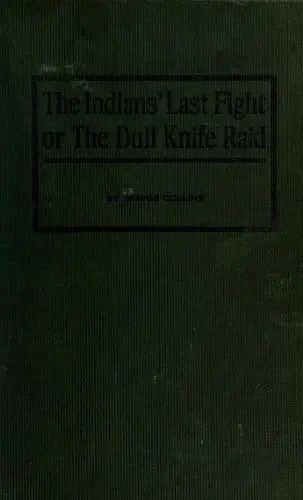
"The Indians' Last Fight; Or, The Dull Knife Raid" by Dennis Collins is a historical account written in the late 19th century. The book aims to shed light on the life of cowmen and Native Americans in the American West, particularly focusing on the events surrounding the Dull Knife Raid. Collins emphasizes the significance of accurate representation of Western life, challenging the prevalent misconceptions about both cow-punchers and Native Americans. The opening of the narrative establishes Collins as both the author and a participant in the events he describes. He introduces the challenging conditions faced by early settlers in the Western frontier, detailing their struggles with harsh environments, scarce resources, and interactions with Native American tribes. The author’s personal anecdotes provide insight into the daily lives of these pioneers, illustrating their perseverance and the camaraderie that developed among them as they sought to establish homes amidst adversity. The tone is reflective, capturing the complexities of frontier life while preparing the reader for deeper explorations of conflict and resilience in the chapters to follow.
Introduction adapted from the source catalogue; source summaries may be automatically generated.
Free to read · English · 111,601 words · No account needed
MAKE TIME FOR A GOOD BOOK
On by default. Untick to stop anonymous reading totals. Each page counts after 10 seconds in view. How this works.
Anonymous counting is on unless you have switched it off.
Our first night was one of rest, with nothing to disturb us but the howling of the coyotes and the bawling of the cattle. Morning found us up early and ready for the chase. We knew it would be useless to try to catch him on a straight run as he would have, at least, half a mile start on us. We decided to run him in a circle, keep inside of his course, and keep him on the run until he became jaded and exhausted and then let him get a chance to drink his fill of water as he would surely be very thirsty after a long gallop. The consequence of this strategy would be that the mustang would become stiffened and it would be easy to run him down and rope him. After making the first large circle, C. M. Rice, seeing his horse lathered with perspiration that trickled down from the flanks of his horse, his favorite Old Tom, decided to return to camp and prepare something to eat for himself and us on our return. If we did not return by night-fall he was to keep the camp-fire burning to act as a beacon for our guidance. In order to save our horses, Brown and I decided that one of us should keep on the chase whilst the other rested his horse. This gave each of us chance to refresh our mount with water and grass until it came his turn to take up the pursuit. In the meantime the mustang was not allowed to have a respite from his exertions, but was kept on the move until about three or four o'clock in the afternoon. Nature asserted herself in his case and frequently, after that time, he would stop to look around and see if his pursuers were likely to give him a chance to rest and refresh himself. It was plainly evident that the pace was telling on him, but he found that his pursuers gave him no opportunity to rest his weary legs. Closely and more closely they came in spite of all he could do to ward off their unremitting pursuit. The moments he took to stop and look around offered us an opportunity to draw closer. Then we both took up the chase at the same time. We divided our forces, one going on one side of him and the other on the opposite. By this time we were within twenty rods of him. By this strategy we headed him for Gypsom Creek in the hope that when he reached it he would stop and drink his fill. That would give us an opportunity of roping him. Everything worked out as we had planned. When the thirsty brute reached the water he drank abundantly of the refreshing fluid. It seemed as though he would never stop. When finally he had his fill we ran him off to the mouth of a canyon where, if once we could get him to enter, there would be no opportunity of his escape as there was no outlet at the other end. I say none, or rather should have said there was one but it was practically out of the question for him to make it. It was about a mile away and the road was filled with boulders and sand heaps and was up hill all the way, and we knew that in his present condition his wind would be gone before he could again reach the open prairie. Now came the opportunity to rope him if he was to be captured at all, as there was nothing left for him to do but choose between the rough boulders and ledges of the other end of the canyon, or strive to evade us by seeking safety in the way he entered. Brown went around and awaited his arrival, while I followed as best I could until I saw him disappear at the head of the canyon. Then I retraced my way and rode around on the divide so as to be in on the final chase. When I came in sight of Brown, I saw that he had him roped securely, but on reaching him I discovered that he had captured him in a prairie-dog town and in the struggle that followed the roping he had jumped into one of the holes and broke his leg between the knee and the fetlock, and the bones were protruding through the flesh. Under those conditions, as he would be of no value to me, and also, as it would be inhuman to turn him loose to suffer and starve, or become the food of mountain lions, or coyotes, I thought it best to end his misery without further delay. This being done, we tightened up our saddle cinches and returned to camp very weary and much wiser than when we set forth in the morning. Thus ended my first, last, and only chase after a wild mustang stallion on the plains of Kansas. As per agreement, Rice had kept the camp fire burning and had, moreover, prepared a supper of hot beans, biscuits, antelope steak, and coffee, which was a feast fit for a king and one which I think no guest of Delmonico ever appreciated more.
Your reading position is saved on this browser. Take it to another device with a library code. Reading pages adapt to text, rather than matching a printed edition.
BEHIND THE BOOK
This eBook is for the use of anyone anywhere in the United States and most other parts of the world at no cost and with almost no restrictions whatsoever. You may copy it, give it away or re-use it under the terms of the Project Gutenberg License included with this eBook or online at www.gutenberg.org. If you are not located in the United States, you will have to check the laws of the country where you are located before using this eBook. Read the source licence.
The original source file, including credits and licence, is retained by this library. Request an original-format copy at no charge. Please include the book title and Project Gutenberg identifier #37922.
KEEP YOUR CURIOSITY GOING
Cécile Tormay

Moritz Busch
John L. Ransom
Frances Wright
Cécile Tormay

Mabel Potter Daggett