THE CLASSIC COLLECTION✦An outlaw’s diary: the CommuneCLASSIC FREE BOOKS
An outlaw’s diary: the Commune
Cécile Tormay
THE CLASSIC COLLECTION · 1915
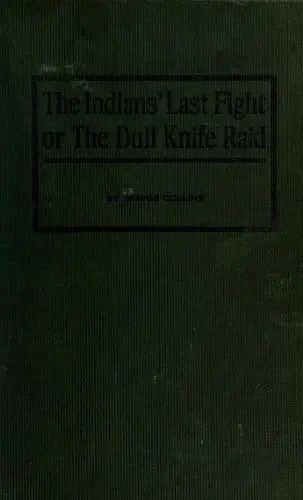
"The Indians' Last Fight; Or, The Dull Knife Raid" by Dennis Collins is a historical account written in the late 19th century. The book aims to shed light on the life of cowmen and Native Americans in the American West, particularly focusing on the events surrounding the Dull Knife Raid. Collins emphasizes the significance of accurate representation of Western life, challenging the prevalent misconceptions about both cow-punchers and Native Americans. The opening of the narrative establishes Collins as both the author and a participant in the events he describes. He introduces the challenging conditions faced by early settlers in the Western frontier, detailing their struggles with harsh environments, scarce resources, and interactions with Native American tribes. The author’s personal anecdotes provide insight into the daily lives of these pioneers, illustrating their perseverance and the camaraderie that developed among them as they sought to establish homes amidst adversity. The tone is reflective, capturing the complexities of frontier life while preparing the reader for deeper explorations of conflict and resilience in the chapters to follow.
Introduction adapted from the source catalogue; source summaries may be automatically generated.
Free to read · English · 111,601 words · No account needed
MAKE TIME FOR A GOOD BOOK
On by default. Untick to stop anonymous reading totals. Each page counts after 10 seconds in view. How this works.
Anonymous counting is on unless you have switched it off.
Whilst these acts of thievery, murder, and other rascality were being perpetrated on the Cimmaron, and Big, and Little Sand creeks, a small contingent paid a visit to a personal friend of mine, named Charles Coe. He, at the time, was holding a herd of beef cattle in the southwestern part of Ford county, awaiting an opportunity to ship them from Dodge City. The herd was owned by Tuttle and Chapman. In his employment he had a negro who performed the duties of cook, as well as acting as chore boy around the outfit. This same Charlie Coe was afterwards book-keeper for the George S. Emerson Mercantile Co. in Dodge City, Kan. At the time I mention he was what was termed a tenderfoot, and along with being inexperienced in the ways of the west, had little or no knowledge of the Indians mode of existence, especially on the warpath. Anything he happened to know of them, he had gleaned from rumor and reading. His tent was located not far from Crooked Creek. When the Indians came upon him, decked out in their war regalia, he was in a quandry what to do. It would have been useless for him to endeavor to seek shelter behind the bank of the creek, as the distance was rather far just then, and his tent would offer no protection from the bullets of the enemy. Plainly he was confronting a proposition the like of which he had never encountered before. It did not take him long to realize the danger of the situation, and he saw at a glance that it was death or glory for him, no matter which horn of the dilemma he chose to take. Instead of seeking safety in flight, he preferred to break a long established precedent of running away, and faced the danger unflinchingly. He seized his gun and stepped outside and waited the coming of his foes. As soon as they came within range, he took careful aim and fired. His first shot brought to earth the horse of the leader of the band. Indications showed that he wrought some damage upon the rider also, as he had to be assisted by his comrades in rascality. They picked him off the ground where he lay, and placed him on a pony behind another redskin. The bold front shown by the white man had the effect of halting the marauders in their mad career, and at the same time had a stimulating effect upon young Coe. He continued to fire at them as long as they remained within range. The reception they had received was wholly unexpected by the Indians, and after firing several random shots at him, without inflicting any damage, turned their horses around and withdrew to the Sand Hills about a mile distant. As soon as they had departed the young tenderfoot entered his tent to take stock of his means of defense. A brief glance at his small supply of ammunition showed him that he was not in a position to stand much of the siege. In fact he had very few cartridges left, and considering prudence the better part of valor decided to make an improvement in his conditions by seeking safety in flight. He gave orders to his stable attendant to hitch up the horses and they would set out for Dodge, which was about thirty miles away. He told the negro the condition of affairs and showed him that they would likely lose their scalps and their lives if the Indians should make another descent upon their camp. To the proposal to abandon the place, the negro made reply, "No, sah, I ain't agwine to leave Marse Tuttle's mules heah for dem pestificatin red debils to get. Ise agwine to take dem along." Having delivered himself of this proclamation of loyalty, he started to hitch up. Coe could not persuade him that he was exposing himself to unnecessary danger, and while Mr. Tuttle would appreciate his feelings of loyalty to his interests, at the same time he was not cruel enough to wish to expose him to the danger of losing his life. This and all other arguments that Coe could urge, were of no avail. He had determined to follow his own course in the matter, and nothing could move him from that determination. He had a strong liking for that team of mules, and a very strong affection for Mr. Tuttle, and in less than an hour later he lost his life through his fidelity to his master's interests. Reluctantly Coe started off for Dodge City. Sharp eyes were watching every move he made. From the Sand Hills they had noticed the preparations made at the tent, and saw the paleface ride away in the direction of the city. They felt that it was useless to follow him, as they knew he was well armed, and they remembered too well the manner of reception he tendered them but an hour before, and knew that he would be prompt to repeat it if they offered him another opportunity. They had no desire to lose any members of their band, and they felt that it would be a certainty that they would suffer some loss if they pursued him, so they let him proceed on his way. Not so did they show any consideration for the negro. When they saw him set out they started in pursuit. They rode down from the Hills, gradually converging to a point in which the darky and the team of mules was the center of attraction. When the negro saw them coming with the evident intention of intercepting him, he put the mules to a gallop, but it was impossible for the team dragging the heavy wagon to outrun the war ponies of the Indians. When they were drawing down upon him they began to shout and shoot at the same time. The poor darkey was terrified. The mules were stampeded and ran away. They overturned the wagon in their flight. In their mad career, the driver had been shot in the back several times and was killed outright. They overtook the mules and unhitching them, led them back to the Sand Hills where Dull Knife had now established his temporary headquarters. They did not scalp the negro, nor burn the wagon as was their custom. Evidently they must have come to the conclusion that the team of mules and the plunder of the tent was sufficient for one day. The darkey was later found and buried by some cowmen, and his grave for a long time was used as a landmark for travelers along the Jones and Plummer trail. Mr. Tuttle was in Dodge City at the time his faithful attendant gave up his life for his interests. Naturally he felt the loss of his servant rather keenly. When the news was brought to him that his wagon was still out there along the trail where it had been upset, he hired Hoodoo Brown, an old scout, to go out and bring it into Dodge, for repairs. The old scout often told me of his experience upon that dangerous journey.
Your reading position is saved on this browser. Take it to another device with a library code. Reading pages adapt to text, rather than matching a printed edition.
BEHIND THE BOOK
This eBook is for the use of anyone anywhere in the United States and most other parts of the world at no cost and with almost no restrictions whatsoever. You may copy it, give it away or re-use it under the terms of the Project Gutenberg License included with this eBook or online at www.gutenberg.org. If you are not located in the United States, you will have to check the laws of the country where you are located before using this eBook. Read the source licence.
The original source file, including credits and licence, is retained by this library. Request an original-format copy at no charge. Please include the book title and Project Gutenberg identifier #37922.
KEEP YOUR CURIOSITY GOING
Cécile Tormay

Moritz Busch
John L. Ransom
Frances Wright
Cécile Tormay

Mabel Potter Daggett