THE CLASSIC COLLECTION✦An outlaw’s diary: the CommuneCLASSIC FREE BOOKS
An outlaw’s diary: the Commune
Cécile Tormay
THE CLASSIC COLLECTION · 1915
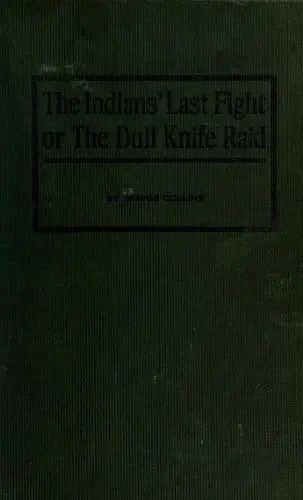
"The Indians' Last Fight; Or, The Dull Knife Raid" by Dennis Collins is a historical account written in the late 19th century. The book aims to shed light on the life of cowmen and Native Americans in the American West, particularly focusing on the events surrounding the Dull Knife Raid. Collins emphasizes the significance of accurate representation of Western life, challenging the prevalent misconceptions about both cow-punchers and Native Americans. The opening of the narrative establishes Collins as both the author and a participant in the events he describes. He introduces the challenging conditions faced by early settlers in the Western frontier, detailing their struggles with harsh environments, scarce resources, and interactions with Native American tribes. The author’s personal anecdotes provide insight into the daily lives of these pioneers, illustrating their perseverance and the camaraderie that developed among them as they sought to establish homes amidst adversity. The tone is reflective, capturing the complexities of frontier life while preparing the reader for deeper explorations of conflict and resilience in the chapters to follow.
Introduction adapted from the source catalogue; source summaries may be automatically generated.
Free to read · English · 111,601 words · No account needed
MAKE TIME FOR A GOOD BOOK
On by default. Untick to stop anonymous reading totals. Each page counts after 10 seconds in view. How this works.
Anonymous counting is on unless you have switched it off.
I have digressed considerably from the subject of Dull Knife's doings, but I hope that matter just mentioned has not been uninteresting to the reader as it gives some idea of the manner of life the old rascal led while at the Darlington Agency. To continue the narrative, the Agent kept up his mode of procedure in dealing with Dull Knife, and the latter continued to raise objections. He kept the trail between his abode and the Agency in a well worn condition owing to his numerous visits to the presiding official. In this manner he managed to put in the whole winter. In other words, he kept the kettle boiling, and one could see that there was something brewing.
If there is anything that an Indian dislikes, it is to get into any trouble that would force him to leave his camp in the winter time, especially when there is much snow on the ground. Gen. Phil. Sheridan was aware of this fact when he made his winter campaign on the Washita after Black Kettle, Satanta, and Lone Wolf, and forever settled the outbreaks of the Indians in that section of the country.
When the grass began to spring up along the valley, and his ponies seemed to be putting on some of the much needed flesh, Dull Knife felt the blood pulsing through his heart with greater vigor, and he began to make preparations for war. He made no secret of his intentions to depart at the earliest opportunity from the restraining influences of the Reservation. It was quite manifest to all the employees at the Agency, and to a great many of the soldiers, that Dull Knife was making his arrangements to part company with his surroundings. News of the intentions of Dull Knife was brought to the Agent by an educated half-breed, George Bent. Any rumor that he had of the matter previously was now sufficiently confirmed to warrant his taking what precautionary measures he deemed proper to restrain the war-like ardor of the distinguished guest within his gates. He summoned Dull Knife to his presence and gave peremptory orders to remove his camp from its present location down the river to a position about eight miles east of where the present city of El Reno now stands. It was a good location as there was plenty of water, timber, and grazing, and should have satisfied the demands of Dull Knife for improved conditions, but he immediately put forth all manner of objections to which the Agent turned a deaf ear. Reluctantly Dull Knife agreed that the conditions in the new location were much better than where he had been living, but he did not see his way clear just then to make a change in his habitation. The reason he gave for his unwillingness to comply with the wishes of the agent was that there was sickness in his family and consequently it would be extremely dangerous to expose them to the necessity of submitting themselves to a change when it was not absolutely necessary. He promised, however, that as soon as his family was restored to health, he would move them to the new location down the river. The Agent permitted the delay suggested by the wily Indian, but as a precautionary measure, had the Commanding Officer at the fort send a troupe of the fourth cavalry to where he was then camped, to stand guard over him until such time as he would make up his mind to remove to the new site selected for his encampment. The placing of a guard over him, gave Dull Knife another opportunity to raise objections to the general scheme of things, and like a spoiled child who cries because it cannot have the rainbow, he commenced to whine once more. No sooner had the troops taken up their position to guard his actions than he came to the Agent to have them removed entirely, or if that was impossible, to have them removed to some distance from his teepee. He asserted strongly that the presence of the soldiers so near to him had a tendency to keep his squaws in a state of terror and that, as a consequence, they would not be able to regain their health, at least, as long as the soldiers remained in the neighborhood. The Agent, to put an end to his continual whining, consented to remove the soldiers to a position somewhat removed from Dull Knife's teepee, but still near enough to keep some sort of guard over him if they were at all careful in the fulfillment of their duty. The soldiers were rollicking, jolly good fellows, not at all bloodthirsty, and whenever an opportunity presented itself for merriment they entered into the spirit of the occasion with all kinds of ardor. Needless to say, they found the task of acting as guard over one redskin a rather tedious affair, and were compelled to break the monotony of existence by means originating with themselves. They managed to pass the time in running horses, playing cards, and with other diversions. In the meantime the Indians passed back and forth among them with as much freedom as if there had never existed anything like a guard.
Your reading position is saved on this browser. Take it to another device with a library code. Reading pages adapt to text, rather than matching a printed edition.
BEHIND THE BOOK
This eBook is for the use of anyone anywhere in the United States and most other parts of the world at no cost and with almost no restrictions whatsoever. You may copy it, give it away or re-use it under the terms of the Project Gutenberg License included with this eBook or online at www.gutenberg.org. If you are not located in the United States, you will have to check the laws of the country where you are located before using this eBook. Read the source licence.
The original source file, including credits and licence, is retained by this library. Request an original-format copy at no charge. Please include the book title and Project Gutenberg identifier #37922.
KEEP YOUR CURIOSITY GOING
Cécile Tormay

Moritz Busch
John L. Ransom
Frances Wright
Cécile Tormay

Mabel Potter Daggett