THE CLASSIC COLLECTION✦An outlaw’s diary: the CommuneCLASSIC FREE BOOKS
An outlaw’s diary: the Commune
Cécile Tormay
THE CLASSIC COLLECTION · 1915
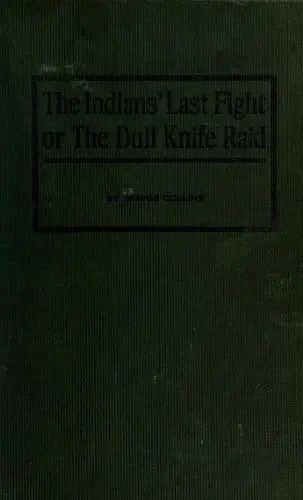
"The Indians' Last Fight; Or, The Dull Knife Raid" by Dennis Collins is a historical account written in the late 19th century. The book aims to shed light on the life of cowmen and Native Americans in the American West, particularly focusing on the events surrounding the Dull Knife Raid. Collins emphasizes the significance of accurate representation of Western life, challenging the prevalent misconceptions about both cow-punchers and Native Americans. The opening of the narrative establishes Collins as both the author and a participant in the events he describes. He introduces the challenging conditions faced by early settlers in the Western frontier, detailing their struggles with harsh environments, scarce resources, and interactions with Native American tribes. The author’s personal anecdotes provide insight into the daily lives of these pioneers, illustrating their perseverance and the camaraderie that developed among them as they sought to establish homes amidst adversity. The tone is reflective, capturing the complexities of frontier life while preparing the reader for deeper explorations of conflict and resilience in the chapters to follow.
Introduction adapted from the source catalogue; source summaries may be automatically generated.
Free to read · English · 111,601 words · No account needed
MAKE TIME FOR A GOOD BOOK
On by default. Untick to stop anonymous reading totals. Each page counts after 10 seconds in view. How this works.
Anonymous counting is on unless you have switched it off.
In the first case, the disaster to Gen. Custer proves the correctness of my contention. Gen. Custer was a man with a national reputation for valor and military experience, yet he allowed that wily old Indian chief, Sitting Bull, to inveigle him into following him and his band into the valley of the Little Big Horn where he turned upon him with all the savagery of which the Indian nature is capable, and not only defeated, but totally annihilated his command. No, not a living man was left to tell the tale of the disaster.
In the second case which I will present to the reader, I shall show not only the inefficiency of a man trained in any other school than that of the "plains," to fight the Red Man on his native heath, but will bring out some of the characteristics of the Indian's mode of procedure.
Gen. G. A. Forsythe was the man whose military reputation as a commander was second to none in the service of Uncle Sam, a man in whom Gen. Phil. Sheridan placed the greatest confidence, a man with whom the same Gen. Sheridan took counsel in any matter requiring military strategy. To show the General's esteem of this man's skill, and at the same time show his appreciation of his worth, Sheridan took him with him, to Germany to view the manoeuvres of the Franco-Prussian war. The above will give the reader an indication of the character of the man who met with so much ill success when fighting the Indians.
In 1868 Gen G. A. Forsythe was located temporarily at Ft. Wallace, having gone to that point for supplies. While there, daily reports were brought to him of the numerous depredations committed by the Indians along the railroads. The last report to reach him brought the unpleasant announcement that two freighters had been murdered and their stock driven off. This was too much. The Indian seemed to be committing all manner of misdeeds with seeming impunity, and he decided that he must put an end to such a state of things and at the same time punish the guilty ones for past misconduct. With this purpose in view, he gained permission from Gen. Sheridan to organize an expedition against them. The license was granted and with forty-seven scouts, among whom was Surgeon Moore and Lieut. Beecher, he set out about the tenth of the month of ----, in a north-westerly direction to overtake the savages. In the inception of this expedition he made one grave mistake for which he paid dearly in the near future. He took along provisions for only ten days, on pack mules. He had no ambulances, nor wagons. In the case of an engagement he did not have men enough, nor sufficient quantity of supplies, to meet the requirements of a cattle round-up, much less an undertaking of the kind he had in view. He set forth in high spirits, for he did not realize the magnitude of the undertaking he had mapped out for himself, nor the danger into which he was rushing. The weather was favorable and the country rather level, so there was nothing to impede his rapid progress. On the fifth day out, some of the scouts discovered a few Indians. Their trail was picked up and as they progressed it became plainer, which showed that they were nearing the vicinity of the foe. On the fifth evening out, they went into camp in a small valley in the northwest corner of the state of Kansas, and not far from the eastern line of Colorado, just where a small stream called the Arickaree flows into the Republican river. In that little stream was a small island covered with scrubby timber. It could not be exactly called an island, as the water flowed on one side of it only, and at a depth of only about a foot, while the other channel was absolutely dry and filled with coarse grass and brush. As they were all weary with the long march already made, they lay down in their blankets to secure a good rest, little thinking what the next day had in store for them. About daylight, the next morning, some of the scouts heard a commotion among the horses and jumped up to see what was wrong. They discovered the Indians in the act of endeavoring to stampede the horses, and they gave the alarm. As soon as the scouts saw the situation, they opened fire upon the redskins and drove them away. The shooting was a signal for all to rise. They realized that danger was near, and they did not have long to wait until it was present. In less than an hour's time, between five and six hundred Chyenne warriors appeared on the hill side, painted and decked out in all the paraphrenalia of a full-fledged war party under the leadership of Roman Nose who at that time was the Bonoparte of the Chyenne tribe.
Your reading position is saved on this browser. Take it to another device with a library code. Reading pages adapt to text, rather than matching a printed edition.
BEHIND THE BOOK
This eBook is for the use of anyone anywhere in the United States and most other parts of the world at no cost and with almost no restrictions whatsoever. You may copy it, give it away or re-use it under the terms of the Project Gutenberg License included with this eBook or online at www.gutenberg.org. If you are not located in the United States, you will have to check the laws of the country where you are located before using this eBook. Read the source licence.
The original source file, including credits and licence, is retained by this library. Request an original-format copy at no charge. Please include the book title and Project Gutenberg identifier #37922.
KEEP YOUR CURIOSITY GOING
Cécile Tormay

Moritz Busch
John L. Ransom
Frances Wright
Cécile Tormay

Mabel Potter Daggett