THE CLASSIC COLLECTION✦An outlaw’s diary: the CommuneCLASSIC FREE BOOKS
An outlaw’s diary: the Commune
Cécile Tormay
THE CLASSIC COLLECTION · 1897
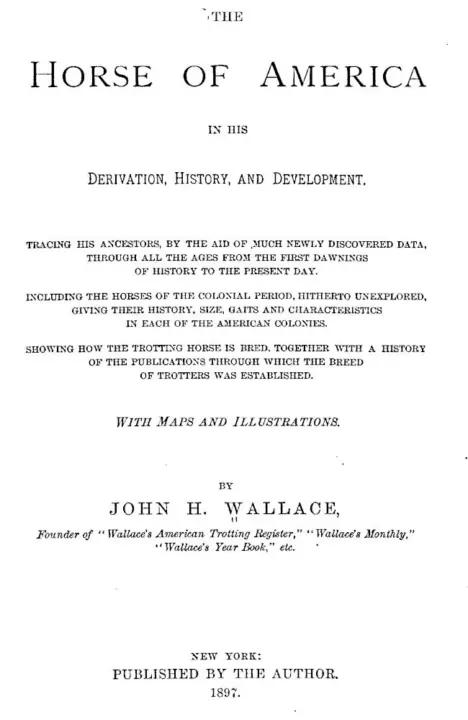
"The Horse of America in His Derivation, History, and Development" by John H. Wallace is a historical account written in the late 19th century. This work meticulously explores the lineage and evolution of the American horse, focusing particularly on its historical roots and development through the ages. Wallace seeks to challenge widely held misconceptions about horse breeds, particularly those concerning the renowned Arabian horse, while illuminating the largely neglected history of horses during the Colonial period in America. The opening of this work sets the stage for an extensive inquiry into the history and ancestry of American horses, emphasizing the author's desire to uncover facts about their lineage that have not been extensively documented before. Wallace introduces his examination by critiquing common narratives regarding the origins of the horse, dismissing the notion that the Arabian breed is superior and asserting that its actual influence on the American horse is minimal. He highlights that much of the existing knowledge surrounding horse history is founded on repetition of previous works, rather than original research. The author expresses satisfaction in the thorough research he has conducted into the equine ancestry and colonial history, intending to provide readers with a more accurate understanding of both the American trotter and the complexities of horse breeding.
Introduction adapted from the source catalogue; source summaries may be automatically generated.
Free to read · English · 251,000 words · No account needed
MAKE TIME FOR A GOOD BOOK
On by default. Untick to stop anonymous reading totals. Each page counts after 10 seconds in view. How this works.
Anonymous counting is on unless you have switched it off.
Some three or four years after the death and burial of the “Tom Titmouse” book and when its odoriferous memory had become less offensive, another effort was made to get control of the registration business, by the same parties in Kentucky. Mr. Brodhead did not appear prominently in this move, but worked through his echo, McDowell. The plan was to present a monster petition to the National Trotting Association, composed chiefly of track owners and track followers, to establish a trotting register. This petition purported to be from breeders, but in fact it embraced all the “swipes” and stable-boys about Lexington and Woodburn, I was told, and there were very few actual breeders in the list, and that few were men who were trying to breed trotters from runners. The movement was inspired and engineered in good degree from Woodburn, and Brodhead’s friends were at work in all directions securing the names of the “rag, tag and bobtail” whose names appeared on the petition, and a very great noise was raised about what was going to be done. Whether the association took any action on the petition, or what it was, I have no recollection, but whatever the disposition made of the petition, it never was heard of again. To the reader not familiar with the condition of things in Kentucky at that time, these persistent and renewed attempts to get control of the registration of trotting horses can hardly be comprehended. They did not grow out of ruffled tempers merely, as the result of friction, but out of strictly business considerations. Kentucky had a great variety of brood mares from which they were trying to breed trotters, and practically every one of them was tricked out with more or less running blood as tail-pieces to their pedigrees, while others were paraded with pedigrees showing a dozen or more successive crosses by thoroughbred horses, and not one of them with a name, a history or a breeder. There were many purchasers flocking to Kentucky with more money than knowledge for the purpose of buying a few animals to serve as the nucleus for a breeding stud, and it was no uncommon thing for such purchasers to estimate the value of a pedigree by its length. When the purchaser got home with his stock, his next step was to send them to me for registration, and here came in the “business” consideration. The pedigree having reached the office of the “Register,” unless it were already known to me, every cross had to be established circumstantially and specifically before it could be accepted, and at the precise point where reasonable information failed the pedigree was cut off. The purchaser then goes back upon the seller, and there the trouble begins. He writes me an indignant letter. “You’re interfering with my business, sah; that pedigree is just as I got it from Colonel Jones, sah; and he’s a gentleman, sah.” It was very seldom, indeed, that a man of this type could be mollified by assuring him that all pedigrees were judged by the same rule and requirement, whether they came from Maine or California or Kentucky. He generally remained an enemy to the “Register” because “it interfered with his business.” From early in the century, three or four counties out of about one hundred and twenty in Kentucky bred running horses and grades and raced them, but no records were kept of their breeding and nobody knows with certainty to-day anything about the more remote crosses. For a time the union of two or three trotting horses upon the top of a line of nameless dams extending ten or fifteen generations was looked upon as the perfection of a trotting pedigree. This notion, foolish as it was, gave Kentucky a great advantage over the breeders of all other sections of the country, and every exposure, with the evidence, that in nine cases out of ten these lines of nameless dams were in whole or in part pure fictions, was cutting the ground from under their supposed superiority in the breeding of their trotters. Under the arguments and illustrations of the Monthly, supported by the incontrovertible statistics of the “Year Book,” the Kentucky cry for “more running blood in the trotter,” was silenced as the child of ignorance and prejudice, and instead of looking for pedigrees tracing back to Godolphin Arabian, everybody began to look for pedigrees that traced to individuals and families distinguished for producing trotters, no difference what blood they possessed. Here the public mind reached the truth, and in grasping it the boasted predominance of Kentucky was crushed, and producing trotting blood was again placed on an equality in all parts of the land. The loss of the pretensions of one section could not be of any specific pecuniary advantage to any other section, but the establishing of the truth was of inestimable advantage to all. The loss of mere “pretentions” would not, in ordinary affairs, be considered a very great loss, but in this instance it was looked upon as a grievous wrong, because it interfered with their “business.” Every slippery fellow who failed to pass a bogus pedigree complained that it interfered with his “business.” Every gang of cheats that got together and hired the use of a track for a few days for the purpose of giving their horses bogus records, when detected, cried out vigorously that this was interfering with their “business.” Besides these, there were scores, perhaps hundreds, of others, ready for some such game to cheat the public, but when they learned the ordeal was severe, their courage failed and they contented themselves by threatening the “Register” for interfering with their “business.” Here was an army of jockeys and cheats, and all they needed to make their numbers formidable was a leader with courage and money, and whose “business” was their own, to seize registration and thus recoup the losses they had sustained in their “business.”
Your reading position is saved on this browser. Take it to another device with a library code. Reading pages adapt to text, rather than matching a printed edition.
BEHIND THE BOOK
This eBook is for the use of anyone anywhere in the United States and most other parts of the world at no cost and with almost no restrictions whatsoever. You may copy it, give it away or re-use it under the terms of the Project Gutenberg License included with this eBook or online at www.gutenberg.org. If you are not located in the United States, you will have to check the laws of the country where you are located before using this eBook. Read the source licence.
The original source file, including credits and licence, is retained by this library. Request an original-format copy at no charge. Please include the book title and Project Gutenberg identifier #62972.
KEEP YOUR CURIOSITY GOING
Cécile Tormay

Moritz Busch
John L. Ransom
Frances Wright
Cécile Tormay

Mabel Potter Daggett