THE CLASSIC COLLECTION✦An outlaw’s diary: the CommuneCLASSIC FREE BOOKS
An outlaw’s diary: the Commune
Cécile Tormay
THE CLASSIC COLLECTION · 1897
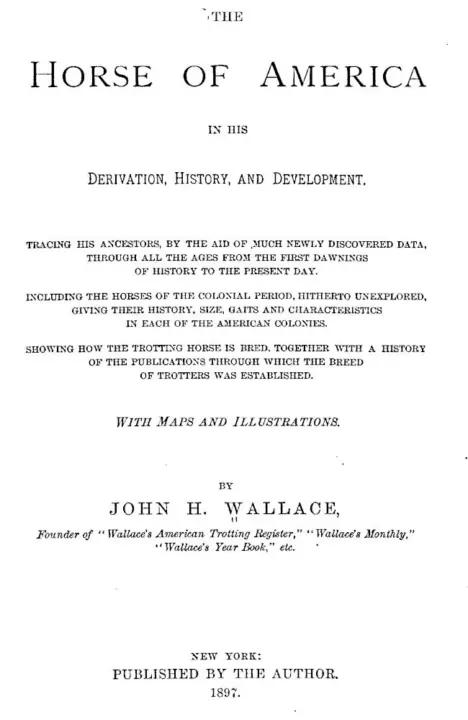
"The Horse of America in His Derivation, History, and Development" by John H. Wallace is a historical account written in the late 19th century. This work meticulously explores the lineage and evolution of the American horse, focusing particularly on its historical roots and development through the ages. Wallace seeks to challenge widely held misconceptions about horse breeds, particularly those concerning the renowned Arabian horse, while illuminating the largely neglected history of horses during the Colonial period in America. The opening of this work sets the stage for an extensive inquiry into the history and ancestry of American horses, emphasizing the author's desire to uncover facts about their lineage that have not been extensively documented before. Wallace introduces his examination by critiquing common narratives regarding the origins of the horse, dismissing the notion that the Arabian breed is superior and asserting that its actual influence on the American horse is minimal. He highlights that much of the existing knowledge surrounding horse history is founded on repetition of previous works, rather than original research. The author expresses satisfaction in the thorough research he has conducted into the equine ancestry and colonial history, intending to provide readers with a more accurate understanding of both the American trotter and the complexities of horse breeding.
Introduction adapted from the source catalogue; source summaries may be automatically generated.
Free to read · English · 251,000 words · No account needed
MAKE TIME FOR A GOOD BOOK
On by default. Untick to stop anonymous reading totals. Each page counts after 10 seconds in view. How this works.
Anonymous counting is on unless you have switched it off.
There was another feature embraced in the “Pinafore,” and protected by the same “copyright,” that was of special significance. It was provided that time made in a public trial, against the watch, should be accepted as of equal value with time made in a race with other horses. It is not worth while to stop to consider the question as to whether these two kinds of performance are of equal merit, and should receive equal honor, for every honest man will call such a claim a bald absurdity on its face. Then why has Woodburn, from time immemorial, it will be asked, always refused to enter a colt in a stake or start one against others? If you ask the manager he will tell you that Mr. Alexander, the owner, is opposed to racing in all its forms. Then why does Woodburn, in one form or other, hold so much stock in the Kentucky Breeders’ Association, one of the most notorious gambling concerns in the whole country? We will not press this question too closely. There can be no shadow of doubt, therefore, that this feature of the “Pinafore” was the special product of the mind of the manager at Woodburn, for no one of the other gentlemen would be willing to own it.
The quasi-organization from which, nominally, the “Pinafore Standard” emanated consisted of the five gentlemen following: Lucas Brodhead, Henry C. McDowell, Richard S. Veech, James C. McFerran, and Colonel Richard West. The names of these five gentlemen when appended to any matter connected with their enterprise and given to the public had no rank assigned to them, except “Committee on Rules.” This implied that there was an organization behind them that had appointed them to this duty, but there never was even a shadow of such an organization. Mr. Brodhead was manager at Woodburn and ambitious to control the trotting pedigrees of the whole country, and for the methods employed the reader is referred to page 430 of this volume. Mr. McDowell is simply Mr. Brodhead’s echo. In December, 1877, he attended the annual meeting of the National Association of Trotting Horse Breeders, and out of compliment to Kentucky he was elected president. He was about the city two or three days, and before he left for home he resigned without ever intimating any reason why he resigned. Mr. Veech is a man of undoubted integrity and plenty of brains, and was identified with the Breeders’ Association from the start. Mr. McFerran and Colonel West are both dead, and while it was not my privilege to know them intimately, I knew enough of them to trust them as honorable and honest men. Not long after the appearance of the original suggestion in the Monthly, as given above, that a standard of qualifications for admission to registration was of paramount importance, and that the preparation of such a standard was in the special province of the National Association of Trotting Horse Breeders, Manager Brodhead caught the idea and the situation, and with Mr. McDowell hurried away to spend a night with Mr. Veech, near Louisville, and thus forestall the action the Breeders’ Association might take in the premises. They were all of one mind as to the importance of keeping Kentucky in the foremost position as a breeding State, but they were not all of one mind as to the means best adapted to that end. Mr. Veech was very clear and pronounced in his views that the way to breed the trotter was to go to the trotter and not to the runner, but what Brodhead said McDowell said, and that left him in the minority. Seated around a table, each with a copy of Wallace’s Monthly containing the table of 2:30 trotters under their sires, they commenced forming some rules. With “The Great Table” before them they could not fail to strike the self-evident requirements of a standard, and two or three of their rules were very good, but as a matter of course the scheme of the majority to get in all the running-bred mares possible and enter them as standard trotting mares had to prevail. Hence the provision for admitting the grandams. Imported Bonnie Scotland was kept many years in the trotting latitudes, and just got one trotter and no more at any rate of speed, hence he was a standard horse according to this scheme, and his dam, Queen Mary, in England, was a standard trotting brood mare. Now if the dam thus became a standard trotting mare, why should not Iago, his sire, become a standard trotting sire? This would have been too glaring and open, and would have been ridiculed as an absurdity by everybody. The trick had to be carried through quietly or it could not succeed. At a later period the sisters of all the standard mares were made standard, and then came the very appropriate and expressive title of the “Pinafore Standard,” for it literally embraced “his sisters and his mother and his aunts.” This scheme would have admitted a vast herd of so-called trotting mares in Kentucky that had no trotting inheritance, had never trotted themselves, and never produced a trotter. This part of the scheme was certainly not the work of the “Committee on Rules,” but the work of an individual for the purpose of carrying out a selfish and inadmissible scheme to promote local and personal interests. When the exposure of this scheme came out Woodburn, with all its influence in Kentucky, could not stand against it an hour, and every “Pinafore” feature was promptly eliminated.
Your reading position is saved on this browser. Take it to another device with a library code. Reading pages adapt to text, rather than matching a printed edition.
BEHIND THE BOOK
This eBook is for the use of anyone anywhere in the United States and most other parts of the world at no cost and with almost no restrictions whatsoever. You may copy it, give it away or re-use it under the terms of the Project Gutenberg License included with this eBook or online at www.gutenberg.org. If you are not located in the United States, you will have to check the laws of the country where you are located before using this eBook. Read the source licence.
The original source file, including credits and licence, is retained by this library. Request an original-format copy at no charge. Please include the book title and Project Gutenberg identifier #62972.
KEEP YOUR CURIOSITY GOING
Cécile Tormay

Moritz Busch
John L. Ransom
Frances Wright
Cécile Tormay

Mabel Potter Daggett