THE CLASSIC COLLECTION✦An outlaw’s diary: the CommuneCLASSIC FREE BOOKS
An outlaw’s diary: the Commune
Cécile Tormay
THE CLASSIC COLLECTION · 1897
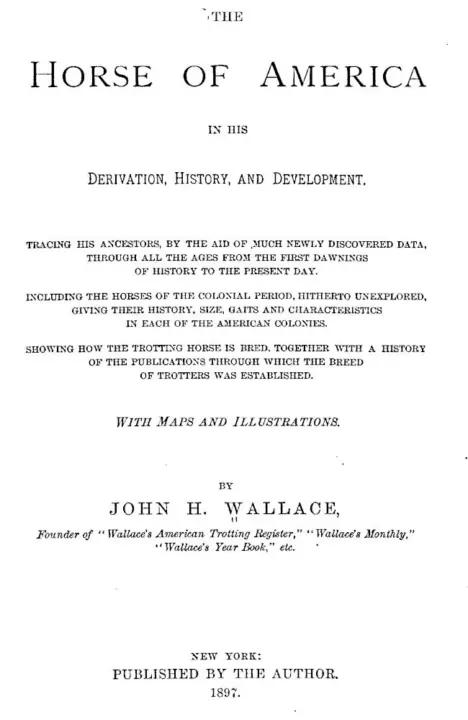
"The Horse of America in His Derivation, History, and Development" by John H. Wallace is a historical account written in the late 19th century. This work meticulously explores the lineage and evolution of the American horse, focusing particularly on its historical roots and development through the ages. Wallace seeks to challenge widely held misconceptions about horse breeds, particularly those concerning the renowned Arabian horse, while illuminating the largely neglected history of horses during the Colonial period in America. The opening of this work sets the stage for an extensive inquiry into the history and ancestry of American horses, emphasizing the author's desire to uncover facts about their lineage that have not been extensively documented before. Wallace introduces his examination by critiquing common narratives regarding the origins of the horse, dismissing the notion that the Arabian breed is superior and asserting that its actual influence on the American horse is minimal. He highlights that much of the existing knowledge surrounding horse history is founded on repetition of previous works, rather than original research. The author expresses satisfaction in the thorough research he has conducted into the equine ancestry and colonial history, intending to provide readers with a more accurate understanding of both the American trotter and the complexities of horse breeding.
Introduction adapted from the source catalogue; source summaries may be automatically generated.
Free to read · English · 251,000 words · No account needed
MAKE TIME FOR A GOOD BOOK
On by default. Untick to stop anonymous reading totals. Each page counts after 10 seconds in view. How this works.
Anonymous counting is on unless you have switched it off.
The prominence of Kentucky as a breeding center is wholly due to the trotting blood she obtained from New York. She had plenty of pacing blood that was good, of its kind, but it was so uncertain and sporadic that it did not commend itself to the breeders of that section as a source of trotting speed. From an early period in the history of the State the habits and fancies of the people, in the richer portions, had been “horsey,” from their knowledge and familiarity with running races for many years, and thus when the demand came for trotters they struck out vigorously to meet that demand. When Mr. R. A. Alexander organized the great Woodburn Farm he established a department of trotters, which was among the very first of any magnitude in the State. As he had been reared abroad he knew nothing about American pedigrees, and in making his purchases of breeding stock he was victimized by every sharper who came along with a brood mare to sell. He was a man of honest purpose and excellent natural judgment which told him to buy such breeding animals as could trot themselves or had produced trotters, and if he had been content to stop with what little he knew of their breeding he would have been all right; but, meantime, the professional pedigree-maker—the successor to the famous Patrick Nesbitt Edgar—came along and tricked them out in an excellent quality of pinchbeck pedigrees containing plenty of running blood that had never trotted nor produced a trotter. When the first Mr. Alexander died he was succeeded in the proprietorship of the great estate by his brother, a very worthy gentleman who made it a law to the establishment that none of his horses should ever start in a race. His fancy and knowledge were all in the line of cattle, and he seemed to neither know nor care anything about horses. Soon after this change in the ownership of the estate a new manager was placed in charge, and it was soon manifest that however absurd and untruthful the pedigrees of breeding stock might be, they must not be questioned nor corrected by any authority whatever. This doctrine of infallibility as applied to Woodburn pedigrees was wholly incompatible with what I conceived to be my duty to the breeding public. I had accepted the Woodburn pedigrees, at the start, as trustworthy, on the grounds of the eminence and high character of the first Mr. Alexander, and it was far more than a surprise to me when I discovered something of the extent to which the pedigrees of the whole establishment had been honeycombed with the dishonesty of “sharpers” and “pedigree-makers.” These fictions antedated any compilation or known authority of trotting pedigrees, and there can be no doubt they were accepted as honest statements of the blood of the animals in question, while many of them were wholly fictitious and all of them contained crosses on the maternal side that were merely imaginary. These embellishments, to call them by no harder name, were uniformly in one and the same direction, all stretching out to embrace as much of the blood of the running horse as possible, and often a great deal that was impossible. Here I may state the general fact that all Kentuckians had claimed and exercised the right so long to shape up their pedigrees to suit themselves and to bring the most money in the market that a number of them still claimed that as a right and became somewhat restive when told that their pedigrees would be recorded just as far as they were proved, and no further. Two or three breeders expostulated against this rule, and in reply they were assured that they had a perfect right to shape their pedigrees as they pleased, but that insertion in the Register was the same as my personal indorsement, and that this indorsement could not be given to any pedigree that I did not know or believe to be honest and true. This ended all doubts about the position and character of the Register, and I think that every breeder of any standing in Kentucky submitted to the rule, with the solitary exception of Woodburn Farm. The manager of that establishment was not only unwilling to have the infallibility of Woodburn pedigrees called in question, but he aspired to the control of the pedigrees of all other breeders in the whole country. When the National Association of Trotting Horse Breeders was organized in December, 1876, he was not only asked, but pressed, to become a member and take part in its management and control. But no, he would be “boss,” or he would be nothing. New York was not the right place to organize it. It should be organized in Kentucky, and with the manager of Woodburn at the head of it. The arrogance of this young manager was something amazing, his intrigues to get control of registration were continued for a number of years, and the means employed to accomplish his ends were of such a character as clearly to demonstrate that of all the men in the world he was the last one who should be placed in the control of such a trust. As this controversy extended through the period of building up the breed of trotters, it is of necessity a part of the literature of the formation of that breed, and as some of the more salient points seem to be of sufficient importance to hand down to future generations, I will here consider them very briefly. In doing this I am conscious of some feeling of embarrassment on account of the personal matters that must enter into the recital, but it is a part of the trotting history of the times, and I prefer that the truth may be preserved, whatever may be the teachings of the canons of taste.
Your reading position is saved on this browser. Take it to another device with a library code. Reading pages adapt to text, rather than matching a printed edition.
BEHIND THE BOOK
This eBook is for the use of anyone anywhere in the United States and most other parts of the world at no cost and with almost no restrictions whatsoever. You may copy it, give it away or re-use it under the terms of the Project Gutenberg License included with this eBook or online at www.gutenberg.org. If you are not located in the United States, you will have to check the laws of the country where you are located before using this eBook. Read the source licence.
The original source file, including credits and licence, is retained by this library. Request an original-format copy at no charge. Please include the book title and Project Gutenberg identifier #62972.
KEEP YOUR CURIOSITY GOING
Cécile Tormay

Moritz Busch
John L. Ransom
Frances Wright
Cécile Tormay

Mabel Potter Daggett