THE CLASSIC COLLECTION✦An outlaw’s diary: the CommuneCLASSIC FREE BOOKS
An outlaw’s diary: the Commune
Cécile Tormay
THE CLASSIC COLLECTION · 1897
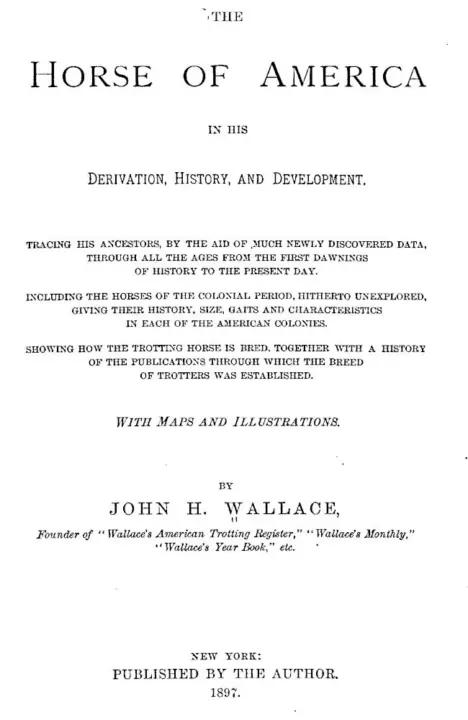
"The Horse of America in His Derivation, History, and Development" by John H. Wallace is a historical account written in the late 19th century. This work meticulously explores the lineage and evolution of the American horse, focusing particularly on its historical roots and development through the ages. Wallace seeks to challenge widely held misconceptions about horse breeds, particularly those concerning the renowned Arabian horse, while illuminating the largely neglected history of horses during the Colonial period in America. The opening of this work sets the stage for an extensive inquiry into the history and ancestry of American horses, emphasizing the author's desire to uncover facts about their lineage that have not been extensively documented before. Wallace introduces his examination by critiquing common narratives regarding the origins of the horse, dismissing the notion that the Arabian breed is superior and asserting that its actual influence on the American horse is minimal. He highlights that much of the existing knowledge surrounding horse history is founded on repetition of previous works, rather than original research. The author expresses satisfaction in the thorough research he has conducted into the equine ancestry and colonial history, intending to provide readers with a more accurate understanding of both the American trotter and the complexities of horse breeding.
Introduction adapted from the source catalogue; source summaries may be automatically generated.
Free to read · English · 251,000 words · No account needed
MAKE TIME FOR A GOOD BOOK
On by default. Untick to stop anonymous reading totals. Each page counts after 10 seconds in view. How this works.
Anonymous counting is on unless you have switched it off.
When, therefore, it was announced that the horse was far more than a mere machine, that he had a mental as well as a physical organization, that these were both equally matters of inheritance, that one horse ran fast because his ancestors ran fast and that another horse trotted fast because his ancestors were able to trot fast, and that no fast runner was ever a fast trotter, there was a tremendous hubbub. This was a new gospel, and it threatened to annihilate the stupid Anglo-Arabian fetish that all that was good in horsedom must of necessity come from that source. For generations the belief had been universal that the only way to improve the horse for any purpose under the sun was to “breed up” to the running horse and thus get back to the blood of the pure Arabian. On the other hand, and as opposed to this ancient fallacy that the way to breed the trotter was to go to the runner, it was urged, with a thousand proofs at the back of it, that the way to breed the runner was to go to the horse that could run, and the way to breed the trotter was to go to the horse that could trot. Here was a direct issue squarely made, and it was not to be expected that such men as Charles J. Foster, Peter C. Kellogg, Joseph O. Simpson, etc., all writers of ability, would quietly surrender without a battle. They had committed themselves to the running-blood traditions, some rich men had shaped their breeding studs in that direction, and without deciding whether a rich man had necessarily more sense than a poor one, they knew instinctively that a rich man could be more liberal in advertising, and that he could be more generous in properly recognizing the little courtesies that might be extended in the way of keeping his establishment before the public in an approving light. Thus, with an eye to the weather-gauge, the editors were able to maintain their own consistency. As the experiences of every succeeding year added thousands of proofs to the plain proposition that the trotter inherits his speed from a trotting ancestry, the “irreconcilables” began to shift their ground, conceding that there must be trotting blood to give the action, but that there must be “speed-sustaining” blood from the thoroughbred to give courage and endurance. This was the second position, and in a commercial sense it was shrewdly chosen for the advantage of certain localities. This position furnished the “thoroughbred foundation” argument, and for a time it had its supporters. This theory also furnished its promised commercial advantages to such localities as had formerly bred running horses, and it was but a week till everybody in those localities had “thoroughbred foundations” for their trotting pedigrees, and those who did not have them could easily procure them. This brought an avalanche of pedigrees, especially from Kentucky, with “thoroughbred foundations,” consisting of long strings of dams by famous horses, but without names, dates, breeders or histories, and many of them impossible. To checkmate this inundation of manufactured foundations, in the office of the Register, a rule was adopted requiring satisfactory identification and history of each dam, and where that could not be given the pedigree would be cut off. This rule saved the “Trotting Register” from becoming the mere dumping place for countless frauds, but it aroused such a feeling of antagonism on the part of the manager of Woodburn Farm that he, at once, started an opposition Register to be compiled at the farm, under his own personal direction. Of this, and what came of it, I will speak further on. It is but just that I should say here, that from a wide knowledge of men and from a study of their moral fiber extending through many years in connection with horse affairs, I have found many Kentuckians that were thoroughly truthful and reliable in pedigree matters; but at the same time it must be admitted that the conditions there for generations past have not been favorable, among horsemen, for the cultivation of the highest type of truthfulness. Many of them have been making their own pedigrees for so long, and padding them out with nameless dams by suppositious sires, to suit themselves—and the market—that they don’t take kindly to any restraint in what they consider their own business.
Your reading position is saved on this browser. Take it to another device with a library code. Reading pages adapt to text, rather than matching a printed edition.
BEHIND THE BOOK
This eBook is for the use of anyone anywhere in the United States and most other parts of the world at no cost and with almost no restrictions whatsoever. You may copy it, give it away or re-use it under the terms of the Project Gutenberg License included with this eBook or online at www.gutenberg.org. If you are not located in the United States, you will have to check the laws of the country where you are located before using this eBook. Read the source licence.
The original source file, including credits and licence, is retained by this library. Request an original-format copy at no charge. Please include the book title and Project Gutenberg identifier #62972.
KEEP YOUR CURIOSITY GOING
Cécile Tormay

Moritz Busch
John L. Ransom
Frances Wright
Cécile Tormay

Mabel Potter Daggett