THE CLASSIC COLLECTION✦An outlaw’s diary: the CommuneCLASSIC FREE BOOKS
An outlaw’s diary: the Commune
Cécile Tormay
THE CLASSIC COLLECTION · 1897
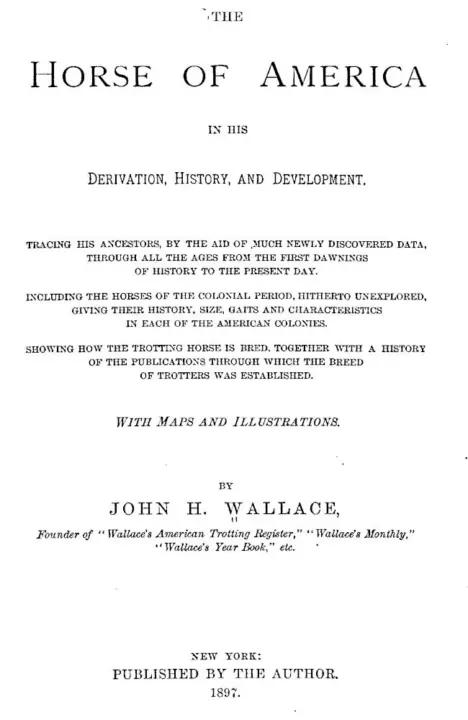
"The Horse of America in His Derivation, History, and Development" by John H. Wallace is a historical account written in the late 19th century. This work meticulously explores the lineage and evolution of the American horse, focusing particularly on its historical roots and development through the ages. Wallace seeks to challenge widely held misconceptions about horse breeds, particularly those concerning the renowned Arabian horse, while illuminating the largely neglected history of horses during the Colonial period in America. The opening of this work sets the stage for an extensive inquiry into the history and ancestry of American horses, emphasizing the author's desire to uncover facts about their lineage that have not been extensively documented before. Wallace introduces his examination by critiquing common narratives regarding the origins of the horse, dismissing the notion that the Arabian breed is superior and asserting that its actual influence on the American horse is minimal. He highlights that much of the existing knowledge surrounding horse history is founded on repetition of previous works, rather than original research. The author expresses satisfaction in the thorough research he has conducted into the equine ancestry and colonial history, intending to provide readers with a more accurate understanding of both the American trotter and the complexities of horse breeding.
Introduction adapted from the source catalogue; source summaries may be automatically generated.
Free to read · English · 251,000 words · No account needed
MAKE TIME FOR A GOOD BOOK
On by default. Untick to stop anonymous reading totals. Each page counts after 10 seconds in view. How this works.
Anonymous counting is on unless you have switched it off.
The grand assemblage of so many great trotters at the Fashion Stud Farm, and all for the purpose of breeding, was the subject of much comment among breeders from one end of the land to the other, and not a few pronounced it all wrong and that it would be succeeded by failure. Mr. Smith lacked some of the elements that go toward making a man popular, and hence, in many cases, there was not much sympathy between him and his brother breeders, but he held tenaciously to the central truth that the way to breed high-class trotters was to mate high-class trotters. His experience has clearly demonstrated the soundness of this canon of breeding, and it has just as clearly demonstrated the unsoundness of the notion that high-class trotters can be bred from animals that never trotted and never could be made to trot. The law, as we have taught it for years, has been vindicated, and that by experiences so wide and so complete that it can no longer be controverted. Mr. Smith has achieved a great honor, and as a producer of high-class speed he stands at the head of all American trotting-horse breeders.
As we have now considered a great triumph, with the causes that led up to it and the lesson it has taught, it seems to be in order to give an example of a great failure and the causes which have produced it. For more than forty years Woodburn Farm, in Kentucky, has been breeding trotters, and up to the close of 1896 just four with records of 2:15 or better have hailed from that great establishment. During all these years, and until Palo Alto Farm was established, Woodburn was the largest establishment in this country. With thousands of broad acres of the most productive soil, with the possession and control of money without limit, and with the experiences of forty years in which to select and breed only to the best, it is the natural and reasonable expectation of everybody interested in the question of breeding the trotter to look to Woodburn as leading all other establishments in the whole world in the production of first-class trotters. And what has Woodburn done? With her experiences of forty years, with all her broad acres and boundless wealth, up to the close of 1896 she has produced just four trotters with records of 2:15 or better. Instead of leading all others, she is at the wrong end of the procession, and if we consider the proportional advantages involved, we find that “all others,” little and big, are leading her. By referring to the above list of breeders that have produced three or more with records of 2:15 or better, we find that Henry N. Smith has produced thirteen, that William Corbett, from his little stud in California, has produced nine, and that the late William H. Wilson, of Cynthiana, Kentucky, from his little band of mares, and without either broad acres or money, has produced eight within the past twelve or fifteen years, and all except one by the same horse. This places Mr. Wilson first among all Kentucky breeders. In the short period of its existence Glenview Farm produced six, and the quite unpretentious farmer, Mr. Timothy Anglin, produced five; W. C. France and Colonel R. G. Stoner produced four each—the same number as Woodburn—but they did not require forty years to accomplish it. Thus the breeding world, with “the little fellows” on top, has gone away ahead and left Woodburn to mumble over her “tin cups,” and exult in the many triumphs she has won against the watch in 2:30. The policy of Woodburn for years past seems to have been to hold the lead of Kentucky breeders in the production of 2:30 trotters, and to this end the youngsters are put in training in the early spring and kept at it till the frosts come, when such of them as are sure to win are brought out and started against the watch, for a “tin cup,” and these are the victories that Woodburn wins. Nobody has ever heard of Woodburn entering a youngster in a stake where he would have to win on his merits. That would be bringing him down to an equality with the colts of such people as William H. Wilson, Colonel R. G. Stoner, Farmer Timothy Anglin, and all the other “little fellows.” Woodburn has made a great deal of money out of these humbug tin-cup records, and as registration and the standard are now absolutely under the control of her manager, the 2:30-tin-cup still remains the evidence of a fast trotter, worthy of standard rank. True, everybody nowadays laughs at the idea that 2:30, with the “tin cup,” is any evidence of even reputable speed, but as they have given a certain kind of pre-eminence and made money in the past, the twins will not be separated, but will hold their places just as long as the standard is under the present control.
Your reading position is saved on this browser. Take it to another device with a library code. Reading pages adapt to text, rather than matching a printed edition.
BEHIND THE BOOK
This eBook is for the use of anyone anywhere in the United States and most other parts of the world at no cost and with almost no restrictions whatsoever. You may copy it, give it away or re-use it under the terms of the Project Gutenberg License included with this eBook or online at www.gutenberg.org. If you are not located in the United States, you will have to check the laws of the country where you are located before using this eBook. Read the source licence.
The original source file, including credits and licence, is retained by this library. Request an original-format copy at no charge. Please include the book title and Project Gutenberg identifier #62972.
KEEP YOUR CURIOSITY GOING
Cécile Tormay

Moritz Busch
John L. Ransom
Frances Wright
Cécile Tormay

Mabel Potter Daggett