THE CLASSIC COLLECTION✦An outlaw’s diary: the CommuneCLASSIC FREE BOOKS
An outlaw’s diary: the Commune
Cécile Tormay
THE CLASSIC COLLECTION · 1897
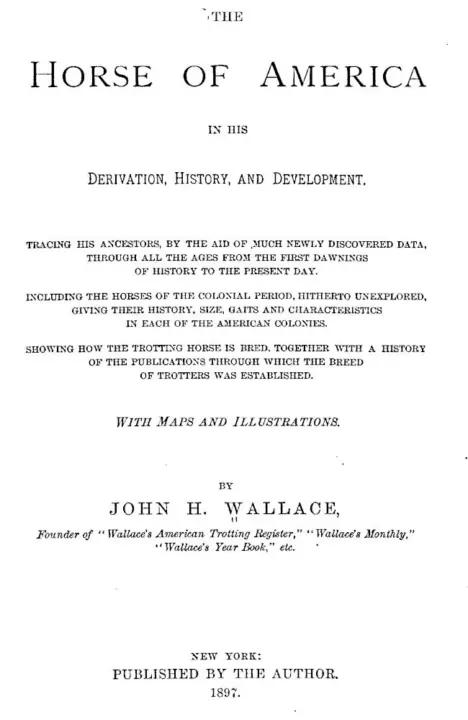
"The Horse of America in His Derivation, History, and Development" by John H. Wallace is a historical account written in the late 19th century. This work meticulously explores the lineage and evolution of the American horse, focusing particularly on its historical roots and development through the ages. Wallace seeks to challenge widely held misconceptions about horse breeds, particularly those concerning the renowned Arabian horse, while illuminating the largely neglected history of horses during the Colonial period in America. The opening of this work sets the stage for an extensive inquiry into the history and ancestry of American horses, emphasizing the author's desire to uncover facts about their lineage that have not been extensively documented before. Wallace introduces his examination by critiquing common narratives regarding the origins of the horse, dismissing the notion that the Arabian breed is superior and asserting that its actual influence on the American horse is minimal. He highlights that much of the existing knowledge surrounding horse history is founded on repetition of previous works, rather than original research. The author expresses satisfaction in the thorough research he has conducted into the equine ancestry and colonial history, intending to provide readers with a more accurate understanding of both the American trotter and the complexities of horse breeding.
Introduction adapted from the source catalogue; source summaries may be automatically generated.
Free to read · English · 251,000 words · No account needed
MAKE TIME FOR A GOOD BOOK
On by default. Untick to stop anonymous reading totals. Each page counts after 10 seconds in view. How this works.
Anonymous counting is on unless you have switched it off.
It is a fact well known to everybody that some trotting-bred stallions have shown greater power in controlling the action of their progeny than others that seemed to be equally well bred. If out of the great mass of stallions, past and present, that have been more or less successful as trotting progenitors, we pick out thirty of the very best, as shown by their progeny, it will probably surprise many of my readers to learn that only three of that number have been able to triumph in the supreme test of getting trotters out of running-bred mares. Of these three Electioneer stands first, Almont second, and Pilot Jr. third. After making all allowance for the anxiety of certain Californians and certain Kentuckians to prove the need of “more running blood in the trotter,” and their manifest willingness to help along with pedigrees in that direction, I am fully convinced that these three horses, in some cases, were able to meet and overcome the hostile elements of the galloper. Not in every case, certainly, nor in a majority of cases. When Senator Stanford was showing me the step of Palo Alto, on his own track, as a three-year-old, I remarked, “Well, Electioneer certainly triumphed in that case,” and the Senator replied, “Yes, but none of my other stallions can do it, and there are some thoroughbred mares upon which Electioneer can’t do it.” When approached by others on this subject in the riper years of his experience, he was in the habit of replying: “There are thoroughbreds and thoroughbreds; some of them will produce trotters to Electioneer, and some will not.” He accepted everything as thoroughbred that had been bought by his agents as thoroughbred, whether in Kentucky or California, and he claimed to be able to pick out those that would produce trotters by their appearance. When pressed to give the characteristics by which he was able to make his selections, he spoke of the shape of the animal, in a general way, and especially by the head and the expression of countenance. In selecting his mares to put in the trotting stud by their “appearance” he would naturally select such as had the “appearance” of trotters, and as he personally knew no more about their pedigrees or the inheritance of the animals than the mares knew themselves, he was very liable to be deceived in the breeding of the animals as he selected them. In selecting a mare by “appearance” as indicating that she might throw trotters to Electioneer, there is a strong suggestion that this “appearance” may have been a legitimate “inheritance” sought to be covered up by that sadly abused term “thoroughbred.” Whether this suggestion ever entered the Senator’s mind I have no means of determining. But whether some of the mares called “thoroughbred” had really a mixed inheritance or not, the fact remains that the three horses named above did succeed in getting some trotters from mares that were strongly running bred. Then the question arises: Why did these three horses succeed where all others failed? We are not able to give an answer to this question that is complete and irrefutable, for there is so much in the laws of generation that we do not and cannot know. Take two brothers, for example, and one is a great success and the other a great failure, and often the failure is the better formed and the better looking horse of the two. All that science teaches us here is that one took after some ancestor, near or remote, that was good, and the other after some ancestor that was not good. Electioneer, Almont and Pilot Jr. all had short pedigrees composed exclusively of trotting and pacing blood, except possibly a few drops of running blood that may have trickled down from the runner through trotting or pacing channels. Their instincts to stick to the trot had been encouraged and more or less completely developed. Electioneer and Almont both had pacing blood some distance away, and Pilot Jr., so far as we know, had nothing but pacing blood, and yet he never paced a step in his life. This embraces all we know of the three horses that proved themselves the most prepotent in overcoming all antagonisms of race or blood. Others equally great, no doubt, have come up since their day, but as breeding is now better understood and as the laws of nature are now more carefully followed, tests of this kind are not often made.
Your reading position is saved on this browser. Take it to another device with a library code. Reading pages adapt to text, rather than matching a printed edition.
BEHIND THE BOOK
This eBook is for the use of anyone anywhere in the United States and most other parts of the world at no cost and with almost no restrictions whatsoever. You may copy it, give it away or re-use it under the terms of the Project Gutenberg License included with this eBook or online at www.gutenberg.org. If you are not located in the United States, you will have to check the laws of the country where you are located before using this eBook. Read the source licence.
The original source file, including credits and licence, is retained by this library. Request an original-format copy at no charge. Please include the book title and Project Gutenberg identifier #62972.
KEEP YOUR CURIOSITY GOING
Cécile Tormay

Moritz Busch
John L. Ransom
Frances Wright
Cécile Tormay

Mabel Potter Daggett