THE CLASSIC COLLECTION✦An outlaw’s diary: the CommuneCLASSIC FREE BOOKS
An outlaw’s diary: the Commune
Cécile Tormay
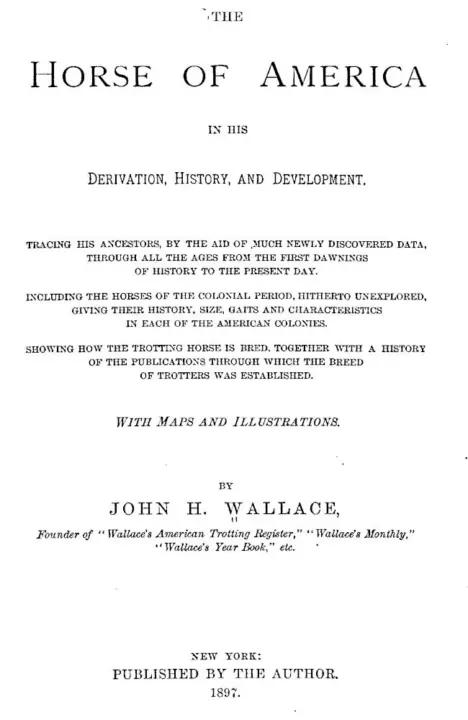
THE CLASSIC COLLECTION · 1897
"The Horse of America in His Derivation, History, and Development" by John H. Wallace is a historical account written in the late 19th century. This work meticulously explores the lineage and evolution of the American horse, focusing particularly on its historical roots and development through the ages. Wallace seeks to challenge widely held misconceptions about horse breeds, particularly those concerning the renowned Arabian horse, while illuminating the largely neglected history of horses during the Colonial period in America. The opening of this work sets the stage for an extensive inquiry into the history and ancestry of American horses, emphasizing the author's desire to uncover facts about their lineage that have not been extensively documented before. Wallace introduces his examination by critiquing common narratives regarding the origins of the horse, dismissing the notion that the Arabian breed is superior and asserting that its actual influence on the American horse is minimal. He highlights that much of the existing knowledge surrounding horse history is founded on repetition of previous works, rather than original research. The author expresses satisfaction in the thorough research he has conducted into the equine ancestry and colonial history, intending to provide readers with a more accurate understanding of both the American trotter and the complexities of horse breeding.
Introduction adapted from the source catalogue; source summaries may be automatically generated.
Free to read · English · 251,000 words · No account needed
MAKE TIME FOR A GOOD BOOK
On by default. Untick to stop anonymous reading totals. Each page counts after 10 seconds in view. How this works.
Anonymous counting is on unless you have switched it off.
In breeding for a particular purpose or qualification all experience goes to show that the elements entering into the new creature must be carefully selected as possessing the quality that we seek to propagate. Nobody would think of breeding a running mare to a trotting horse if he was seeking to breed a running colt. No thoughtful and intelligent man would think of breeding a running horse upon a trotting mare if he were seeking to breed a trotting colt. The runner to the runner and the trotter to the trotter has been demonstrated ten thousand times as the right way. The cross-bred or half-and-half-bred animal may be something of a trotter or something of a runner, doing neither well; and this uncertainty never can become a certainty as to which it may be till you try him. The evil of half-and-half breeding does not cease with the life of the animal, for the division in his own inheritance will manifest itself in his progeny for generations, or till it is bred out. But, strange as it may seem, there are still a few old men living who, from pride of opinion advanced in their younger days, still maintain that trotting speed must come from the “thoroughbred” and “point with pride” to the great horse Palo Alto as the complete illustration of their belief. In relation to the breeding of Palo Alto I will here tell a little story, premising that I neither accept it as true nor reject it as false, for I know nothing about it. The late Mr. William H. Wilson, of Cynthiana, Kentucky, was in many respects a remarkable man. He was full of energy and push, and his brain seemed to teem with formidable ideas, chiefly relating to his prospects, and the management of his own business. He was intelligent in horse matters, and very well informed on local horse history. He did a great deal of work for me in the way of straightening out tangled skeins, and in tracing obscure pedigrees. In this way I came to know Mr. Wilson very well, and as I never found him wrong on these questions I came to place great confidence in his word and his judgment in all pedigree matters that he had investigated. Some time about 1889, probably, he asked me to investigate the pedigree of Dame Winnie, the dam of Palo Alto, for, he said, he had every reason to believe she was not by Planet, but by a trotting-bred horse that he named, but that name has escaped me. I replied that I had not time then, but I would think about it. Some months afterward he was again in my office and he again urged the investigation. My reply was that there were some very upright and honest men in Kentucky as well as some great rogues, and if I were to undertake to investigate this pedigree the rogues could get forty men, if so many were necessary, for a bottle of whisky or a half-dollar a head, who could remember just what it was necessary to remember, and forget just what it was necessary to forget in order to prove that the mare was by Planet. I recalled my experience with suborned evidence in the past, and knew just what I might expect in the future, and so I had concluded to make no more investigations in certain portions of Kentucky until I had an opportunity to cross-examine the witnesses. Dame Winnie was a plain, common-looking mare, with nothing about her to indicate high breeding, and if we lay aside Mr. Wilson’s story and accept the pedigree as usually given she was strongly running bred, but at several points in her pedigree she fails of being thoroughbred. The internal evidence as to the breeding of this mare, brought to light in the performance of her produce, suggests very strongly the probability that she possessed some trotting blood, from some source not far removed. She has five representatives in the 2:30 list, and this of itself strongly supports Mr. Wilson’s untold story, that I would not listen to. In passing I will say I would be glad to listen to it now; for this solid foundation of experience is so stoutly corroborative of what he suggested as to justify an effort to reach the exact truth. When it was known in Kentucky that Senator Stanford had sent his representative down there to gather up a lot of “thoroughbred” mares from which to breed trotters in California, every dealer in the State had just what he wanted. He was looking for pedigrees, and it was a very easy matter to shape up the pedigrees just to suit him.
Your reading position is saved on this browser. Take it to another device with a library code. Reading pages adapt to text, rather than matching a printed edition.
BEHIND THE BOOK
This eBook is for the use of anyone anywhere in the United States and most other parts of the world at no cost and with almost no restrictions whatsoever. You may copy it, give it away or re-use it under the terms of the Project Gutenberg License included with this eBook or online at www.gutenberg.org. If you are not located in the United States, you will have to check the laws of the country where you are located before using this eBook. Read the source licence.
The original source file, including credits and licence, is retained by this library. Request an original-format copy at no charge. Please include the book title and Project Gutenberg identifier #62972.
KEEP YOUR CURIOSITY GOING
Cécile Tormay

Moritz Busch
John L. Ransom
Frances Wright
Cécile Tormay

Mabel Potter Daggett