THE CLASSIC COLLECTION✦An outlaw’s diary: the CommuneCLASSIC FREE BOOKS
An outlaw’s diary: the Commune
Cécile Tormay
THE CLASSIC COLLECTION · 1897
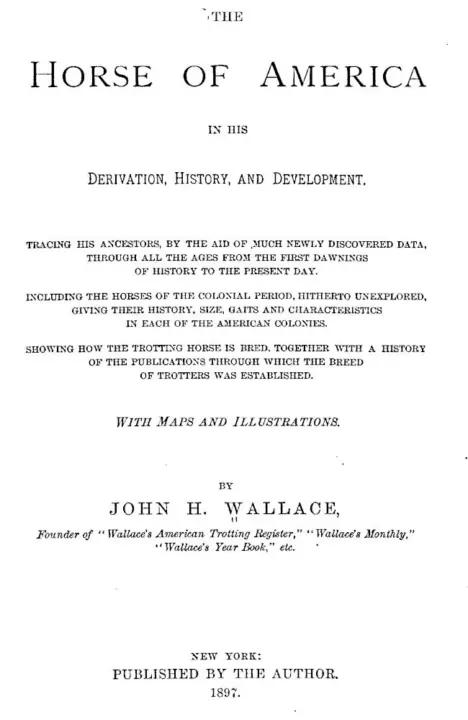
"The Horse of America in His Derivation, History, and Development" by John H. Wallace is a historical account written in the late 19th century. This work meticulously explores the lineage and evolution of the American horse, focusing particularly on its historical roots and development through the ages. Wallace seeks to challenge widely held misconceptions about horse breeds, particularly those concerning the renowned Arabian horse, while illuminating the largely neglected history of horses during the Colonial period in America. The opening of this work sets the stage for an extensive inquiry into the history and ancestry of American horses, emphasizing the author's desire to uncover facts about their lineage that have not been extensively documented before. Wallace introduces his examination by critiquing common narratives regarding the origins of the horse, dismissing the notion that the Arabian breed is superior and asserting that its actual influence on the American horse is minimal. He highlights that much of the existing knowledge surrounding horse history is founded on repetition of previous works, rather than original research. The author expresses satisfaction in the thorough research he has conducted into the equine ancestry and colonial history, intending to provide readers with a more accurate understanding of both the American trotter and the complexities of horse breeding.
Introduction adapted from the source catalogue; source summaries may be automatically generated.
Free to read · English · 251,000 words · No account needed
MAKE TIME FOR A GOOD BOOK
On by default. Untick to stop anonymous reading totals. Each page counts after 10 seconds in view. How this works.
Anonymous counting is on unless you have switched it off.
For years past I have observed that the less a man knows about horse history and horse achievements, the more importance he attaches to the word “thoroughbred;” and of all the millions and millions of lies that have been told about pedigrees nine-tenths have been concocted and circulated for the one purpose of enhancing the supposed value of the animal by claiming “thoroughbred” blood. The “instinct” to lie about pedigrees, so common among certain classes of horsemen, seems to be “the sum of inherited habits” that has come down from generation to generation. If you ask one of these mendacious gentlemen whether American Eclipse was a thoroughbred he will answer, with a strong marked expression of contempt and pity for your ignorance on his countenance, “Certainly he was thoroughbred.” If you then ask him about his pedigree he will answer, “I don’t know anything about his pedigree.” Then you venture to ask how he knows he was thoroughbred if he does not know anything about his pedigree, and he will squelch you completely by saying, “No horse not thoroughbred could ever have done what American Eclipse did.” Here we get at the real basis of the universal mendacity on this subject. The preacher wrote a great book called “The Perfect Horse” in which he maintained that the Morgan Horse was thoroughbred. The lawyer wrote another great book on “The American Roadster” in which he maintained that Dexter was a thoroughbred. With two gentlemen of intelligence and education writing such miserable stuff, what are we to expect from the masses?
Now here is the horse American Eclipse, the greatest horse of his day in his racing achievements, that in his blood is very far from being “thoroughbred,” under any rule that has ever been suggested or devised. Now, with this taint on his escutcheon, it follows that no one of his descendants for at least five generations can be classed as thoroughbred. As a progenitor, Eclipse cannot be considered a great horse, either in his immediate or more remote descendants. Medoc was about his best, and he was better than his sire. Another son, called Monmouth Eclipse, was grandly bred on the side of his dam, was sold, it was said, for fifteen thousand dollars for stock purposes, and proved a most lamentable failure, never having got a colt that was worth fifteen dollars as a race horse. The great fame of American Eclipse, therefore, rested upon what were then designated as “his mighty achievements upon the turf.” A reasonably complete history of this horse may be found in Wallace’s Monthly for March, 1877, p. 160. His great race against Henry, in which he represented the North as against the South, was doubtless the most memorable turf event that ever took place on this continent, and a very brilliant description of it will be found at the reference given above. This race of four-mile heats took place on the Union Course, Long Island, May, 1823, for twenty thousand dollars a side, and it was, in effect, Eclipse against the world. Eclipse, fit or not fit, must start, while his opponents had several prepared to start against him and all they had to determine was to select the fastest and best of the whole party. At the last hour Henry was chosen as the champion of the South, and he won the first heat by about a length in 7:37½. A change was made in the rider of Eclipse and he won the second heat by about two lengths in 7:49. In the third heat the instructions to the rider of Henry were not to hurry the gait, but to trail to near the finish and then pull out and win in a rush. The rider of Eclipse understood the tactics of the enemy and he hurried the pace every step of the way, in order to tire out his younger opponent. When near the finish Henry made his dash and covered Eclipse’s quarter with his head, but he could get no further and abandoned the contest. Eclipse had been punished unmercifully from start to finish, and the time of the heat was 8:24. This shows an average rate of speed in the third heat of two minutes and six seconds to the mile, a rate which half a dozen trotters and a round dozen of pacers have beaten for a single mile. It shows also the cruelty, to say nothing of the absurdity, of heat racing at the distance of four miles. Still American Eclipse was the greatest running horse of his generation.
Your reading position is saved on this browser. Take it to another device with a library code. Reading pages adapt to text, rather than matching a printed edition.
BEHIND THE BOOK
This eBook is for the use of anyone anywhere in the United States and most other parts of the world at no cost and with almost no restrictions whatsoever. You may copy it, give it away or re-use it under the terms of the Project Gutenberg License included with this eBook or online at www.gutenberg.org. If you are not located in the United States, you will have to check the laws of the country where you are located before using this eBook. Read the source licence.
The original source file, including credits and licence, is retained by this library. Request an original-format copy at no charge. Please include the book title and Project Gutenberg identifier #62972.
KEEP YOUR CURIOSITY GOING
Cécile Tormay

Moritz Busch
John L. Ransom
Frances Wright
Cécile Tormay

Mabel Potter Daggett