THE CLASSIC COLLECTION✦An outlaw’s diary: the CommuneCLASSIC FREE BOOKS
An outlaw’s diary: the Commune
Cécile Tormay
THE CLASSIC COLLECTION · 1897
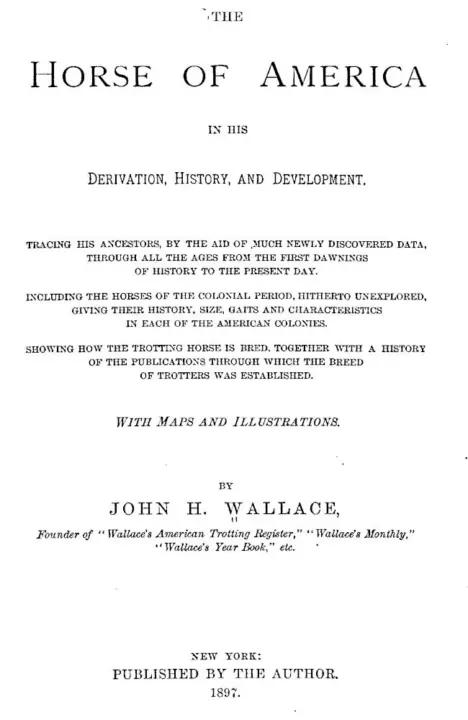
"The Horse of America in His Derivation, History, and Development" by John H. Wallace is a historical account written in the late 19th century. This work meticulously explores the lineage and evolution of the American horse, focusing particularly on its historical roots and development through the ages. Wallace seeks to challenge widely held misconceptions about horse breeds, particularly those concerning the renowned Arabian horse, while illuminating the largely neglected history of horses during the Colonial period in America. The opening of this work sets the stage for an extensive inquiry into the history and ancestry of American horses, emphasizing the author's desire to uncover facts about their lineage that have not been extensively documented before. Wallace introduces his examination by critiquing common narratives regarding the origins of the horse, dismissing the notion that the Arabian breed is superior and asserting that its actual influence on the American horse is minimal. He highlights that much of the existing knowledge surrounding horse history is founded on repetition of previous works, rather than original research. The author expresses satisfaction in the thorough research he has conducted into the equine ancestry and colonial history, intending to provide readers with a more accurate understanding of both the American trotter and the complexities of horse breeding.
Introduction adapted from the source catalogue; source summaries may be automatically generated.
Free to read · English · 251,000 words · No account needed
MAKE TIME FOR A GOOD BOOK
On by default. Untick to stop anonymous reading totals. Each page counts after 10 seconds in view. How this works.
Anonymous counting is on unless you have switched it off.
This outside filly that had been smuggled into the band of Kentuckians was advertised along with them, as a foal of 1862, in the fall of 1864; she was sold as a foal of 1862; she was entered in a sweepstake for three-year-olds as a foal of 1862; she was exhibited at a horse show as a foal of 1862; she started to run the only race she ever attempted as a foal of 1862, and proving herself utterly worthless as a race mare, she was given away on the spot as a foal of 1862.
As the only representative of Lexington in the band was “the yearling bay colt Frank,” as shown by Mr. Anderson, the partner of Mr. Welch; and as the records at Woodburn had clearly and distinctly shown that Swigert’s Grey Eagle mare was barren in 1862, the bottom was out of the conspiracy and it was abandoned. There was a little fussing about the possibility that there might have been a mistake and that Waxy might have been a foal of 1863 after all, but it amounted to nothing more than the enfeebled squeak of an asthmatic mouse and then all was quiet.
Before passing to the other branch of the investigation, this seems to be the proper place to speak of the incidents of the sale and its sequences at the Fair Grounds at San Jose, January 3, 1865. There were some twelve or fifteen head, that had been previously advertised, offered at public sale, and a number of those were sold, all indeed in which this inquiry has any interest. When the stock arrived at San Jose, there was a good deal of confusion, and it is just possible that some of them were not correctly placed. The only discrepancy which I have found between Mr. Welch’s inventory and the facts is in the color of the filly No. 18, that appears in the inventory as a chestnut, but is advertised and sold as a bay. This mistake in color is not infrequent in the spring of the year before the old coat is shed, and I think it may be reasonably accounted for on this ground. James L. Eoff, well known from ocean to ocean as the king of all “horse sharps,” seems to have taken a good deal of interest in assorting the animals and in picking up scraps of information from the boys who had come with them. At the same time he was an excellent judge of racing stock, and as silent as the grave to the victims whom he sought to mislead and then beat. In this way he soon knew more about the breeding of the animals than those in charge of them. Mr. William Woodward seems to have been his friend (?) with plenty of money, but a perfect “tenderfoot” in the mysteries of the race horse. No doubt he pointed out to Mr. Woodward the so-called Lexington filly and advised him to buy her, assuring him that he wanted her himself, but if he wanted to take a little fly in racing he would not bid against him. The sale came off, and Eoff ran up the Revenue filly, out of Sally Morgan, to three hundred and twenty-five dollars and got her, it is said, for Theodore Winters. When they came to the filly by Bob Johnson, out of the mare by Brawner’s Eclipse, Eoff bought her at two hundred and fifty dollars for himself, and named her Lilly Hitchcock. The next animal sold was the filly by Lexington, dam unknown, and she was bought by William Woodward at two hundred and fifty dollars, and he named her Waxy. The sale was slimly attended and much of the stock was bid in for the owner, Mr. John Anderson. That night the wine flowed very freely, as it was the initiation of the “tenderfoot,” Mr. Woodward, into the ranks of running-horse men. After they all “got hot” (except Eoff), a sweepstakes was opened for the three fillies, Ada C. (the Revenue filly), Lilly Hitchcock and Waxy, at two hundred and fifty dollars each, and Eoff was careful to see that it was made “play or pay.” The race was a dash of a mile and a quarter, and it took place nearly twelve months after the match was made. Eoff won easily with Lilly Hitchcock, and Waxy was so badly beaten that Woodward gave her away on the spot and “swore off” ever owning another running horse. Thus Eoff’s cunning carried his plot through, without a break at any point. From the hour he bought this filly he stoutly maintained she was by Lexington and out of the Brawner’s Eclipse mare. She ran all her races under this pedigree and never was challenged, and if ever there was a mare in California bred in this way, this is likely to be the mare. We can understand just how he could have discovered where Waxy came from, and that she never saw Kentucky, and on this knowledge he based the game he played on poor Woodward.
Your reading position is saved on this browser. Take it to another device with a library code. Reading pages adapt to text, rather than matching a printed edition.
BEHIND THE BOOK
This eBook is for the use of anyone anywhere in the United States and most other parts of the world at no cost and with almost no restrictions whatsoever. You may copy it, give it away or re-use it under the terms of the Project Gutenberg License included with this eBook or online at www.gutenberg.org. If you are not located in the United States, you will have to check the laws of the country where you are located before using this eBook. Read the source licence.
The original source file, including credits and licence, is retained by this library. Request an original-format copy at no charge. Please include the book title and Project Gutenberg identifier #62972.
KEEP YOUR CURIOSITY GOING
Cécile Tormay

Moritz Busch
John L. Ransom
Frances Wright
Cécile Tormay

Mabel Potter Daggett