THE CLASSIC COLLECTION✦An outlaw’s diary: the CommuneCLASSIC FREE BOOKS
An outlaw’s diary: the Commune
Cécile Tormay
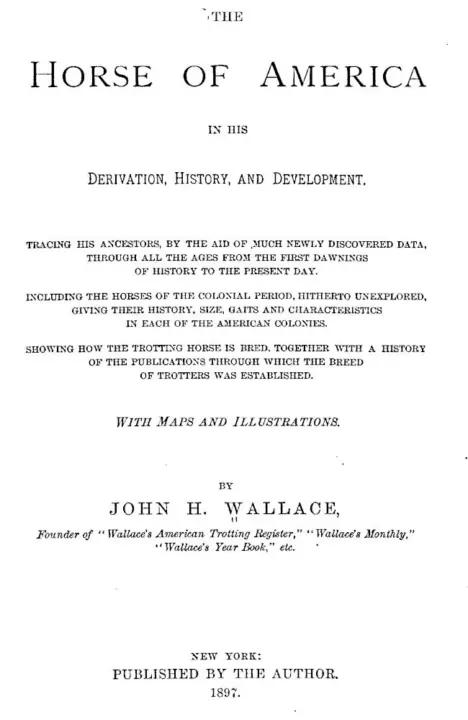
THE CLASSIC COLLECTION · 1897
"The Horse of America in His Derivation, History, and Development" by John H. Wallace is a historical account written in the late 19th century. This work meticulously explores the lineage and evolution of the American horse, focusing particularly on its historical roots and development through the ages. Wallace seeks to challenge widely held misconceptions about horse breeds, particularly those concerning the renowned Arabian horse, while illuminating the largely neglected history of horses during the Colonial period in America. The opening of this work sets the stage for an extensive inquiry into the history and ancestry of American horses, emphasizing the author's desire to uncover facts about their lineage that have not been extensively documented before. Wallace introduces his examination by critiquing common narratives regarding the origins of the horse, dismissing the notion that the Arabian breed is superior and asserting that its actual influence on the American horse is minimal. He highlights that much of the existing knowledge surrounding horse history is founded on repetition of previous works, rather than original research. The author expresses satisfaction in the thorough research he has conducted into the equine ancestry and colonial history, intending to provide readers with a more accurate understanding of both the American trotter and the complexities of horse breeding.
Introduction adapted from the source catalogue; source summaries may be automatically generated.
Free to read · English · 251,000 words · No account needed
MAKE TIME FOR A GOOD BOOK
On by default. Untick to stop anonymous reading totals. Each page counts after 10 seconds in view. How this works.
Anonymous counting is on unless you have switched it off.
1. Bay mare, 6 years old, by imp. Sovereign, dam by Glencoe, g. d. Ann Merry. 2. Bay filly, 3 years, by Vandal, dam Miss Singleton by Old Denmark, g. d. Bellamira by Monarch. 3. Bay filly, 2 years old, by Mambrino Chief, dam by Commodore. 4. Bay horse, 3 years old, by Mambrino Chief, dam by Gray Eagle. 5. Black colt, 2 years old, by Kt. of St. George, dam (dam of Capitola) by Margrave. 6. Bay mare, 9 years old, by imp. Glencoe, dam by Rudolph, g. d. Belle Anderson. 7. Bay filly, 2 years old, by Revenue, dam Sally Morgan by Emancipation. 8. Chestnut filly, 4 years old, by Vandal, dam by Gray Eagle, g. d. Churchill. 9. Chestnut mare by Wagner (dam of No. 11). 10. Bay mare by Sovereign. 11. Black colt, 2 years old, by Kt. of St. George, dam No. 9, by Wagner. 12. Chestnut filly, 3 years old, by Jack Gamble, dam Betty King by Boston. 13. Bay mare, 6 years old, by imp. Sovereign, dam by Mirabeau, g. d. Arabella. 14. Captain Beard, b. s., 9 years old, by imp. Yorkshire, dam by imp. Glencoe, g. d. by imp. Leviathan, g. g. d. by Stockholder. 15. Gray mare by Gray Eagle, dam Mary Morris, by Medoc. 16. Hope, ch. m. by Glencoe, dam Susette by Aratus. 17. Bay mare by Sovereign, dam by Gray Eagle. 18. Chestnut filly, 2 years old, by Bob Johnson, dam by Brawner’s Eclipse. 19. Chestnut filly, 3 years old, by Kt. of St. George, dam by Gray Eagle. 20. Bay colt, one year old, by Lexington, dam by Gray Eagle, g. d. Mary Morris. 21. Ch. c., 2 years old by Ringgold, dam Hope by Glencoe. 22 and 23. Pair 3:00 six-year-old trotting mares. 24. Black mare, trotter, 8 years old; time, 2:50. 25. Bay gelding, trotter, 5 years old; time, near 3:00. 26. Bay mare for show, but not to go.
From this inventory we must conclude that Mr. Welch was a careful and methodical man. He knew he had twenty-six animals ready to start, and after he had written off the descriptions and pedigrees of these twenty-six animals he verified his work by numbering them from one to twenty-six inclusive, and then he knew he had not omitted any one. This inventory is the basis of the whole truth in this matter, and is the only evidence in the wide world of what animals Mr. Welch started with to California. As this is the vital and only starting point to reach the truth, I trust my readers will examine it again carefully and see whether it includes any filly or mare by Lexington, of any age. When you ask any of these “more-running-blood-in-the-trotter” people who took Waxy, the phantom daughter of Lexington, to California, you will get an evasive answer, and when pressed they will at last say, John P. Welch. Now, as to John P. Welch, “he being dead yet speaketh.” From his unknown grave he tells these people they are trying to establish what is not true, and with his ghostly finger points to the inventory and demands, “Where is the Lexington filly in that list? You are trying to displace the truth with a falsehood,” and he drives this charge home to the heart of each one of them.
Your reading position is saved on this browser. Take it to another device with a library code. Reading pages adapt to text, rather than matching a printed edition.
BEHIND THE BOOK
This eBook is for the use of anyone anywhere in the United States and most other parts of the world at no cost and with almost no restrictions whatsoever. You may copy it, give it away or re-use it under the terms of the Project Gutenberg License included with this eBook or online at www.gutenberg.org. If you are not located in the United States, you will have to check the laws of the country where you are located before using this eBook. Read the source licence.
The original source file, including credits and licence, is retained by this library. Request an original-format copy at no charge. Please include the book title and Project Gutenberg identifier #62972.
KEEP YOUR CURIOSITY GOING
Cécile Tormay

Moritz Busch
John L. Ransom
Frances Wright
Cécile Tormay

Mabel Potter Daggett