THE CLASSIC COLLECTION✦An outlaw’s diary: the CommuneCLASSIC FREE BOOKS
An outlaw’s diary: the Commune
Cécile Tormay
THE CLASSIC COLLECTION · 1897
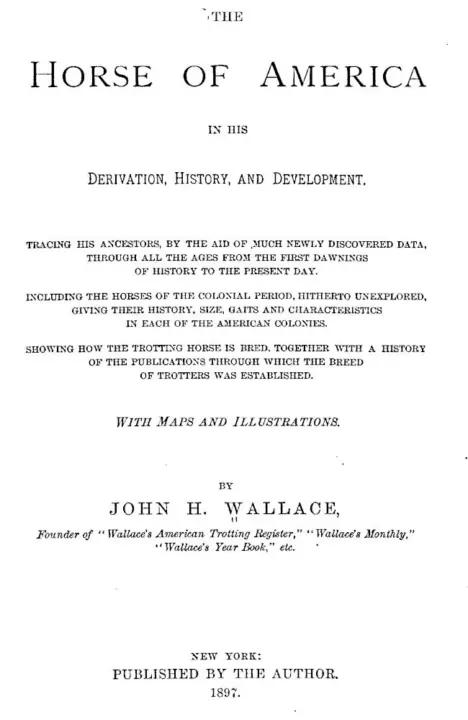
"The Horse of America in His Derivation, History, and Development" by John H. Wallace is a historical account written in the late 19th century. This work meticulously explores the lineage and evolution of the American horse, focusing particularly on its historical roots and development through the ages. Wallace seeks to challenge widely held misconceptions about horse breeds, particularly those concerning the renowned Arabian horse, while illuminating the largely neglected history of horses during the Colonial period in America. The opening of this work sets the stage for an extensive inquiry into the history and ancestry of American horses, emphasizing the author's desire to uncover facts about their lineage that have not been extensively documented before. Wallace introduces his examination by critiquing common narratives regarding the origins of the horse, dismissing the notion that the Arabian breed is superior and asserting that its actual influence on the American horse is minimal. He highlights that much of the existing knowledge surrounding horse history is founded on repetition of previous works, rather than original research. The author expresses satisfaction in the thorough research he has conducted into the equine ancestry and colonial history, intending to provide readers with a more accurate understanding of both the American trotter and the complexities of horse breeding.
Introduction adapted from the source catalogue; source summaries may be automatically generated.
Free to read · English · 251,000 words · No account needed
MAKE TIME FOR A GOOD BOOK
On by default. Untick to stop anonymous reading totals. Each page counts after 10 seconds in view. How this works.
Anonymous counting is on unless you have switched it off.
Eighth. With the high indorsement of Mr. Llewellyn Holton as a man of truth and honor, given on page 421 of this chapter; and with the evidence before me of his clear and unclouded memory in giving correctly not only the pedigrees but the year in which Maria Russell was foaled, and all this before there was any pressure or suspicion on his part as to where his disclosure might lead, I cannot, as an honest man, fail to believe that he told the truth. Thus, after leaving out all the minor evidences, we have the three major points fully and clearly established, namely, (1) the inscription on the silver cup that Captain Holton owned her in 1836; (2) the evidence of William Duvall that he owned her in 1842; and (3) the statement of Llewellyn Holton that he owned her always and that she died his.
Ninth. At the Woodburn sale of 1863 and 1868 there were certainly at least two hundred experienced horsemen and breeders present who were able to discriminate concerning a mare represented to be thirteen years old when she looked ten years more; or concerning a mare represented to be eighteen years old when she looked as if she were twenty-eight. Hence, no man was willing to bid five dollars on her. This I take it, was the personal judgment of every man who thought anything about it, and when she died a few weeks after the last sale, nobody could doubt that she died of old age, and nobody could doubt that Mr. Alexander represented her to the public just as she had been represented to him, both in age and breeding, by the rogue who victimized him.
The mare Sally Russell, the grandam of Maud S., had been sold to Mr. Alexander by the foreman of Captain Russell’s farm, and it does not appear that he represented her as having been bred by Captain Russell. Indeed, it was not claimed at Woodburn that Captain Russell bred her until a representative of that establishment called at my office to examine the service books of Boston and there found that “John Russell’s one-eyed mare” had been bred in 1849. If a fraud, therefore, was established the Russell family must bear the odium. Hence all evidence from that source must be considered in the light of the fact that every member of the family is deeply interested. But notwithstanding the efforts of the Russell family to preserve the father’s name from obloquy, and notwithstanding the trip in search of some superannuated darkey who could remember anything and everything in consideration of the pour-boire that would be forthcoming, there stood that terrible statement of Llewellyn Holton that could not be met by evidence. The whole matter was against him, and Mr. Brodhead was not happy. He knew he could not prove him wrong, and the only course left open was to get him to take back certain things that he had said on the ground that his memory had failed and that the fight was between “Old Kaintuck” and outside parties who had no business to interfere with Kentucky affairs. On an appointed day, therefore, all who were supposed to have any influence with Mr. Holton, in the whole countryside, met Mr. Brodhead, and they came down on “the poor old paralytic” hammer and tongs. They asked him what he remembered about all the horses, each in his turn, in the whole neighborhood, whether he had ever heard of them before or not. This was kept up a long time, but they could not prevail on him to take back a single specific statement he had made. He had said Captain Russell had never owned Maria Russell or any of her produce, and he would not take it back. He had said Maria Russell had two good eyes when she died, and he would not take it back. At last when the poor old invalid was worn out they sprung the patriotic dodge of “Kentucky against the world” upon him and this had some effect, but not enough to save the anxious “bulldozers” from a feeling of great depression. At last Mr. Brodhead seized a pen and indited a letter for him to sign, addressed to me, with the request that I would publish it. I am not able to say how many attempts were made to get such a letter as he would be willing to sign, but several different drafts were made, and sick and worried, and in order to get rid of his tormentors, he signed, and the letter came to me, and I published it as follows:
Your reading position is saved on this browser. Take it to another device with a library code. Reading pages adapt to text, rather than matching a printed edition.
BEHIND THE BOOK
This eBook is for the use of anyone anywhere in the United States and most other parts of the world at no cost and with almost no restrictions whatsoever. You may copy it, give it away or re-use it under the terms of the Project Gutenberg License included with this eBook or online at www.gutenberg.org. If you are not located in the United States, you will have to check the laws of the country where you are located before using this eBook. Read the source licence.
The original source file, including credits and licence, is retained by this library. Request an original-format copy at no charge. Please include the book title and Project Gutenberg identifier #62972.
KEEP YOUR CURIOSITY GOING
Cécile Tormay

Moritz Busch
John L. Ransom
Frances Wright
Cécile Tormay

Mabel Potter Daggett