THE CLASSIC COLLECTION✦An outlaw’s diary: the CommuneCLASSIC FREE BOOKS
An outlaw’s diary: the Commune
Cécile Tormay
THE CLASSIC COLLECTION · 1897
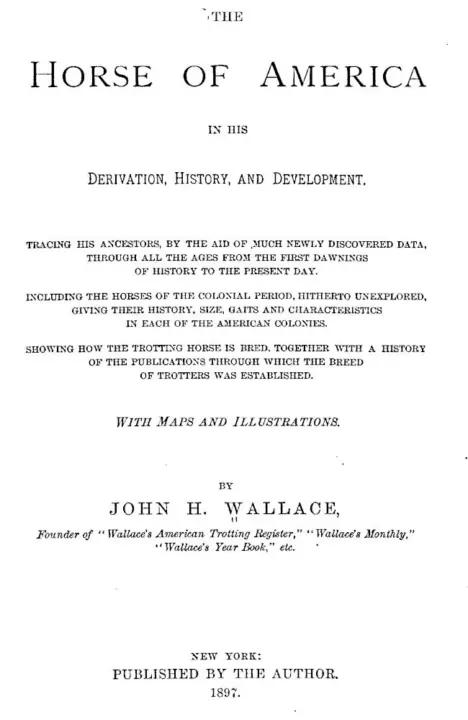
"The Horse of America in His Derivation, History, and Development" by John H. Wallace is a historical account written in the late 19th century. This work meticulously explores the lineage and evolution of the American horse, focusing particularly on its historical roots and development through the ages. Wallace seeks to challenge widely held misconceptions about horse breeds, particularly those concerning the renowned Arabian horse, while illuminating the largely neglected history of horses during the Colonial period in America. The opening of this work sets the stage for an extensive inquiry into the history and ancestry of American horses, emphasizing the author's desire to uncover facts about their lineage that have not been extensively documented before. Wallace introduces his examination by critiquing common narratives regarding the origins of the horse, dismissing the notion that the Arabian breed is superior and asserting that its actual influence on the American horse is minimal. He highlights that much of the existing knowledge surrounding horse history is founded on repetition of previous works, rather than original research. The author expresses satisfaction in the thorough research he has conducted into the equine ancestry and colonial history, intending to provide readers with a more accurate understanding of both the American trotter and the complexities of horse breeding.
Introduction adapted from the source catalogue; source summaries may be automatically generated.
Free to read · English · 251,000 words · No account needed
MAKE TIME FOR A GOOD BOOK
On by default. Untick to stop anonymous reading totals. Each page counts after 10 seconds in view. How this works.
Anonymous counting is on unless you have switched it off.
From this synopsis of all that has been developed in the blood lines of Black Hawk, there can be no longer any mystery about where he got the characteristics making him so intensely different from the representatives of the typical Morgan. His sire was out of a high-class Narragansett pacer, and his dam was probably a fast Narragansett pacer, thus giving him presumably seventy-five per cent. of Narragansett blood and twenty-five per cent. of Morgan blood. The fight that was made against him all his life, as not being a genuine Morgan, had its foundation in justice and truth. He was not a Morgan in either blood or character. He founded a very valuable line of trotters, something that no other branch of the Morgan family has ever accomplished, and of right his descendants should be designated as “the Black Hawk Family,” and not jumbled up with the heterogeneous mass of nondescripts still called “the Morgan Family.” Black Hawk’s gait was spluttery and uneven, rather than square and mechanical. A few of his progeny were very perfectly gaited, but a great many of them manifested their evil inheritance, which, together with unskillful handling, destroyed all possible value as trotters. He placed three in the 2:30 list; fourteen of his sons were sires of 2:30 performers, six of them with two or more, and two daughters produced 2:30 performers. He died November, 1856.
ETHAN ALLEN, 43.—This was a handsome, bright bay horse, less than fifteen hands high, with three white feet and a star. He was foaled 1849, got by Black Hawk, 5; dam, a fast trotting grey mare of unknown pedigree. With a list of all the celebrated American horses before him, it would be very difficult, if not impossible, for the best informed horseman to select an animal that has been so great a favorite with the American people, and for so long a time, as the famous Ethan Allen. When four years old he gave the world a sensation by eclipsing everything that had appeared before him at that age; and again when he was eighteen years old he renewed and intensified the sensation by trotting in 2:15 with a running mate. These sensations of his youth and his old age, did much to give him a standing with the people; but his wonderful beauty and remarkable docility and kindness, with the elegance and ease of his action, made him the favorite of everybody. His trotting gait was recognized by the best judges and experts as probably more perfect than that of any horse of his day. Others have gone faster singly, but no one has done it in greater perfection of motion. In his great flights of speed he was not bounding in the air, but down close to the ground, with a gliding motion that steals from quarter-pole to quarter-pole with inconceivable rapidity. He was bred by Joel W. Holcomb, of Ticonderoga, New York, and as the result of a practical joke he played, for the purpose of annoying his uncle, David Hill, the owner of Black Hawk, against whom he had some pique just at that time, many well-meaning and no doubt honest people once believed, and possibly still believe, that Ethan Allen was by Flying Morgan and not by Black Hawk. The fact that Ethan Allen was the same color as Flying Morgan and that there was some resemblance in size and style of action of the two horses, lent a strong suggestion to the joke as a truth. I am indebted to Mr. I. V. Baker, Jr., of Comstock’s Landing, S. B. Woodward, then of Ticonderoga, and B. H. Baldwin, of Whitehall, New York, for the details of the way the Flying Morgan story started, and need only say the narrator was an eye-witness to the whole affair. In the spring of 1852, in the barroom of S. B. Woodward’s hotel, at Ticonderoga, quite a number of the villagers being present, Mr. Joel W. Holcomb came in and said he was going to write a letter to R. M. Adams, of Burlington, Vermont, the owner of Flying Morgan, and he was going to have some fun with him; and, going to the desk in the room, he wrote, substantially as follows: “I don’t know but I have made all the reputation for David Hill and old Black Hawk that I care to. I am willing to have the credit go where it belongs, and desire to let yourself and the public know that my colt Ethan Allen is got by your horse Flying Morgan.”
Your reading position is saved on this browser. Take it to another device with a library code. Reading pages adapt to text, rather than matching a printed edition.
BEHIND THE BOOK
This eBook is for the use of anyone anywhere in the United States and most other parts of the world at no cost and with almost no restrictions whatsoever. You may copy it, give it away or re-use it under the terms of the Project Gutenberg License included with this eBook or online at www.gutenberg.org. If you are not located in the United States, you will have to check the laws of the country where you are located before using this eBook. Read the source licence.
The original source file, including credits and licence, is retained by this library. Request an original-format copy at no charge. Please include the book title and Project Gutenberg identifier #62972.
KEEP YOUR CURIOSITY GOING
Cécile Tormay

Moritz Busch
John L. Ransom
Frances Wright
Cécile Tormay

Mabel Potter Daggett