THE CLASSIC COLLECTION✦An outlaw’s diary: the CommuneCLASSIC FREE BOOKS
An outlaw’s diary: the Commune
Cécile Tormay
THE CLASSIC COLLECTION · 1897
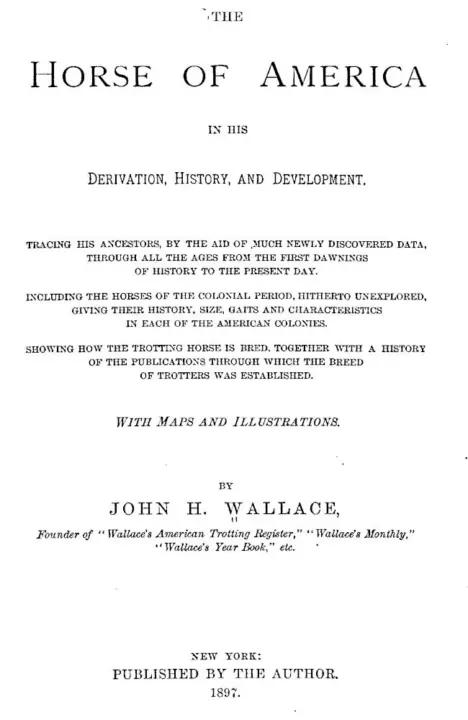
"The Horse of America in His Derivation, History, and Development" by John H. Wallace is a historical account written in the late 19th century. This work meticulously explores the lineage and evolution of the American horse, focusing particularly on its historical roots and development through the ages. Wallace seeks to challenge widely held misconceptions about horse breeds, particularly those concerning the renowned Arabian horse, while illuminating the largely neglected history of horses during the Colonial period in America. The opening of this work sets the stage for an extensive inquiry into the history and ancestry of American horses, emphasizing the author's desire to uncover facts about their lineage that have not been extensively documented before. Wallace introduces his examination by critiquing common narratives regarding the origins of the horse, dismissing the notion that the Arabian breed is superior and asserting that its actual influence on the American horse is minimal. He highlights that much of the existing knowledge surrounding horse history is founded on repetition of previous works, rather than original research. The author expresses satisfaction in the thorough research he has conducted into the equine ancestry and colonial history, intending to provide readers with a more accurate understanding of both the American trotter and the complexities of horse breeding.
Introduction adapted from the source catalogue; source summaries may be automatically generated.
Free to read · English · 251,000 words · No account needed
MAKE TIME FOR A GOOD BOOK
On by default. Untick to stop anonymous reading totals. Each page counts after 10 seconds in view. How this works.
Anonymous counting is on unless you have switched it off.
Horsemen of average intelligence and writers on the horse, oftentimes much below average intelligence in horse matters, all seem to unite on the Arabian horse as their fetish, when in fact they know nothing about him. The songs of the poets and the stories of the novelists have taken the place, in the minds of the people of all nations, of solid history and sober experience. When a story writer wishes to depict an athletic and daring hero, he never fails to mount him upon an “Arab steed,” when some blood-curdling adventures are to be disclosed. When Admiral Rous, the great racing authority in England, announced some years ago, that the English race horse was purely descended from the horses of Arabia Deserta, without one drop of plebeian blood, all England believed him, and this rash and groundless dictum has served all writers as conclusive evidence ever since. Now, it is not probable that more than two or at most three per cent. of the blood of the English race horse as he stands to-day is Arabian blood. The greatness and value of the Arabian horse is purely mythical. He has been tested hundreds of times, both on the course and in the stud, and in every single instance he has proved a failure. This is what all history and experience teach. There are but few horses bred in Arabia and there are, comparatively, but few there now. From the time of their first introduction into Yemen—Arabia Felix—up to the time of Mohammed, about two hundred and seventy years, they were still very scarce. Mohammed was not a horseman nor a horse breeder, nor is it known that he ever mounted a horse but once, and then he had but two in his army. When he made his first pilgrimage to Mecca he rode a camel; and when he went the second time in triumph, mounted on a camel, he made the requisite number of circuits round the holy place, then dismounted and broke the idols that had been set up there. Then came the triumphant shout of his followers; “There is no God but Allah and Mohammed is his prophet.” Since then, this cry has rung over a thousand battlefields, and as I write it is still heard in the homes of the slaughtered Armenians. From a great, warlike, and conquering people, the followers of Mohammed have degenerated into an aggregation of robbers and murderers of defenseless Christians. Since the days of Mohammed, horses no doubt have increased in numbers, but all modern travelers express their surprise at the small numbers they see. The horse is an expensive luxury in Arabia, and none but the rich can afford to keep him. He fills no economic place in the domestic life of the Arab, for he is never used for any purpose except display and robbery. Nobody is able to own a horse but the sheiks and a few wealthy men. Nobody would think of mounting a horse for a journey, be it long or short. The camel fills the place of the horse, the cow and a flock of sheep, all in one, and surely the Arabs are right in saying, “Job’s beast is a monument of God’s mercy.” It is very evident that nearly all the horses said to have been brought from Arabia never saw Arabia. As an illustration of the uncertainty of what a man is getting when he thinks he is buying an Arabian, in the Orient, I will give, in some detail the experiences of Mr. Wilfrid S. Blunt, a wealthy Englishman who had an ambition to regenerate the English race horse by bringing in fresh infusions of Arabian blood. He went to Arabia to buy the best, but he didn’t go into Arabia to find it. He skirted along through the border land where agriculture and civilization prevailed, while away off to the south the wild tribes roamed over the desert, and to the north, not far away, was the land of abundance that had been famous for more than three thousand years for the great numbers and excellence of the horses bred there. Here on the banks of the Euphrates Mr. Blunt found the town of Deyr, and he soon discovered it was a famous horse market. The inhabitants were the only people he met with who seemed to understand and appreciate the value of pedigrees, and there were no horses in the town but “thoroughbreds.” Here Mr. Blunt made nearly all his purchases which amounted to eighteen mares and two stallions “at reasonable prices.” As will be seen in the extracts from his book, he was strikingly solicitous that the friends at home should have no doubt about the quality of the stock he purchased being all “thoroughbred.” No doubt he realized the awkwardness of the location as not the right one in which to secure “thoroughbred” Arabians and hence the vigorous indorsement of the honesty of the “slick and experienced” dealers as honest men and true descendants of the Bedouins of the desert. In this “he doth protest too much” and thus suggests that while the pedigrees came from the tribes of the desert to the South, it might be possible that the horses came from the farmers who bred them to the North. However this may have been, the whole enterprise turned out to be a flat failure, and after a number of years spent in begging for popular support, the whole collection was dispersed under the hammer of the auctioneer, not realizing a tithing of the cost.
Your reading position is saved on this browser. Take it to another device with a library code. Reading pages adapt to text, rather than matching a printed edition.
BEHIND THE BOOK
This eBook is for the use of anyone anywhere in the United States and most other parts of the world at no cost and with almost no restrictions whatsoever. You may copy it, give it away or re-use it under the terms of the Project Gutenberg License included with this eBook or online at www.gutenberg.org. If you are not located in the United States, you will have to check the laws of the country where you are located before using this eBook. Read the source licence.
The original source file, including credits and licence, is retained by this library. Request an original-format copy at no charge. Please include the book title and Project Gutenberg identifier #62972.
KEEP YOUR CURIOSITY GOING
Cécile Tormay

Moritz Busch
John L. Ransom
Frances Wright
Cécile Tormay

Mabel Potter Daggett