THE CLASSIC COLLECTION✦An outlaw’s diary: the CommuneCLASSIC FREE BOOKS
An outlaw’s diary: the Commune
Cécile Tormay
THE CLASSIC COLLECTION · 1897
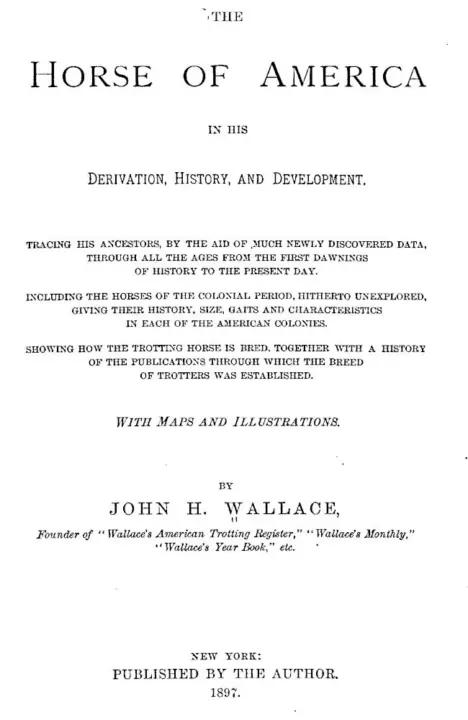
"The Horse of America in His Derivation, History, and Development" by John H. Wallace is a historical account written in the late 19th century. This work meticulously explores the lineage and evolution of the American horse, focusing particularly on its historical roots and development through the ages. Wallace seeks to challenge widely held misconceptions about horse breeds, particularly those concerning the renowned Arabian horse, while illuminating the largely neglected history of horses during the Colonial period in America. The opening of this work sets the stage for an extensive inquiry into the history and ancestry of American horses, emphasizing the author's desire to uncover facts about their lineage that have not been extensively documented before. Wallace introduces his examination by critiquing common narratives regarding the origins of the horse, dismissing the notion that the Arabian breed is superior and asserting that its actual influence on the American horse is minimal. He highlights that much of the existing knowledge surrounding horse history is founded on repetition of previous works, rather than original research. The author expresses satisfaction in the thorough research he has conducted into the equine ancestry and colonial history, intending to provide readers with a more accurate understanding of both the American trotter and the complexities of horse breeding.
Introduction adapted from the source catalogue; source summaries may be automatically generated.
Free to read · English · 251,000 words · No account needed
MAKE TIME FOR A GOOD BOOK
On by default. Untick to stop anonymous reading totals. Each page counts after 10 seconds in view. How this works.
Anonymous counting is on unless you have switched it off.
The week following his Buffalo race Jay Gould defeated another strong field at Kalamazoo, Michigan; and in 1872 started four times, winning in all his races, lowering his record to 2:21¼, the then champion stallion record. He was kept in the stud in 1873, but being challenged on behalf of Bashaw Jr., the following year, was given a hurried fall preparation, and met his challenger at Baltimore. Bashaw Jr., broke down in the first heat, and Gould of course won an empty victory, but to satisfy the audience was driven a public trial in 2:19½. Meanwhile Smuggler had lowered the stallion record to 2:20, and Jay Gould was sent against it at Boston, trotting under unfavorable circumstances in 2:20½ and 2:21½. This practically closed his turf career. He made a number of seasons at Fashion Farm, and in his later years at Walnut Hill Farm, near Lexington, Kentucky, and died of old age June 10, 1894. Jay Gould’s opportunities were never of the best. In his earlier years in the stud General Knox was more used at Fashion Farm than Jay Gould, and there was no training done at Fashion until 1886. Jay Gould is the sire of twenty-nine standard performers, the most noted of which is the great mare Pixley, 2:08¼. Fourteen of his sons have produced thirty standard performers, and twenty-eight of his daughters have produced forty-six performers, among the latter being the great pacer, Robert J., 2:01½, and such trotters as Poem, 2:11½, Colonel Kuser, 2:11¼, Mahogany, 2:12¼, Edgardo, 2:13¾, etc. His most noted producing daughter is Lucia, whose dam was the famous old trotting mare Lucy, 2:18¼, by George M. Patchen, 2:23½. Lucia is the dam of Edgardo, 2:13¾, Hurly Burly, 2:16¼, and several others in the 2:30 list, and her blood is breeding on through both her sons and daughters.
STRATHMORE, taking all things into consideration, must be rated among the very greatest sons of Hambletonian. He was a solid bay horse, of the substantial Hambletonian type, foaled 1866, bred by Aristides Welch at his Chestnut Hill farm, near Philadelphia, and was got by Hambletonian out of the quite famous trotting mare Lady Waltermire, by North American, and Lady Waltermire’s dam was said to have been by Harris’ Hambletonian. This North American sired Whitehall, that got the famous trotter Rhode Island, sire of the still more celebrated Governor Sprague, and in the section treating of the latter the reader will find particulars concerning North American. Lady Waltermire was a noted trotting mare in her day, and it has been claimed that she performed faster than 2:30, but I have never been able to substantiate this claim. When Strathmore was a three-year-old, in 1869, I visited Chestnut Hill. Mr. Welch then had three sons of Hambletonian, viz., William Welch, Rysdyk, and Strathmore, who was then called Goodwin Watson. The two former were led out to be shown, but when I inquired for Goodwin Watson, Mr. Welch’s reply was “Oh, he’s a pacer”—except that he used an adjective in connection with “pacer” that added emphasis, and betrayed some degree of regret, or indeed disgust. The fact that several of Strathmore’s sons have gotten many fast pacers need not be marveled at. I am not aware that Strathmore was ever trained, and probably his pacing inclination furnishes the reason. When he was seven years old he was purchased by Colonel R. G. Stoner, of Paris, Kentucky, and named Strathmore, and up to this time, Colonel Stoner states, he had but three foals, one of which was afterward known as Chestnut Hill, 2:22½, the first of his get to earn a reputation. His first two seasons were made in Montgomery County, after which he was taken to Paris, in Bourbon County. Colonel Stoner states in one of his catalogues that Strathmore’s early opportunities in Kentucky were very inferior; that in 1877 and 1878 the service fees earned would not pay for his keep; that up to 1879 he never served a mare with a record or the dam of an animal with a record, and that it was not until Steinway trotted in 1878 as a two-year old in 2:31¾, and Santa Claus as a five-year-old in 2:18 in 1879 that any good mares came to Strathmore. At Colonel Stoner’s sale, February 9, 1886, Strathmore was sold for two thousand one hundred and fifty dollars to Rockhill & Bro., of Fort Wayne, Indiana, and they owned him until his death, March 11, 1895. Strathmore has seventy-one in the standard list; twenty-six of his sons and fifty-four of his daughters have produced one hundred and fifty-eight standard performers.
Your reading position is saved on this browser. Take it to another device with a library code. Reading pages adapt to text, rather than matching a printed edition.
BEHIND THE BOOK
This eBook is for the use of anyone anywhere in the United States and most other parts of the world at no cost and with almost no restrictions whatsoever. You may copy it, give it away or re-use it under the terms of the Project Gutenberg License included with this eBook or online at www.gutenberg.org. If you are not located in the United States, you will have to check the laws of the country where you are located before using this eBook. Read the source licence.
The original source file, including credits and licence, is retained by this library. Request an original-format copy at no charge. Please include the book title and Project Gutenberg identifier #62972.
KEEP YOUR CURIOSITY GOING
Cécile Tormay

Moritz Busch
John L. Ransom
Frances Wright
Cécile Tormay

Mabel Potter Daggett