THE CLASSIC COLLECTION✦An outlaw’s diary: the CommuneCLASSIC FREE BOOKS
An outlaw’s diary: the Commune
Cécile Tormay
THE CLASSIC COLLECTION · 1897
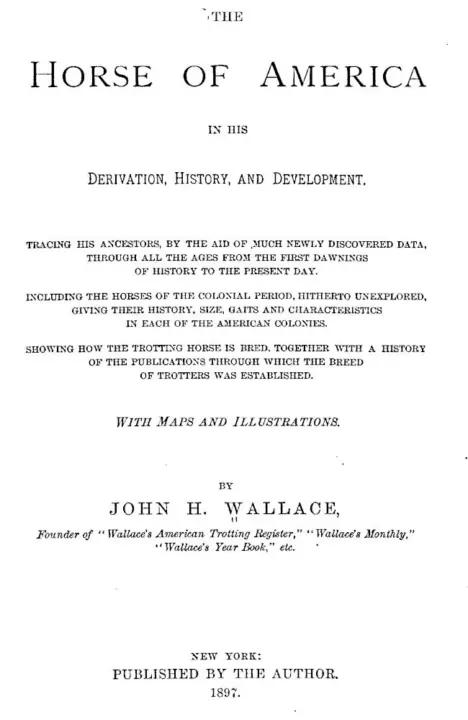
"The Horse of America in His Derivation, History, and Development" by John H. Wallace is a historical account written in the late 19th century. This work meticulously explores the lineage and evolution of the American horse, focusing particularly on its historical roots and development through the ages. Wallace seeks to challenge widely held misconceptions about horse breeds, particularly those concerning the renowned Arabian horse, while illuminating the largely neglected history of horses during the Colonial period in America. The opening of this work sets the stage for an extensive inquiry into the history and ancestry of American horses, emphasizing the author's desire to uncover facts about their lineage that have not been extensively documented before. Wallace introduces his examination by critiquing common narratives regarding the origins of the horse, dismissing the notion that the Arabian breed is superior and asserting that its actual influence on the American horse is minimal. He highlights that much of the existing knowledge surrounding horse history is founded on repetition of previous works, rather than original research. The author expresses satisfaction in the thorough research he has conducted into the equine ancestry and colonial history, intending to provide readers with a more accurate understanding of both the American trotter and the complexities of horse breeding.
Introduction adapted from the source catalogue; source summaries may be automatically generated.
Free to read · English · 251,000 words · No account needed
MAKE TIME FOR A GOOD BOOK
On by default. Untick to stop anonymous reading totals. Each page counts after 10 seconds in view. How this works.
Anonymous counting is on unless you have switched it off.
“While there is no person that would be more welcome at the farm than yourself, if the only object of your visit would be the purchase of Volunteer, then your trip would not be a profitable or successful one, as no breeder in Kentucky has money enough to buy him.... I have as high a regard for money as the most of men for the uses it may subserve, but there are certain things which money cannot buy, as the Teacher of old taught Simon the Samaritan.”
And so Volunteer remained at Walnut Grove, and “lagged superfluous on the stage” long after his owner had passed away, and died December 13, 1888, at the extraordinary age of thirty-four years, seven months and twelve days.
Volunteer sired thirty-four standard performers, and forty of his sons and forty-eight of his daughters produced an aggregate of two hundred and twenty-one standard performers. The most successful of his sons is the Michigan sire, Louis Napoleon, that was out of the Harry Clay mare, Hattie Wood, dam also of Victor Bismarck and Gazelle, 2:21. Louis Napoleon has twenty-seven in the standard list, and fourteen of his sons and twenty-two of his daughters are producers, his best son being Jerome Eddy, 2:16½, sire of Fanny Wilcox, 2:10¼, and twenty-seven other standard performers.
DICTATOR very early in his career attracted attention as the full brother to the famous Dexter, who was his senior by five years, and who was king of the trotting turf, and the most famous trotter in all the world just at the time when Dictator was merging from colthood to maturity. Dictator had thus from the very start the advantage of splendid stud opportunities. He was bred by Jonathan Hawkins, of Walden, Orange County, New York, and was foaled in 1863. He was got by Hambletonian out of the famous Clara, the dam of Dexter, 2:17¼, Alma, 2:28¾, Astoria, 2:29½, etc., by Seely’s American Star; grandam the McKinstry mare, breeding unknown, but that produced Shark with a saddle record of 2:27¾. Dictator was a seal-brown horse with a white rear ankle, and stood scant fifteen hands and one inch. He was made on a small but a fine model, and was, all in all, a handsome little horse, and most of his get partook of his fine quality of structure, though many were unsound. Shortly after Dexter made his début on the turf, Dictator was bought by Mr. Harrison Durkee, a wealthy New York gentleman who had an extensive stock farm at Flushing, Long Island. The colt was then but eleven months old and was left at the Hawkins farm until two years old. Then he was sent to Mr. Alden Goldsmith’s place, at Washingtonville, to be broken, after which he was taken to Mr. Durkee’s farm. The colt was very fast, but the fame of Dexter was already wide, and, no great importance being attached to development of stallions in that day, he was considered of more value for breeding than for racing. He was worked considerably at Mr. Durkee’s farm, and Colonel John W. Conley and H. C. Woodnut, who at different times had charge of him, have both declared that they knew him to be one of the fastest trotters of his day. In 1874 Colonel Richard West sold Almont to General Withers, and to fill his place leased Dictator in the autumn of 1875, and he made the seasons of 1876 and 1877 at Colonel West’s Edgehill farm, Georgetown, Kentucky. Standing at a higher fee than Almont or George Wilkes, he attracted little outside patronage, and he was returned to Long Island. It has been stated that when at Colonel West’s, George Brasfield drove Dictator quarters as fast as thirty-four and one-half seconds. After his return to Flushing he sank from public notice until the appearance of Director as a great three-year-old in 1880. Then a couple of years later came the phenomenal Jay-Eye-See, and close after him Phallas, and with these three great trotters on the turf at once “the sire of Jay-Eye-See, 2:10, Phallas, 2:13¾, and Director, 2:17,” came again prominently before the public. In 1883 he was purchased by Major H. C. McDowell, and Messrs. David Bonner and A. A. Bonner, for a price that was said to have been twenty-five thousand dollars, and taken to Ashland farm at Lexington. Eventually he became the sole property of Major McDowell, and died May 25, 1893.
Your reading position is saved on this browser. Take it to another device with a library code. Reading pages adapt to text, rather than matching a printed edition.
BEHIND THE BOOK
This eBook is for the use of anyone anywhere in the United States and most other parts of the world at no cost and with almost no restrictions whatsoever. You may copy it, give it away or re-use it under the terms of the Project Gutenberg License included with this eBook or online at www.gutenberg.org. If you are not located in the United States, you will have to check the laws of the country where you are located before using this eBook. Read the source licence.
The original source file, including credits and licence, is retained by this library. Request an original-format copy at no charge. Please include the book title and Project Gutenberg identifier #62972.
KEEP YOUR CURIOSITY GOING
Cécile Tormay

Moritz Busch
John L. Ransom
Frances Wright
Cécile Tormay

Mabel Potter Daggett