THE CLASSIC COLLECTION✦An outlaw’s diary: the CommuneCLASSIC FREE BOOKS
An outlaw’s diary: the Commune
Cécile Tormay
THE CLASSIC COLLECTION · 1897
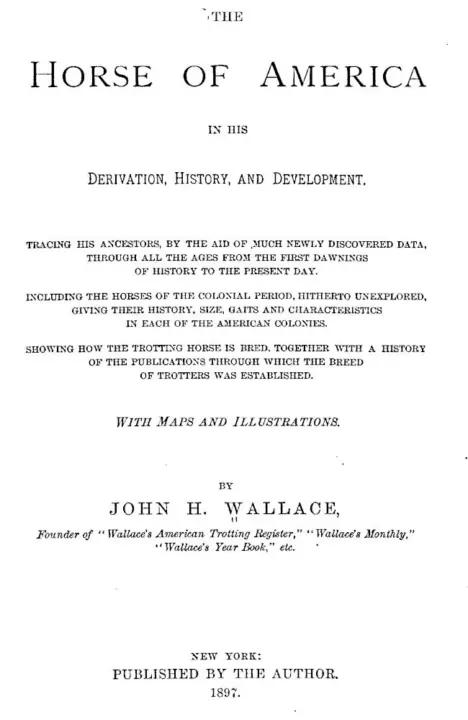
"The Horse of America in His Derivation, History, and Development" by John H. Wallace is a historical account written in the late 19th century. This work meticulously explores the lineage and evolution of the American horse, focusing particularly on its historical roots and development through the ages. Wallace seeks to challenge widely held misconceptions about horse breeds, particularly those concerning the renowned Arabian horse, while illuminating the largely neglected history of horses during the Colonial period in America. The opening of this work sets the stage for an extensive inquiry into the history and ancestry of American horses, emphasizing the author's desire to uncover facts about their lineage that have not been extensively documented before. Wallace introduces his examination by critiquing common narratives regarding the origins of the horse, dismissing the notion that the Arabian breed is superior and asserting that its actual influence on the American horse is minimal. He highlights that much of the existing knowledge surrounding horse history is founded on repetition of previous works, rather than original research. The author expresses satisfaction in the thorough research he has conducted into the equine ancestry and colonial history, intending to provide readers with a more accurate understanding of both the American trotter and the complexities of horse breeding.
Introduction adapted from the source catalogue; source summaries may be automatically generated.
Free to read · English · 251,000 words · No account needed
MAKE TIME FOR A GOOD BOOK
On by default. Untick to stop anonymous reading totals. Each page counts after 10 seconds in view. How this works.
Anonymous counting is on unless you have switched it off.
Just how great a loss this was to the trotting breed was not realized until long after—until in fact Goldsmith Maid had conquered all before her, and made a record as a campaigner never equaled, and until his two great sons, Almont and Belmont, rose to pre-eminent places in the list of great sires. Other sons of this remarkable progenitor have taken rank as sires, and his daughters proved of the highest excellence as brood mares; but Almont and Belmont have each established such large, important, and popular sub-families that this work would be incomplete without some brief sketch of each.
Alexander’s Abdallah got Goldsmith Maid, 2:14, Rosalind, 2:21⅔, Thorndale, 2:22¼, Major Edsall, 2:29, and St. Elmo, 2:30. Fourteen of his sons have produced one hundred and fifty-five standard performers, and twenty-nine of his daughters have produced forty-four standard performers, among them being the noted campaigners, Favonia, 2:15, and Jerome Eddy, 2:16⅔, the latter also a successful sire. The following table gives the families of his most prominent sons:
------------------------------------------------------------------------ Total No. produced in two generations. ------------------------------------------------------------------+ Standard performers produced by sons and daughters. | -----------------------------------------------------------+ | Producing daughters. | | -----------------------------------------------------+ | | Producing sons. | | | -----------------------------------------------+ | | | Standard performers. | | | | -----------------------------------------+ | | | | Year died. | | | | | ----------------------------------+ | | | | | Year foaled. | | | | | | ---------------------------+ | | | | | | Name. | | | | | | | ---------------------------+------+------+-----+-----+-----+------+----- Almont, 2:39¾ | 1864 | 1884 | 37 | 95 | 72 | 609 | 646 Belmont | 1864 | 1889 | 58 | 63 | 48 | 560 | 618 Hambletonian (Wood’s) | 1858 | 1885 | 24 | 12 | 13 | 49 | 73 Major Edsall, 2:29 | 1859 | 1886 | 3 | 6 | 3 | 87 | 90 Thorndale, 2:22¼ | 1865 | 1894 | 10 | 8 | 14 | 47 | 57 Jim Munro | 1861 | 1882 | 8 | 5 | 17 | 38 | 46 Abdallah Pilot | 1865 | 1881 | 3 | 1 | 1 | 17 | 20 ---------------------------+------+------+-----+-----+-----+------+-----
ALMONT was bred at Woodburn Farm, was foaled 1864, and was by Alexander’s Abdallah out of Sally Anderson, by Mambrino Chief; grandam Kate, a wonderfully fast pacer by Pilot Jr. Colonel R. P. Pepper informed me that he knew Kate as well as any of his own horses, and that her speed at the pace was “simply terrific.” Kate, whose dam was called the Pope mare, pedigree unknown, had several foals, among them the “catch filly” that was the dam of Clay Pilot, sire of The Moor, that got the great brood mare Beautiful Bells, 2:29½, and Sultan, 2:24, the sire of the world-famous Stamboul, 2:07½. Thus the blood of this pacing Pilot Jr. mare figures in three great sub-families, the Almont family, the Beautiful Bells family, and the Sultan family. Almont was a beautiful cherry bay, very rich in shade, and without any white whatever. He was fifteen hands two and one-quarter inches high at the wither, somewhat higher behind, and stoutly and symmetrically made all over. He could not be called a handsome or highly finished horse, but he was emphatically a well-made one. He had very excellent feet and legs, and these he reproduced with great uniformity, as well as his very intelligent and even disposition. He was trained early at Woodburn, and, like his sire, started but once and distanced his competitor in 2:39¾, this being in his four-year-old form. He soon after showed 2:32 over the slow Woodburn track, and was sold to the late Colonel Richard West for eight thousand dollars and put in the stud. In 1874 the late General W. T. Withers, Lexington, Kentucky, bought him for fifteen thousand dollars, and a half dozen of years later he was very generally regarded as the greatest of living sires, and his prestige made the name of Fairlawn Farm of world-wide renown, and made his owner rich. The fact that ninety-five of his sons have sired standard performers, a greater number of producing sons than is to the credit of any other horse, Hambletonian alone excepted, indicates the high rank Almont must be accorded as a progenitor. In considering his success it is well for breeders particularly to note that good judges considered Almont capable of showing a 2:20 gait any day, and that, like Electioneer, he always was daily given regular and ample track exercise. His gait has been described as bold and open, without an excess of knee action, but with immense display of power behind. Almont died of spasmodic colic, July 4, 1884, in the fullness of his fame, and at an age when, had he been more discreetly used in the stud, he should have been at his prime as a stock horse.
Your reading position is saved on this browser. Take it to another device with a library code. Reading pages adapt to text, rather than matching a printed edition.
BEHIND THE BOOK
This eBook is for the use of anyone anywhere in the United States and most other parts of the world at no cost and with almost no restrictions whatsoever. You may copy it, give it away or re-use it under the terms of the Project Gutenberg License included with this eBook or online at www.gutenberg.org. If you are not located in the United States, you will have to check the laws of the country where you are located before using this eBook. Read the source licence.
The original source file, including credits and licence, is retained by this library. Request an original-format copy at no charge. Please include the book title and Project Gutenberg identifier #62972.
KEEP YOUR CURIOSITY GOING
Cécile Tormay

Moritz Busch
John L. Ransom
Frances Wright
Cécile Tormay

Mabel Potter Daggett