THE CLASSIC COLLECTION✦An outlaw’s diary: the CommuneCLASSIC FREE BOOKS
An outlaw’s diary: the Commune
Cécile Tormay
THE CLASSIC COLLECTION · 1897
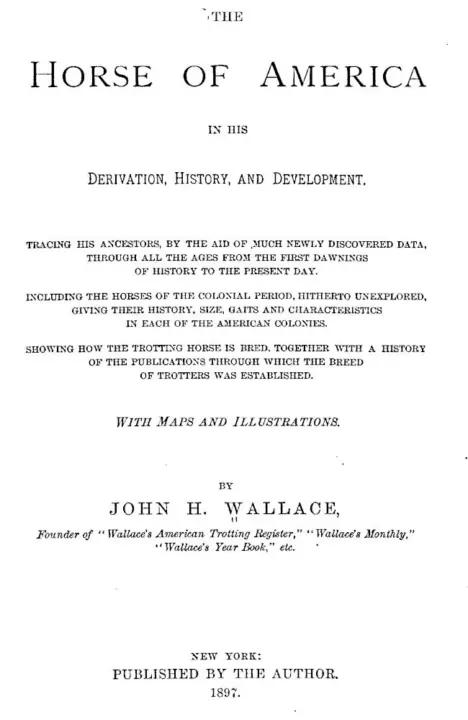
"The Horse of America in His Derivation, History, and Development" by John H. Wallace is a historical account written in the late 19th century. This work meticulously explores the lineage and evolution of the American horse, focusing particularly on its historical roots and development through the ages. Wallace seeks to challenge widely held misconceptions about horse breeds, particularly those concerning the renowned Arabian horse, while illuminating the largely neglected history of horses during the Colonial period in America. The opening of this work sets the stage for an extensive inquiry into the history and ancestry of American horses, emphasizing the author's desire to uncover facts about their lineage that have not been extensively documented before. Wallace introduces his examination by critiquing common narratives regarding the origins of the horse, dismissing the notion that the Arabian breed is superior and asserting that its actual influence on the American horse is minimal. He highlights that much of the existing knowledge surrounding horse history is founded on repetition of previous works, rather than original research. The author expresses satisfaction in the thorough research he has conducted into the equine ancestry and colonial history, intending to provide readers with a more accurate understanding of both the American trotter and the complexities of horse breeding.
Introduction adapted from the source catalogue; source summaries may be automatically generated.
Free to read · English · 251,000 words · No account needed
MAKE TIME FOR A GOOD BOOK
On by default. Untick to stop anonymous reading totals. Each page counts after 10 seconds in view. How this works.
Anonymous counting is on unless you have switched it off.
In considering this table it is necessary to remember that the Electioneer family dates from 1878, and that no family of anything approaching so late a date makes a showing that will bear comparison with this. In considering the rank of families this question of age is always vital. Electioneer’s first crop of foals at Palo Alto—1878—numbered seven, and of these two are represented above, while another was the famous gelding Fred Crocker. The next numbered but twenty-one, and of these Eros, Elector, and Anteeo are in the table, and ten are in the 2:20 list. His third and fourth crops (1880 and 1881) numbered sixteen and twenty-three respectively, and the forty of 1882 was the greatest number he ever got in one year. I am informed that in all Electioneer got less than four hundred foals at Palo Alto; and that, since the first one saw light in 1878 this family should in eighteen years make the showing it has with nearly fifty per cent. of its members in the 2:30 list, and four hundred and ninety-three of the second generation also there, is certainly remarkable. Electioneer has to his credit in the 2:15 list the following trotters: Arion, 2:07¾, Sunol, 2:08¼, Palo Alto, 2:08¾, Helena, 2:12½, Belleflower, 2:12¾, Utility, 2:13, Quality, 2:13¼, Conductor, 2:14¼, and Norval, 2:14¾, an “extreme speed list” greater than to the credit of any other sire, while among the get of his sons are such trotters as Azote, 2:04¾, Fantasy, 2:06, Little Albert, 2:10, Lynne Bel, 2:10½, Copeland, 2:11½, Athanio, 2:11¾, Cobwebs, 2:12, etc., etc. Sixty-five of his sons have sired four hundred and thirty-seven performers, and forty-three of his daughters have produced fifty-six performers. With all these facts kept in view the study of the above table will prove interesting and instructive in forming an estimate of the merit of Electioneer as a trotting progenitor.
ALEXANDER’S ABDALLAH was the founder of one of the very greatest of the Hambletonian sub-families, and he stands in the records as a progenitor of the first rank. This was a stout bay horse, about fifteen and one-half hands high. Excepting a right white ankle he was a rich solid bay. The only reliable portrait in existence of this horse was a drawing by Herbert Kittredge, made from a photograph taken of Abdallah after he went to Kentucky. The picture of Abdallah published in this work is a faithful reproduction of the Kittredge portrait published in Wallace’s Monthly for March, 1881, and in the absence of any reliable detailed description of the horse this portrait must be taken as the best reflection we now have of his individuality. He was bred by Lewis J. Sutton, of Warwick, Orange County, New York, and was foaled 1852. Mr. Sutton had in 1851 a good road mare that he had got at Carl Young’s roadhouse in Third Avenue, New York. This mare, Katy Darling, had been quite a trotter, and had, it was said, won a match race on Union Course. Her reputation as a trotter and her fine form caused Mr. Sutton to buy her when, as he describes it, “she was standing on three legs,” in the hope of getting a foal from her. He took her home in March, 1851, and in August bred her to Rysdyk’s Hambletonian, then a two-year-old colt, and September 22, 1852, she produced the subject of this sketch. Two years later Mr. Sutton sold Katy Darling to James W. Benedict, of Warwick, from whom she was purchased by Hezekiah Hoyt, who took her to Muscatine, Iowa, where she produced a chestnut colt that was gelded, by Hector, son of La Tourrett’s Bellfounder. This gelding was her only foal other than Alexander’s Abdallah, and Katy Darling died at Muscatine, the property of a Mr. Stewart. A search was long kept up for the pedigree of this mare, and for the full details of what is known of her history the reader is referred to the different volumes of Wallace’s Monthly. The conclusion from all the evidence found is that she was probably by a son of Andrew Jackson.
Your reading position is saved on this browser. Take it to another device with a library code. Reading pages adapt to text, rather than matching a printed edition.
BEHIND THE BOOK
This eBook is for the use of anyone anywhere in the United States and most other parts of the world at no cost and with almost no restrictions whatsoever. You may copy it, give it away or re-use it under the terms of the Project Gutenberg License included with this eBook or online at www.gutenberg.org. If you are not located in the United States, you will have to check the laws of the country where you are located before using this eBook. Read the source licence.
The original source file, including credits and licence, is retained by this library. Request an original-format copy at no charge. Please include the book title and Project Gutenberg identifier #62972.
KEEP YOUR CURIOSITY GOING
Cécile Tormay

Moritz Busch
John L. Ransom
Frances Wright
Cécile Tormay

Mabel Potter Daggett