THE CLASSIC COLLECTION✦An outlaw’s diary: the CommuneCLASSIC FREE BOOKS
An outlaw’s diary: the Commune
Cécile Tormay
THE CLASSIC COLLECTION · 1897
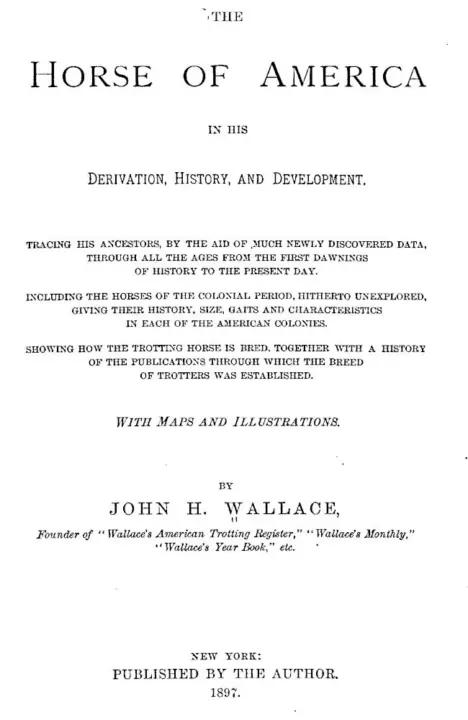
"The Horse of America in His Derivation, History, and Development" by John H. Wallace is a historical account written in the late 19th century. This work meticulously explores the lineage and evolution of the American horse, focusing particularly on its historical roots and development through the ages. Wallace seeks to challenge widely held misconceptions about horse breeds, particularly those concerning the renowned Arabian horse, while illuminating the largely neglected history of horses during the Colonial period in America. The opening of this work sets the stage for an extensive inquiry into the history and ancestry of American horses, emphasizing the author's desire to uncover facts about their lineage that have not been extensively documented before. Wallace introduces his examination by critiquing common narratives regarding the origins of the horse, dismissing the notion that the Arabian breed is superior and asserting that its actual influence on the American horse is minimal. He highlights that much of the existing knowledge surrounding horse history is founded on repetition of previous works, rather than original research. The author expresses satisfaction in the thorough research he has conducted into the equine ancestry and colonial history, intending to provide readers with a more accurate understanding of both the American trotter and the complexities of horse breeding.
Introduction adapted from the source catalogue; source summaries may be automatically generated.
Free to read · English · 251,000 words · No account needed
MAKE TIME FOR A GOOD BOOK
On by default. Untick to stop anonymous reading totals. Each page counts after 10 seconds in view. How this works.
Anonymous counting is on unless you have switched it off.
The first table following gives some idea of the supremacy of the Hambletonian family over all others. When we seek a rival to Hambletonian as a trotting progenitor we must do so among his sons; and by turning to the second table it will be noted that many of these outrank the founders of any and all the other great trotting families.
------------------------------------------------------------------------ Total No. Standard performers in two generations. ------------------------------------------------------------------+ Standard performers produced by sons and daughters. | -----------------------------------------------------------+ | Producing daughters. | | -----------------------------------------------------+ | | Producing sons. | | | -----------------------------------------------+ | | | Standard performers. | | | | -----------------------------------------+ | | | | Year died. | | | | | ----------------------------------+ | | | | | Year foaled. | | | | | | ---------------------------+ | | | | | | Name. | | | | | | | ---------------------------+------+------+-----+-----+-----+------+----- Hambletonian | 1849 | 1876 | 40 | 148 | 80 | 1665 | 1705 Blue Bull | 1858 | 1880 | 60 | 47 | 77 | 211 | 271 Mambrino Chief | 1844 | 1862 | 6 | 23 | 17 | 119 | 125 Ethan Allen | 1849 | 1876 | 6 | 22 | 18 | 118 | 124 Pilot Jr. | 1858 | 1865 | 8 | 6 | 18 | 72 | 80 George M. Patchen | 1849 | 1864 | 4 | 15 | 4 | 70 | 74 Champion (807) | 1853 | 1874 | 8 | 6 | 7 | 53 | 61 ---------------------------+------+------+-----+-----+-----+------+-----
In this table Ethan Allen is given as the representative of his family in preference to his sire, Black Hawk, the real founder, for the reasons that he was a far greater horse, and makes a better showing than his sire, and further because he was a contemporary of Hambletonian. For exactly the same reasons George M. Patchen is given as the representative progenitor of the Clay line.
The next table demonstrates what the Hambletonian family has done in the second and third generations, and the relative standing of the leading sub-families of the greatest trotting line. It embraces separately every sire that has to his own credit and to the credit of his sons and daughters an aggregate of fifty or more standard performers, twenty-three in all, while the totals to the credit of all the other sons of Hambletonian are grouped in the last line:
------------------------------------------------------------------------ Total No. Standard performers in two generations. ------------------------------------------------------------------+ Standard performers produced by sons and daughters. | -----------------------------------------------------------+ | Producing daughters. | | -----------------------------------------------------+ | | Producing sons. | | | -----------------------------------------------+ | | | Standard performers. | | | | -----------------------------------------+ | | | | Year died. | | | | | ----------------------------------+ | | | | | Year foaled. | | | | | | ---------------------------+ | | | | | | Name. | | | | | | | ---------------------------+------+------+-----+-----+-----+------+----- George Wilkes | 1856 | 1882 | 83 | 94 | 81 | 1801 | 1884 Electioneer | 1868 | 1890 | 154 | 65 | 43 | 493 | 647 Happy Medium | 1863 | 1888 | 92 | 51 | 47 | 272 | 364 Harold | 1864 | 1893 | 44 | 43 | 45 | 248 | 292 Dictator | 1863 | 1893 | 52 | 44 | 42 | 234 | 286 Volunteer | 1854 | 1888 | 34 | 40 | 48 | 221 | 255 Strathmore | 1866 | 1895 | 71 | 26 | 54 | 158 | 229 Abdallah (15) | 1852 | 1865 | 5 | 14 | 29 | 199 | 204 Aberdeen | 1866 | 1892 | 45 | 25 | 19 | 110 | 155 Egbert | 1875 | —— | 75 | 25 | 18 | 74 | 149 Messenger Duroc. | 1865 | 189- | 23 | 24 | 41 | 125 | 148 Edward Everett | 1855 | 1878 | 13 | 12 | 16 | 112 | 125 Administrator | 1863 | 1892 | 14 | 20 | 44 | 93 | 107 Jay Gould | 1864 | 1894 | 29 | 14 | 28 | 76 | 105 Victor Bismarck | 1867 | 189- | 31 | 13 | 13 | 64 | 95 Cuyler | 1868 | 1894 | 15 | 15 | 36 | 74 | 89 Masterlode | 1868 | 189- | 28 | 17 | 16 | 57 | 85 Sweepstakes | 1867 | 189- | 35 | 4 | 20 | 39 | 74 Sentinel | 1863 | 1873 | 8 | 9 | 14 | 57 | 65 Middletown | 1860 | 1891 | 14 | 9 | 11 | 49 | 63 Squire Talmage | 1866 | 1891 | 23 | 9 | 14 | 35 | 58 Dauntless | 1867 | 189- | 31 | 6 | 9 | 20 | 51 Echo | 1866 | 189- | 16 | 9 | 15 | 34 | 50 Other sons (125) | —— | —— | 618 | 229 | 412 | 980 | 1600 ---------------------------+------+------+-----+-----+-----+------+-----
This table shows what each horse himself produced, and how his blood is breeding on through his sons and daughters; and above all it demonstrates the stupendous fact that in three generations the Hambletonian family has produced upward of seven thousand standard performers, and all facts and all experience now beyond cavil justify what I ventured to declare in Wallace’s Monthly many years ago: “The Hambletonian line stands above all other lines and must survive because it is the fittest.”
Your reading position is saved on this browser. Take it to another device with a library code. Reading pages adapt to text, rather than matching a printed edition.
BEHIND THE BOOK
This eBook is for the use of anyone anywhere in the United States and most other parts of the world at no cost and with almost no restrictions whatsoever. You may copy it, give it away or re-use it under the terms of the Project Gutenberg License included with this eBook or online at www.gutenberg.org. If you are not located in the United States, you will have to check the laws of the country where you are located before using this eBook. Read the source licence.
The original source file, including credits and licence, is retained by this library. Request an original-format copy at no charge. Please include the book title and Project Gutenberg identifier #62972.
KEEP YOUR CURIOSITY GOING
Cécile Tormay

Moritz Busch
John L. Ransom
Frances Wright
Cécile Tormay

Mabel Potter Daggett