THE CLASSIC COLLECTION✦An outlaw’s diary: the CommuneCLASSIC FREE BOOKS
An outlaw’s diary: the Commune
Cécile Tormay
THE CLASSIC COLLECTION · 1897
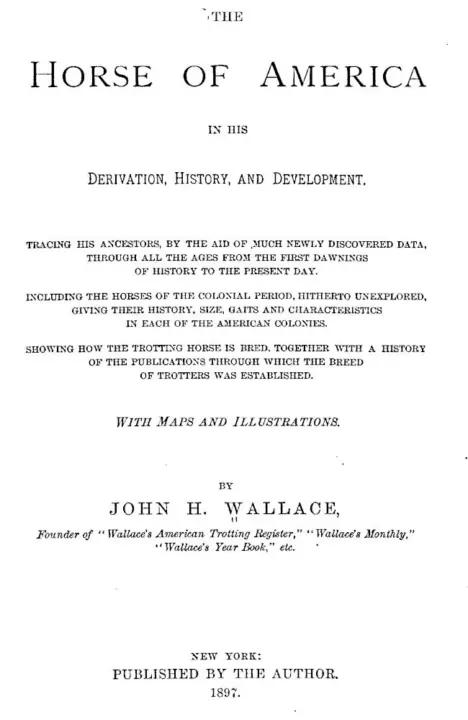
"The Horse of America in His Derivation, History, and Development" by John H. Wallace is a historical account written in the late 19th century. This work meticulously explores the lineage and evolution of the American horse, focusing particularly on its historical roots and development through the ages. Wallace seeks to challenge widely held misconceptions about horse breeds, particularly those concerning the renowned Arabian horse, while illuminating the largely neglected history of horses during the Colonial period in America. The opening of this work sets the stage for an extensive inquiry into the history and ancestry of American horses, emphasizing the author's desire to uncover facts about their lineage that have not been extensively documented before. Wallace introduces his examination by critiquing common narratives regarding the origins of the horse, dismissing the notion that the Arabian breed is superior and asserting that its actual influence on the American horse is minimal. He highlights that much of the existing knowledge surrounding horse history is founded on repetition of previous works, rather than original research. The author expresses satisfaction in the thorough research he has conducted into the equine ancestry and colonial history, intending to provide readers with a more accurate understanding of both the American trotter and the complexities of horse breeding.
Introduction adapted from the source catalogue; source summaries may be automatically generated.
Free to read · English · 251,000 words · No account needed
MAKE TIME FOR A GOOD BOOK
On by default. Untick to stop anonymous reading totals. Each page counts after 10 seconds in view. How this works.
Anonymous counting is on unless you have switched it off.
These letters are conclusive, so far as the region of the Las Animas is concerned, and with that region knocked out there is not enough left to justify further search for evidence that the prehistoric races had any knowledge of the horse. Nothing remained then but the linguistic test, and in 1885 I had such an opportunity for applying this test as may never occur again. This test formulated itself in my mind, in this shape: “Did any of the nations or tribes of the aboriginal inhabitants of this continent have a word in their language indicating a horse?” When in California I applied to Mr. Bancroft, the compiler and publisher of the great documentary history of the Pacific coast, who then had a large corps of skilled translators at work on his famous compilation, and submitted my question. He introduced me to his principal linguist, who knew not only Spanish, English and other modern languages, but also the language of the Indians of the coast, the mountains and the plains, of the period covered by the question. The question did not seem to be new to him, and he answered with the candor and conscientiousness of a man who knew what he was saying, that there was no word in any of the Indian tongues, ancient or modern, that represented the horse. This settled the question of the supposed prehistoric character and rank of the horse, and we are thus driven to accept the infinitesimally small number left behind by Cortez, Nunez and De Soto as the seed from which sprang the countless thousands of wild horses that for generations roamed the Western plains.
The story of the Conquest of Mexico is full of blood and cruelty, but as we have nothing to do with any part of the story except so much of it as relates to the introduction of the horse to the continent of North America, it will require but small space to tell it. Cortez sailed from Cuba for Yucatan, February, 1519, with an army of six hundred and sixty-three men, two hundred Indians and sixteen horses. This wholly inadequate supply of cavalry was the weak place in his venture, but the horses could not be had in Cuba, without paying an incredible price. Those he was able to secure cost from four to five hundred pesos de oro each. The peso was the Spanish dollar. The expedition was nominally fitted out for Yucatan, but its real aim was the heart of Mexico. In his first fight with the Indians near the coast, men mounted on horses were feared by the natives as monstrous apparitions. This overwhelming fear of the horse may seem to some of my readers as overdone by the historian, but it seems to have been the common experience of all the different nations and tribes of Indians wherever the horse made his first appearance in battle. In the first battle two of the horses were killed, and in the second another was killed, and all that remained were more or less severely wounded. Cortez was afterward joined by Alvarado, at Vera Cruz, with twenty horses and one hundred and fifty men. In making his official reports directly to the home government in Spain instead of the governor of Cuba, Cortez gave mortal offense to that dignitary, and he sent out an armada under Narvaez to supersede Cortez and return him in chains to Cuba. This armada consisted of eighteen vessels, carrying nine hundred men, eighty of whom were cavalry. After some diplomacy, Cortez, feeling that with his little handful of men he was wholly unable to meet Narvaez, he did all he could to avoid a conflict. Each party knew the exact strength of the other, and as Narvaez began to threaten, Cortez determined to fight for his rights and his liberty. He then had but five men mounted, but he took advantage of the carelessness of his adversary, made a night attack in the midst of a tempest, and captured Narvaez and his whole army. The private soldiers of that day, like their commanders, had no idea or principle to fight for except for plunder, and they were always ready to attach themselves to the most successful robber. Cortez was their ideal leader, and at once he had a new army of devoted followers. He then had eighty-five mounted men, and he felt strong enough to hold and rule the great country he had conquered. Mexico was conquered in 1521, and the news of the vast amount of treasure captured brought a great crowd of emigrants from Spain and from all her dominions. The Spaniards, like other nations of Southern Europe, kept their horses entire and whenever representatives of both sexes strayed away, reproduction would follow. As the country became more tranquil, and as the tide of European settlers kept pouring in, we can easily understand how the little bands of estrays should grow into larger bands and soon become as wild as though they had never seen a human being except to flee from him.
Your reading position is saved on this browser. Take it to another device with a library code. Reading pages adapt to text, rather than matching a printed edition.
BEHIND THE BOOK
This eBook is for the use of anyone anywhere in the United States and most other parts of the world at no cost and with almost no restrictions whatsoever. You may copy it, give it away or re-use it under the terms of the Project Gutenberg License included with this eBook or online at www.gutenberg.org. If you are not located in the United States, you will have to check the laws of the country where you are located before using this eBook. Read the source licence.
The original source file, including credits and licence, is retained by this library. Request an original-format copy at no charge. Please include the book title and Project Gutenberg identifier #62972.
KEEP YOUR CURIOSITY GOING
Cécile Tormay

Moritz Busch
John L. Ransom
Frances Wright
Cécile Tormay

Mabel Potter Daggett