THE CLASSIC COLLECTION✦An outlaw’s diary: the CommuneCLASSIC FREE BOOKS
An outlaw’s diary: the Commune
Cécile Tormay
THE CLASSIC COLLECTION · 1897
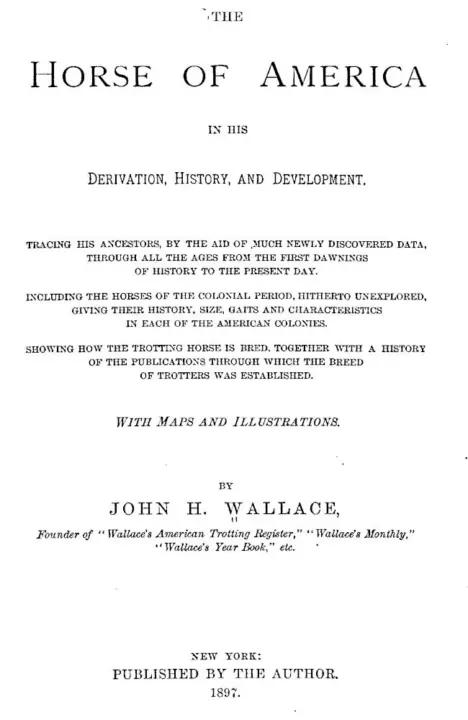
"The Horse of America in His Derivation, History, and Development" by John H. Wallace is a historical account written in the late 19th century. This work meticulously explores the lineage and evolution of the American horse, focusing particularly on its historical roots and development through the ages. Wallace seeks to challenge widely held misconceptions about horse breeds, particularly those concerning the renowned Arabian horse, while illuminating the largely neglected history of horses during the Colonial period in America. The opening of this work sets the stage for an extensive inquiry into the history and ancestry of American horses, emphasizing the author's desire to uncover facts about their lineage that have not been extensively documented before. Wallace introduces his examination by critiquing common narratives regarding the origins of the horse, dismissing the notion that the Arabian breed is superior and asserting that its actual influence on the American horse is minimal. He highlights that much of the existing knowledge surrounding horse history is founded on repetition of previous works, rather than original research. The author expresses satisfaction in the thorough research he has conducted into the equine ancestry and colonial history, intending to provide readers with a more accurate understanding of both the American trotter and the complexities of horse breeding.
Introduction adapted from the source catalogue; source summaries may be automatically generated.
Free to read · English · 251,000 words · No account needed
MAKE TIME FOR A GOOD BOOK
On by default. Untick to stop anonymous reading totals. Each page counts after 10 seconds in view. How this works.
Anonymous counting is on unless you have switched it off.
The surprise of the Englishman at finding no pacers in South America seems to have been as great as that of the Italian at finding so many of them in England, one hundred years earlier. These horses were strictly Spanish, and probably were descended from those brought from Palos in 1493 by Columbus, the first horses that ever crossed the Atlantic. The “one little fiddling nag” that showed some kind of a pacing gait may have been of English blood and captured from some English expedition, several of which were unfortunate; or his failure to trot may have been the result of an injury. It should not be forgotten that in that period every sea captain was out for what he could capture, and this was especially the case as between the English and the Spanish. These are the outlines of the principal points of evidence that the pacing habit of action came from the North and not from the South. That there were pacers in both Greece and Rome before the Christian era, and perhaps later, there can be no doubt, for they were both overrun and devastated again and again by the hordes of Northern Barbarians, bringing their flocks and their herds and their families, as well as their horses, with them.
This question naturally suggests itself here: “If the English pacer had been the popular favorite of the English people for so many centuries, how did it come that he and his habit of action had been so completely wiped out in one century, the seventeenth?” This question might be answered in very few words, by saying the people thought they were getting something better to put in his place. In reaching this conclusion I will not pretend to say the judgment of the people was not right, that is, if they exercised any judgment in the case. “Jamie the Scotsman” when on the throne set the fashion in the direction of foreign blood by paying the enormous price of five hundred pounds for the Markham Arabian. The Duke of Newcastle, when he was young, had personally seen this horse, and while he thought he was a true Arabian, he described him as a very ordinary horse in his size and form, and an entire failure as a race horse. It seems that any average native pacer could outrun him, but he carried the badge of royalty, and that was sufficient to make him fashionable, as he was not only the king’s horse, but was himself a royal Arabian. The weak place in the character of James I., in addition to his intolerable pedantry, was his inordinate ambition to be considered the wisest sovereign who ever sat upon a throne since the days of Solomon. His courtiers, nobility, and all who approached him understood his weakness, and a little quiet praise of the great superiority of the Arabian blood in the horse, over all other breeds and varieties, was always grateful to the monarch, for he was the original discoverer and patentee of that blood. Then and there, in order to praise the wisdom of a foolish king, a foolish fashion grew into a foolish notion that has afflicted all England from that day to this. No humbug of either ancient or modern times has had so long a run and so wide a range as the miserable fallacy “that all excellence in the horse comes from the Arabian.” Notwithstanding the thousand tests that have been made and the thousand failures that have invariably followed, from the time of King James to the present day, there are still men writing books and magazine articles on the assumption that “all excellence in the horse comes from the Arabian,” without ever having devoted an honest hour to the study of the question as to whether this is a truth or a fallacy. This craze for Arabian blood was the primary cause of the extinction of the pacer, and this craze was so strong in its influence that when a foreign horse was brought in, no difference from what country, if he were of the lighter type he was called an Arabian and so advertised in order to secure the patronage of breeders. Horses brought from the African coast were invariably classed as Arabians, notwithstanding they and their ancestors were in Africa more than a thousand years before there were any horses in Arabia; and the same may be said of Spain. But as this line of inquiry has already been considered in another chapter, I will get back to the immediate topic.
Your reading position is saved on this browser. Take it to another device with a library code. Reading pages adapt to text, rather than matching a printed edition.
BEHIND THE BOOK
This eBook is for the use of anyone anywhere in the United States and most other parts of the world at no cost and with almost no restrictions whatsoever. You may copy it, give it away or re-use it under the terms of the Project Gutenberg License included with this eBook or online at www.gutenberg.org. If you are not located in the United States, you will have to check the laws of the country where you are located before using this eBook. Read the source licence.
The original source file, including credits and licence, is retained by this library. Request an original-format copy at no charge. Please include the book title and Project Gutenberg identifier #62972.
KEEP YOUR CURIOSITY GOING
Cécile Tormay

Moritz Busch
John L. Ransom
Frances Wright
Cécile Tormay

Mabel Potter Daggett