THE CLASSIC COLLECTION✦An outlaw’s diary: the CommuneCLASSIC FREE BOOKS
An outlaw’s diary: the Commune
Cécile Tormay
THE CLASSIC COLLECTION · 1897
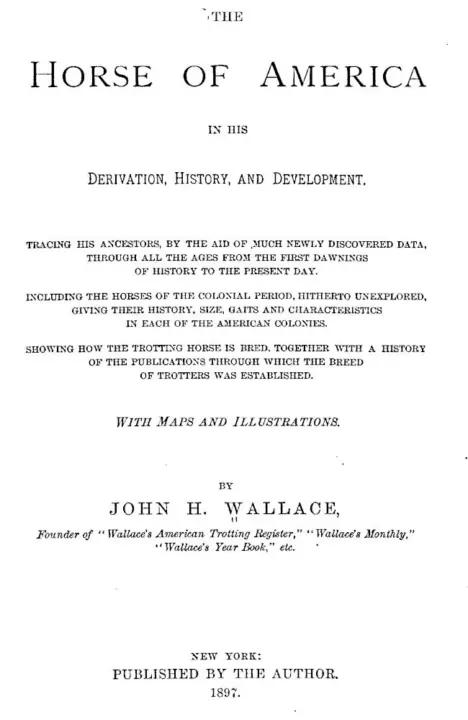
"The Horse of America in His Derivation, History, and Development" by John H. Wallace is a historical account written in the late 19th century. This work meticulously explores the lineage and evolution of the American horse, focusing particularly on its historical roots and development through the ages. Wallace seeks to challenge widely held misconceptions about horse breeds, particularly those concerning the renowned Arabian horse, while illuminating the largely neglected history of horses during the Colonial period in America. The opening of this work sets the stage for an extensive inquiry into the history and ancestry of American horses, emphasizing the author's desire to uncover facts about their lineage that have not been extensively documented before. Wallace introduces his examination by critiquing common narratives regarding the origins of the horse, dismissing the notion that the Arabian breed is superior and asserting that its actual influence on the American horse is minimal. He highlights that much of the existing knowledge surrounding horse history is founded on repetition of previous works, rather than original research. The author expresses satisfaction in the thorough research he has conducted into the equine ancestry and colonial history, intending to provide readers with a more accurate understanding of both the American trotter and the complexities of horse breeding.
Introduction adapted from the source catalogue; source summaries may be automatically generated.
Free to read · English · 251,000 words · No account needed
MAKE TIME FOR A GOOD BOOK
On by default. Untick to stop anonymous reading totals. Each page counts after 10 seconds in view. How this works.
Anonymous counting is on unless you have switched it off.
In old newspapers, advertisements, etc., we sometimes come across “Esopus Horses, Esopus Mares,” and, for years, I was not able to tell what this term meant. The locality of Kingston was originally called Esopus, and in that neighborhood there were several farmers who bred horses largely, at an early day in the history of the colony, and the locality became famous for the character and quality of the horses produced there. They were of the best and purest Dutch blood, and for what we would call “all-purpose horses” their fame was very wide in that day. Hence I infer that the term “Esopus” was used to indicate what was considered the best type of Dutch horses. There is danger of going astray in the meaning of the term “Dutch horses,” as in later times it was applied to the great, massive draft horses of Pennsylvania. They were better “for agricultural purposes,” as Van der Donck puts it, than the Connecticut horses, because they were larger and stronger, but they were sprightly and active and some of them could run very well. They had a fine reputation in the adjoining colonies.
New Amsterdam, and consequently all the plantations in New Netherlands, surrendered to Colonel Nicolls, commanding the British forces, August 27, 1664. Colonel Nicolls remained as governor of the colony three or four years and until he was succeeded by Governor Lovelace. Among his early official acts, Governor Nicolls laid out a race course on Hempstead Plains, and named it Newmarket, after the famous course in England. No engineering or grading was necessary, as nature had already made a perfect course without stick or stone or other obstruction. The first race was run 1665, and although it was a long distance from the city, the presence of the governor gave the occasion prestige and there was a great gathering of the gentry from town, and the farmers of Long Island. These meetings were kept up annually by the appointment of succeeding governors, and after a time they were held twice a year, spring and fall. There are some very important facts about these races that are not known and probably never will be known, namely, who were the nominators and what breed of horses were entered in these contests. With these two essential facts left out the value of the information is greatly impaired. As it is known, however, that there were but two breeds or types of horses that could have been engaged in these contests, it becomes a matter of interest to reach a conclusion as to which were the victors. Mr. John Austin Stevens has done some very excellent work on this part of the horse history of New York, but I cannot agree with him in his characterization of the Dutch horses as being Flemish. They did not come from Flanders, but from Utrecht. They were not great unwieldy brutes, such as we would associate with Flanders, but hardy, compact animals that could make their way in the wilderness. Although larger, it does not follow that they could not run as fast or even faster than the New England ponies. All breeds of horses were very much smaller two hundred years ago than they are now. These races were instituted, evidently, for the improvement of the breed of horses in the colony, and the great majority of these horses were the descendants of the original stock brought from Utrecht. We must, therefore, conclude that they were not slow, heavy, unwieldy animals with no action, as the language of Mr. Stevens would seem to imply, but capable of improvement in the direction of speed. No doubt there were very many New England horses in the colony, “lighter and better adapted to the saddle,” but neither the interests nor the pride of the old Dutch settlers would have permitted them to support racing for a period of more than eighty years, unless the early Utrecht blood was represented. Besides this, the weights carried, one hundred and forty pounds, and the distance, generally two-mile heats, were conditions that were strongly against the New Englanders, even if they were lighter of foot. With these two breeds in the field, we may accept it as an inevitable sequence that the superior qualities of the one would very soon be engrafted on the other, and by this process of breeding, a better type would be produced than either of the originals. This first step was only a prelude to the next, and that again to the next, until the common, plain lesson was thoroughly learned, that if a running horse was wanted the way to get him was to breed to a running horse that had proved he was a running horse. The improvement became very wide and general, and occasionally an animal was produced with such phenomenal speed that he was barred from stakes and purses. On this foundation, and this alone, the running turf was built up and continued for about eighty years, with occasional intervals, when the gamblers made it so nasty that no decent people would go near it.
Your reading position is saved on this browser. Take it to another device with a library code. Reading pages adapt to text, rather than matching a printed edition.
BEHIND THE BOOK
This eBook is for the use of anyone anywhere in the United States and most other parts of the world at no cost and with almost no restrictions whatsoever. You may copy it, give it away or re-use it under the terms of the Project Gutenberg License included with this eBook or online at www.gutenberg.org. If you are not located in the United States, you will have to check the laws of the country where you are located before using this eBook. Read the source licence.
The original source file, including credits and licence, is retained by this library. Request an original-format copy at no charge. Please include the book title and Project Gutenberg identifier #62972.
KEEP YOUR CURIOSITY GOING
Cécile Tormay

Moritz Busch
John L. Ransom
Frances Wright
Cécile Tormay

Mabel Potter Daggett