THE CLASSIC COLLECTION✦An outlaw’s diary: the CommuneCLASSIC FREE BOOKS
An outlaw’s diary: the Commune
Cécile Tormay
THE CLASSIC COLLECTION · 1897
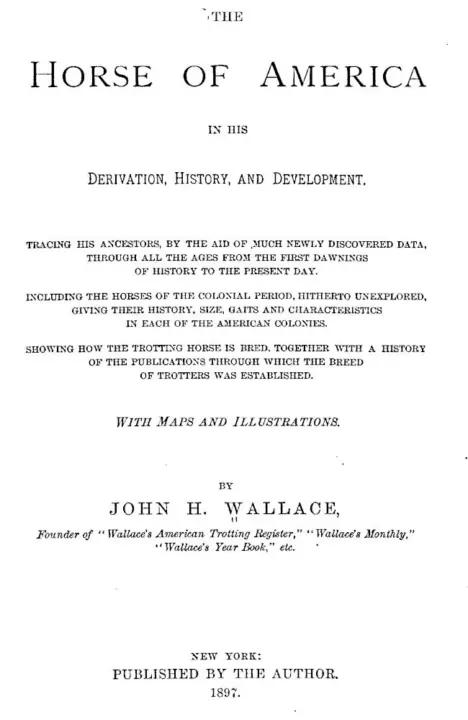
"The Horse of America in His Derivation, History, and Development" by John H. Wallace is a historical account written in the late 19th century. This work meticulously explores the lineage and evolution of the American horse, focusing particularly on its historical roots and development through the ages. Wallace seeks to challenge widely held misconceptions about horse breeds, particularly those concerning the renowned Arabian horse, while illuminating the largely neglected history of horses during the Colonial period in America. The opening of this work sets the stage for an extensive inquiry into the history and ancestry of American horses, emphasizing the author's desire to uncover facts about their lineage that have not been extensively documented before. Wallace introduces his examination by critiquing common narratives regarding the origins of the horse, dismissing the notion that the Arabian breed is superior and asserting that its actual influence on the American horse is minimal. He highlights that much of the existing knowledge surrounding horse history is founded on repetition of previous works, rather than original research. The author expresses satisfaction in the thorough research he has conducted into the equine ancestry and colonial history, intending to provide readers with a more accurate understanding of both the American trotter and the complexities of horse breeding.
Introduction adapted from the source catalogue; source summaries may be automatically generated.
Free to read · English · 251,000 words · No account needed
MAKE TIME FOR A GOOD BOOK
On by default. Untick to stop anonymous reading totals. Each page counts after 10 seconds in view. How this works.
Anonymous counting is on unless you have switched it off.
Mr. Cadwallader R. Colden, of New York, commenced the publication of another sporting magazine, that was of very great merit, and did much to correct some of the errors that abounded in Mr. Skinner’s publication. In the controversies which naturally sprang up he had greatly the advantage of his adversary, for he knew horse history and Mr. Skinner did not. Mr. Colden was a man of marked ability, and over the signature of “An Old Turfman” he made himself famous as a writer. He hated a fraud and wherever he saw one he did not hesitate to hit it. His publication was a large and expensive one, racing was then under the periodical interdict of public opinion, and after about two or three years, and greatly to the loss and misfortune of the truths of horse history, the publication was discontinued. The weekly press had no representative in the field of “horse literature and sporting subjects” until early in the thirties, when the Spirit of the Times was founded by William T. Porter. The conception of a weekly paper devoted to all kinds of sports, such as hunting, fishing, racing, gaming, etc., was not only new in this country, but it was brilliant. Mr. Porter was not only a gentleman in his appearance and manners, but he had fine social qualities and was a writer of ability and polish. Such a personage would naturally gather about him friends and correspondents that were congenial, and very soon The Spirit of the Times became noted as the organ of a great body of educated men who loved sport and enjoyed wit. It was the only publication of its kind on the continent, and it soon obtained a very wide circulation. Mr. Porter knew very little of horses, either theoretically or practically, but he was a ready adapter and wrote some fine descriptions of famous racing contests. His habits were sportive rather than industrious, hence he left nothing behind him of value to his friends or to the world except the mere fact that he was the founder of the first sporting paper in this country. In course of time the paper with all its belongings became the property of John Richards, the former pressman, and Mr. Porter had to look for a living wherever he could find it. Mr. George Wilkes then took him under his wing, and started a new sporting paper called Porter’s Spirit of the Times. The use of this name carried with it the support of a good many friends, but as he was not able to write anything, practically, for the new paper, from its very commencement in September, 1856, it failed to yield any support to Mr. Porter, and not much to Mr. Wilkes and his partners. Litigation arose and Mr. Wilkes finally withdrew from Porter’s Spirit of the Times, and started Wilkes’ Spirit of the Times in September, 1859. We then had three sporting papers all claiming to be the original and only legitimate Spirit of the Times. Among their readers they were distinguished as the Old Spirit, Porter’s Spirit, and Wilkes’ Spirit. The circulation of the Old Spirit was largely in the Southern States, and the war destroyed it, in 1861. Porter’s Spirit having but little money and still less brains, died about the same time. This left Mr. Wilkes in open possession of the field, and his remarkably trenchant articles on the conduct of the war gave Wilkes’ Spirit of the Times a very wide circulation, even among those who cared nothing for sporting matters. At the same time he was fortunate in securing the services of Mr. Charles J. Foster, an able writer on horse subjects, and a very industrious and capable man in managing and discussing affairs connected with the horse. Some years later, Mr. Wilkes dropped his own name from the title of his paper, and not long afterward he added twenty-five or thirty years to its age by changing the numbers so as to cover the period of the original Spirit of the Times founded by William T. Porter. The old sporting publications, one and all, maintained the view, so far as they ever had any view to maintain, that all that was of any value in the American horse, for whatever purpose, had come down to us from the Arabian through the English race horse. Their value, therefore, consists wholly in the naked statistics which they contain.
Your reading position is saved on this browser. Take it to another device with a library code. Reading pages adapt to text, rather than matching a printed edition.
BEHIND THE BOOK
This eBook is for the use of anyone anywhere in the United States and most other parts of the world at no cost and with almost no restrictions whatsoever. You may copy it, give it away or re-use it under the terms of the Project Gutenberg License included with this eBook or online at www.gutenberg.org. If you are not located in the United States, you will have to check the laws of the country where you are located before using this eBook. Read the source licence.
The original source file, including credits and licence, is retained by this library. Request an original-format copy at no charge. Please include the book title and Project Gutenberg identifier #62972.
KEEP YOUR CURIOSITY GOING
Cécile Tormay

Moritz Busch
John L. Ransom
Frances Wright
Cécile Tormay

Mabel Potter Daggett