THE CLASSIC COLLECTION✦An outlaw’s diary: the CommuneCLASSIC FREE BOOKS
An outlaw’s diary: the Commune
Cécile Tormay
THE CLASSIC COLLECTION · 1897
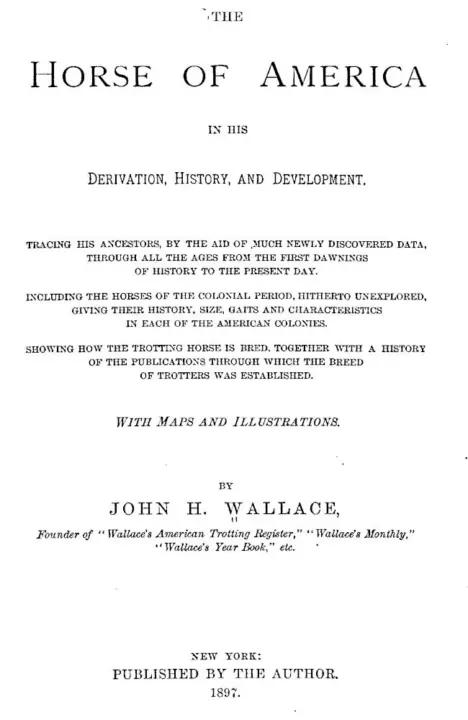
"The Horse of America in His Derivation, History, and Development" by John H. Wallace is a historical account written in the late 19th century. This work meticulously explores the lineage and evolution of the American horse, focusing particularly on its historical roots and development through the ages. Wallace seeks to challenge widely held misconceptions about horse breeds, particularly those concerning the renowned Arabian horse, while illuminating the largely neglected history of horses during the Colonial period in America. The opening of this work sets the stage for an extensive inquiry into the history and ancestry of American horses, emphasizing the author's desire to uncover facts about their lineage that have not been extensively documented before. Wallace introduces his examination by critiquing common narratives regarding the origins of the horse, dismissing the notion that the Arabian breed is superior and asserting that its actual influence on the American horse is minimal. He highlights that much of the existing knowledge surrounding horse history is founded on repetition of previous works, rather than original research. The author expresses satisfaction in the thorough research he has conducted into the equine ancestry and colonial history, intending to provide readers with a more accurate understanding of both the American trotter and the complexities of horse breeding.
Introduction adapted from the source catalogue; source summaries may be automatically generated.
Free to read · English · 251,000 words · No account needed
MAKE TIME FOR A GOOD BOOK
On by default. Untick to stop anonymous reading totals. Each page counts after 10 seconds in view. How this works.
Anonymous counting is on unless you have switched it off.
Out of this list of thirty-five or forty so-called Arabian horses, there is one that requires special mention, not only because a correction may be made in his history, but because I have frequently spoken of him as the only Arabian that had left any mark upon the horse stock of the country. Lindsay’s Arabian, as he was called, was a grey horse and represented to be over fifteen hands high. The story is that he was a Barb and had been presented to the commander of a British man-of-war, when a colt, by the ruler of one of the Barbary States, as an expression of gratitude to the captain for having saved the life of his son. The captain sailed away for a South American port, and while lying there he took his present ashore to let him have a little exercise. The colt was given the free range of a lumber-yard, as the story goes, and in his playfulness a pile of lumber fell upon him and broke three of his legs. The British officer was greatly grieved at his loss and proposed to put the colt out of misery by knocking him on the head. There happened to be an American trading vessel in port and the skipper “allowed if he had that critter on his vessel he could save him.” The officer at once gave him to the skipper and told him his history. Yankee ingenuity and thrift soon got him aboard the trader and he was swung up and his legs properly bandaged. The surgical treatment was good, the bones knit, and in due time the vessel arrived at New London, and the colt was taken to the vicinity of Hartford. Just where this story originated it is not possible now to say, nor do I know that it ever had currency in Connecticut, but it was certainly rehearsed and probably believed in Maryland. He was owned by Colonel Wyllis of Hartford, and was advertised in 1770 under the single name of Ranger, and described as “a fine English stallion of the Barbary breed, bred in England.” From this it would appear that nothing was then known of his romantic history. As a part of his Maryland history it was said that General Washington’s attention had been attracted to a body of Connecticut cavalry by the excellence of their horses, and at his instance Captain Lindsay bought Ranger, because he was the sire of many of those horses, and took him to Maryland, where he was ever afterward known as “Lindsay’s Arabian.” The story of the indorsement of Washington made an excellent stallion card, and it is not necessary that we should inquire into it too closely, for the dates might raise a question. The horse passed from Colonel Wyllis to James Howard, of Windham, and was advertised by him as “The Imported Arabian Horse called The Ranger to stand at his stable the season of 1778.” Hence we must conclude that he was not taken to the South before the season of 1779, or possibly later. Then, as now, to catch the popular fancy, North and South, the horse is no longer an “English stallion of the Barbary breed” but an “Imported Arabian Horse.” His cross was well esteemed in his day, and it has held its place in the estimation of all the experienced horsemen as a good cross in an old pedigree. We now see that he was bred in England, that he was got by a Barb horse or the son of a Barb horse, and that it is not probable there was a single drop of Arabian blood in his veins. This little sketch will serve to illustrate the methods, general and particular, that were invariably used to place a fictitious value upon the so-called imported “Arabians.” In no other department of human knowledge has there been such a universal and persistent habit of misrepresenting the truth of history as in matters relating to the horse. It seems to have been, and still is, a kind of psychical contagion that has been generating dishonesty and a habit of lying in the minds of the great body of horsemen for the past two hundred and fifty years. If a horse is brought from Turkey, or Syria, or Egypt, or Spain, or Morocco, or any of the Barbary States, he is at once called an “Arabian.” This is worse than a misnomer, for it is an essential untruth, and its universal use does not redeem it from its essence of deception and fraud. It must be conceded, however, that this deception may have sprung from bad teaching and ignorance rather than from a depraved moral sense, for many people, as well as the poets and the novelists, may have concluded that as the nations named above got their religion from Arabia, so they got their horse stock from the same country, and thus the horses brought from Turkey, or Syria, or Egypt, or Spain, or Morocco, or any of the Barbary States, are descendants of the Arabian horse and thus entitled to the name “Arabian.” This seems to be the only theory upon which this universal misrepresentation can be palliated. Let us repeat a sentence or two here, to show what history reveals on this point. Strabo says there were no horses in Arabia at the beginning of the Christian era. Philostorgius says that in the year 356, two hundred “well-bred” Cappadocian horses were sent as a present to the prince of Yemen, by the Emperor Constantius. These were the first horses in Arabia. In the days of Mohammed horses were exceedingly scarce in Arabia, and they have remained so to the present time. The horse is an expensive exotic in Arabia, as he is never used for any domestic purpose, nor for any other purpose except robbery or display. For all domestic and commercial uses the camel is far better. All the countries named above were abundantly supplied with horses, at least eight hundred or a thousand years before there were any horses in Arabia. The Moslems got their religion from Arabia, but not their horses. This topic is more fully discussed in the chapter on the Arabian horse.
Your reading position is saved on this browser. Take it to another device with a library code. Reading pages adapt to text, rather than matching a printed edition.
BEHIND THE BOOK
This eBook is for the use of anyone anywhere in the United States and most other parts of the world at no cost and with almost no restrictions whatsoever. You may copy it, give it away or re-use it under the terms of the Project Gutenberg License included with this eBook or online at www.gutenberg.org. If you are not located in the United States, you will have to check the laws of the country where you are located before using this eBook. Read the source licence.
The original source file, including credits and licence, is retained by this library. Request an original-format copy at no charge. Please include the book title and Project Gutenberg identifier #62972.
KEEP YOUR CURIOSITY GOING
Cécile Tormay

Moritz Busch
John L. Ransom
Frances Wright
Cécile Tormay

Mabel Potter Daggett