THE CLASSIC COLLECTION✦An outlaw’s diary: the CommuneCLASSIC FREE BOOKS
An outlaw’s diary: the Commune
Cécile Tormay
THE CLASSIC COLLECTION · 1897
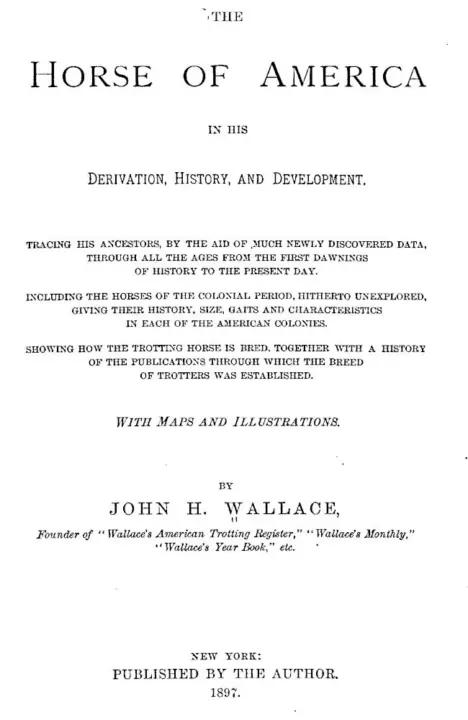
"The Horse of America in His Derivation, History, and Development" by John H. Wallace is a historical account written in the late 19th century. This work meticulously explores the lineage and evolution of the American horse, focusing particularly on its historical roots and development through the ages. Wallace seeks to challenge widely held misconceptions about horse breeds, particularly those concerning the renowned Arabian horse, while illuminating the largely neglected history of horses during the Colonial period in America. The opening of this work sets the stage for an extensive inquiry into the history and ancestry of American horses, emphasizing the author's desire to uncover facts about their lineage that have not been extensively documented before. Wallace introduces his examination by critiquing common narratives regarding the origins of the horse, dismissing the notion that the Arabian breed is superior and asserting that its actual influence on the American horse is minimal. He highlights that much of the existing knowledge surrounding horse history is founded on repetition of previous works, rather than original research. The author expresses satisfaction in the thorough research he has conducted into the equine ancestry and colonial history, intending to provide readers with a more accurate understanding of both the American trotter and the complexities of horse breeding.
Introduction adapted from the source catalogue; source summaries may be automatically generated.
Free to read · English · 251,000 words · No account needed
MAKE TIME FOR A GOOD BOOK
On by default. Untick to stop anonymous reading totals. Each page counts after 10 seconds in view. How this works.
Anonymous counting is on unless you have switched it off.
These two men worked on different plans, and each had its advantages. Pick limited his labors to the great animals of the past, and took them up in chronological order, giving a brief sketch of the history and performances of each. This plan required space, and when he had completed his first volume of five hundred and twenty-eight pages he had only reached the close of 1763. The second volume, bringing the work down to the close of 1772, made its appearance in 1805. Mr. Pick did not live to continue the work, and it fell into the hands of Mr. R. Johnson, who brought out the third volume in 1822, which continued the chronological order to the close of 1782. After the lapse of forty-five years, namely 1867, the fourth volume appeared under Mr. Johnson’s name, bringing the work to the close of 1792, and I am not aware that the work has been continued. These four volumes contained much that cannot be found elsewhere, and are very valuable.
When we come to study these assemblages of impossible things put together and called pedigrees, we begin to realize the absolute rottenness of the alleged pedigrees of that whole early period. Take, for instance, the case of the horse called the Bald Galloway. He bore this name because he had a bald face, and was of the Galloway breed. This Galloway breed took its name from the old Province of Galloway, in the southwestern part of Scotland. They were small, active horses and were famous for many generations as a breed of pacers. It has been said that the last pacers in Great Britain were found in Galloway. This horse, Bald Galloway, was foaled some time about 1708 and was famous as a fast race horse till he trained off at five years old. I think there is no doubt about his being a genuine Galloway, and if so how could he have a pedigree all of foreign blood and ending in a “Royal Mare?” This Galloway horse was the sire of the famous Roxana, that produced Lath and his full brother Cade, that made the early reputation of the great Godolphin Arabian. I will ask my readers to refer to the Curwen Bay Barb, No. 11, near the commencement of this chapter. This was one of the very best of all the Barbs imported, and his origin and history are given with unusual fullness, as well as an enumeration of the best of his get. In examining this enumeration it will be seen that a good number of his best foals were out of Galloway mares and are called “Galloways.” Brocklesby Betty was one of the great mares of her day, and the Stud Book says that “as a runner, she was thought to be the superior of any horse or mare of her time.” She was foaled 1711, was got by Curwen Bay Barb and out of Mr. Leedes’ Hobby Mare. She was a brood mare before she was trained, and her performances were soon after the establishment of the Racing Calendars, which show her great superiority. The “Hobbies” were a breed of Irish pacing horses that had been noted for more than a hundred years, on both sides of the Irish channel, as saddle horses, hunters, and runners. The theory that these “Irish Hobbies” were descended from the horses on board one of the ships of the Spanish Armada, that was wrecked on the Irish coast, is purely fanciful, for they were known as a breed long before the Spanish Armada was projected. The Hobbies were larger and better formed, as a rule, than the Galloways, and more highly esteemed. These illustrations of the influence and power of indigenous blood in the formation of the breed, known throughout the world as the English race horse might be extended indefinitely, but let these suffice. With the “Galloways” and the “Hobbies,” well known to our ancestors two hundred years ago as established breeds or tribes of horses, we cannot avoid the conclusion that they were very prodigal of fancy and very economical of truth when they attempted to clothe Bald Galloway, Leedes’ Hobby, etc., in foreign pedigrees to make them fashionable. Aside from the matters of evidence here introduced going to show the composite material entering into the constitution, structure and instincts of the race horse as he is today, there is another that plays a very prominent part in the combination. When we see a race horse fourteen hands high, and another of equally pure blood standing beside him seventeen hands high, we naturally wonder, and ask, Why this difference in size? The Turk, the Barb, the Hobby, the Galloway, and indeed all the old English racing stock, were very small, scarcely averaging fourteen hands. After we have made every allowance for a salubrious climate and a generous and unstinted dietary we must concede a gradual increase of growth, but these things fail to account for a difference of twelve inches in the height of two horses bred in the same lines for untold generations. The conclusion seems to be inevitable that there were big horses as well as little ones in the original combination of ancestors. From these diverse sources of his inheritance, it becomes plain to the mind of every one that the English race horse is thoroughly composite in the blood he inherits, and it is beyond the powers of analysis to determine whether one element did more than another in making him the fastest running horse in the world.
Your reading position is saved on this browser. Take it to another device with a library code. Reading pages adapt to text, rather than matching a printed edition.
BEHIND THE BOOK
This eBook is for the use of anyone anywhere in the United States and most other parts of the world at no cost and with almost no restrictions whatsoever. You may copy it, give it away or re-use it under the terms of the Project Gutenberg License included with this eBook or online at www.gutenberg.org. If you are not located in the United States, you will have to check the laws of the country where you are located before using this eBook. Read the source licence.
The original source file, including credits and licence, is retained by this library. Request an original-format copy at no charge. Please include the book title and Project Gutenberg identifier #62972.
KEEP YOUR CURIOSITY GOING
Cécile Tormay

Moritz Busch
John L. Ransom
Frances Wright
Cécile Tormay

Mabel Potter Daggett