THE CLASSIC COLLECTION✦An outlaw’s diary: the CommuneCLASSIC FREE BOOKS
An outlaw’s diary: the Commune
Cécile Tormay
THE CLASSIC COLLECTION · 1858
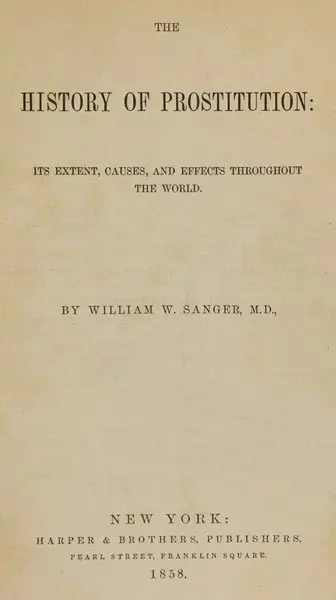
"The History of Prostitution: Its Extent, Causes, and Effects throughout the World" by William W. Sanger, M.D. is a historical account written in the mid-19th century. The book examines the widespread phenomenon of prostitution, its historical contexts, and its social implications, specifically addressing the factors that contribute to its existence and persistence across societies. It offers an extensive analysis of prostitution from ancient times to modern practices, aiming to raise awareness about the issue and provoke discussion on potential solutions. At the start of the volume, Sanger outlines the gravity of prostitution as a societal plague, emphasizing its historical presence and the necessity of discussing it openly. He critiques the tendency of society to ignore the issue and its consequences, arguing for a need to understand its roots and impacts. The introduction sets the stage for his investigation, revealing his intention to delve into the origins, evolution, and regulation of prostitution throughout history. Sanger touches upon various civilizations, starting with ancient Jewish customs and legislation, indicating that prostitution has always been intertwined with societal norms and moral frameworks.
Introduction adapted from the source catalogue; source summaries may be automatically generated.
Free to read · English · 274,600 words · No account needed
MAKE TIME FOR A GOOD BOOK
On by default. Untick to stop anonymous reading totals. Each page counts after 10 seconds in view. How this works.
Anonymous counting is on unless you have switched it off.
[350] Lewis and Clarke's Expedition, i. p. 135.
[351] Ib. i. p. 151.
[352] Beckwourth, p. 179.
[353] Murray's British America, i. p. 94.
[354] Indian Traits, i. p. 128.
[355] Murray's British America, i. 94.
[356] Beckwourth, p. 157.
[357] Beckwourth, p. 238.
[358] Lewis and Clarke's Expedition, i. 166.
[359] Id. ib.
[360] Murray's British America, i. 125.
[361] The principal facts in this and the following chapter are taken from Mr. Horace St. John's article on Prostitution, in Mayhew's "London Labor and the London Poor."
[362] Russell's History of Polynesia, p. 75.
[363] Their institution is ascribed to Oro, the god of war. The resemblance between Areoi and [Greek: Aeês], the Greek god of war, is a coincidence.
[364] South Sea Missions, p. 88.
[365] U. S. Exploring Expedition, vol. ii. p. 22.
[366] Missionary Voyage of Ship Duff, 1796, p. 336.
[367] U. S. Exploring Expedition, vol. ii. p. 80.
[368] Ib. 148.
[369] Wilkes, vol. iv. p. 77.
[370] Since the preceding paragraphs were written, the operations of the Allied Powers against China, and the capture of Canton, have given some farther insight into the domestic economy of this people. The special correspondent of the London Times, writing from Hong Kong, February 22, 1858, thus describes Chinese holidays:
"During the entrée acte all China has been exploding crackers, and Hong Kong has been celebrating its 'Isthmian games.' Toward the close of the three days of festivity the Chinese holiday became almost exciting. If they had kept up half as sharp a fire at Canton on the 29th of December as they did on the 14th of February, we should never have got over the walls with a less loss than 500 men. The streets both of Canton and Hong Kong were piled with myriads of exploded cracker carcasses. In Hong Kong, where I passed the last day of these festivities, grave men and sedate children were from morning till midnight hanging strings of these noisy things from their balconies, and perpetually renewing them as they exploded. The sing-song women, in their rich, handsome dresses, were screeching their shrill songs, and twanging their two-stringed lutes on every veranda in the Chinese quarter, while the lords of creation, assembled at a round table, were cramming the day-long repast. The women--hired singing women of not doubtful reputation--in the intervals of their music, take their seats at the table opposite the men. They do not eat, but their business being to promote the conviviality of the feast, they challenge the men to the samshu cup, and drink with them. It is astonishing to see what a quantity of diluted samshu these painted and brocaded she-Celestials can drink without any apparent effect. Ever and anon one of the company retires to a couch and takes an opium pipe, and then returns and recommences his meal. I was invited to one of these feasts; the dishes were excellent, but it lasted till I loathed the sight of food. I believe the Chinese spend fabulous sums in these entertainments; the sing-song women are often brought from distances, and are certainly chosen with some discrimination. They are an imitation of the Chinese lady, and, as the Chinese lady has no education and no duties, the difference between the poor sing-song girl and the poor abject wife is probably not observable in appearance or manner. The dress is particularly modest and becoming. They all have great quantities of black hair. If they would let it fall disheveled down their backs as the Manilla women do, they would be more picturesque, but not formal and decent, as China is, even in its wantonness. The Chinawoman's hair is gummed and built up into a structure rather resembling a huge flat-iron, and the edifice is adorned with combs, and jewels, and flowers, arranged with a certain taste. An embroidered blue silk tunic reaches from her chin nearly to her ankles. Below the tunic appear the gay trowsers, wrought with gold or silver thread; the instep glancing through the thin, white silk stockings, and a very small foot (when left to nature the Chinese have beautiful feet and hands) in a rich slipper, with a tremendous white sole in form of an inverted pyramid. In these sing-song girls you see the originals of the Chinese pictures--the painted faces, the high-arched, penciled eyebrows, the small, round mouth, the rather full and slightly sensual lip, naturally or artificially of a deep vermilion, the long, slit-shaped, half closed eyes, suggestive of indolence and slyness. What the voluble and jocose conversation addressed to them by the men may mean I can not tell, but their manners are quite decent, their replies are short and reserved, and every gesture, or song, or cup of samshu seems to be regulated by a known ceremonial."
Your reading position is saved on this browser. Take it to another device with a library code. Reading pages adapt to text, rather than matching a printed edition.
BEHIND THE BOOK
This eBook is for the use of anyone anywhere in the United States and most other parts of the world at no cost and with almost no restrictions whatsoever. You may copy it, give it away or re-use it under the terms of the Project Gutenberg License included with this eBook or online at www.gutenberg.org. If you are not located in the United States, you will have to check the laws of the country where you are located before using this eBook. Read the source licence.
The original source file, including credits and licence, is retained by this library. Request an original-format copy at no charge. Please include the book title and Project Gutenberg identifier #41873.
KEEP YOUR CURIOSITY GOING
Cécile Tormay

Moritz Busch
John L. Ransom
Frances Wright
Cécile Tormay

Mabel Potter Daggett