THE CLASSIC COLLECTION✦An outlaw’s diary: the CommuneCLASSIC FREE BOOKS
An outlaw’s diary: the Commune
Cécile Tormay
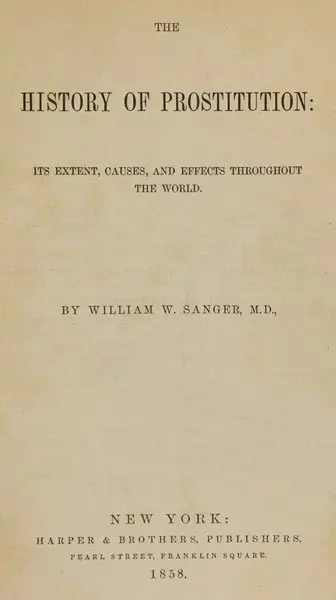
THE CLASSIC COLLECTION · 1858
"The History of Prostitution: Its Extent, Causes, and Effects throughout the World" by William W. Sanger, M.D. is a historical account written in the mid-19th century. The book examines the widespread phenomenon of prostitution, its historical contexts, and its social implications, specifically addressing the factors that contribute to its existence and persistence across societies. It offers an extensive analysis of prostitution from ancient times to modern practices, aiming to raise awareness about the issue and provoke discussion on potential solutions. At the start of the volume, Sanger outlines the gravity of prostitution as a societal plague, emphasizing its historical presence and the necessity of discussing it openly. He critiques the tendency of society to ignore the issue and its consequences, arguing for a need to understand its roots and impacts. The introduction sets the stage for his investigation, revealing his intention to delve into the origins, evolution, and regulation of prostitution throughout history. Sanger touches upon various civilizations, starting with ancient Jewish customs and legislation, indicating that prostitution has always been intertwined with societal norms and moral frameworks.
Introduction adapted from the source catalogue; source summaries may be automatically generated.
Free to read · English · 274,600 words · No account needed
MAKE TIME FOR A GOOD BOOK
On by default. Untick to stop anonymous reading totals. Each page counts after 10 seconds in view. How this works.
Anonymous counting is on unless you have switched it off.
[316] We have calculated that there are upward of six hundred thousand women in London between fifteen and forty-five years old. The proportion of married women among these would be 370,000 and upward; unmarried women over twenty years, and widows, about 314,000.
[317] A very singular fact in connection with the census is that there is not a single individual returned as a prostitute. This is not that the authorities do not take cognizance of crime, for there are 22,451 female prisoners in Great Britain, all of whom, however, except 1274, are returned as having some legal occupation. There are 7600 female vagrants, sleeping in barns, tents, etc., of whom 2600 are under twenty years of age.
[318] Thomas Fowell Ruxton, on Prison Discipline.
[319] Lord Jeffrey, Edinburgh Review.
[320] Rosa Anglica, Pavia, 1492.
[321] A brief treatise touching the cure of the disease now usually called Lues Venerea. By W. Clovves, one of her Majesty's Chirurgeons. 1569: p. 149.
[322] Madame Calderon de la Barca.
[323] Clavijero.
[324] Waddy Thompson, Mexico in 1846, p. 115.
[325] Madame Calderon de la Barca, p. 259.
[326] Norman, Yucatan.
[327] Stevens, Travels in Central America.
[328] Among the Napuals, a remnant of the ancient Aztec inhabitants, marriage seems to have been under the direction of the chiefs, and consisted in first submitting the parties to lustrations, such as washing them in a river, and afterward tying them together in the bride's house, whither the relations brought presents to the new couple.
It was customary for only the kindred to lament the death of ordinary persons, but the decease of a cazique or war-chief was signalized by a general mourning for four days. Rape was punished with death, adultery by making the offender the slave of the injured husband, "unless pardoned by the high-priest on account of past services in war." There were certain degrees of relationship within which it was unlawful to marry, and sexual intercourse in such limits was punished with death. Upon matters of this kind there existed the greatest rigor, for, says Herrera, "he who courted or made signs to a married woman was banished." Fornication was punished by whipping.--Squier's Notes on Central America, p. 346.
[329] Squier, p. 50.
[330] Peru; Reiseskizzen in den Jahren 1838-1842. (Peru, Sketches of Travel.) By J. J. Von Tschudi. 2 vols. St. Gallen, 1846.
[331] Horace St. John.
[332] Stewart's Brazil and La Plata: New York, 1856.
[333] Ewbank's Brazil, p. 135.
[334] Ib. p. 141.
[335] Lewis and Clarke's Expedition across the Rocky Mountains, vol. ii.
p. 144.
[336] Thatcher's Indian Traits, vol. i. p. 51.
[337] Lewis and Clarke's Expedition, i. 358.
[338] Ib. i. 166.
[339] Id. ib.
[340] Indian Traits, i. 104.
[341] Life and Adventures of James P. Beckwourth, p. 148.
[342] Beckwourth, p. 201.
[343] Id. p. 401.
[344] Indian Traits, i. p. 114.
[345] Beckwourth, p. 169.
[346] Beckwourth, p. 212.
[347] Murray's British North America, vol. i. p. 115.
[348] Murray's British North America, vol. i. p. 94.
[349] Indian Traits, i. p. 136.
Your reading position is saved on this browser. Take it to another device with a library code. Reading pages adapt to text, rather than matching a printed edition.
BEHIND THE BOOK
This eBook is for the use of anyone anywhere in the United States and most other parts of the world at no cost and with almost no restrictions whatsoever. You may copy it, give it away or re-use it under the terms of the Project Gutenberg License included with this eBook or online at www.gutenberg.org. If you are not located in the United States, you will have to check the laws of the country where you are located before using this eBook. Read the source licence.
The original source file, including credits and licence, is retained by this library. Request an original-format copy at no charge. Please include the book title and Project Gutenberg identifier #41873.
KEEP YOUR CURIOSITY GOING
Cécile Tormay

Moritz Busch
John L. Ransom
Frances Wright
Cécile Tormay

Mabel Potter Daggett