THE CLASSIC COLLECTION✦An outlaw’s diary: the CommuneCLASSIC FREE BOOKS
An outlaw’s diary: the Commune
Cécile Tormay
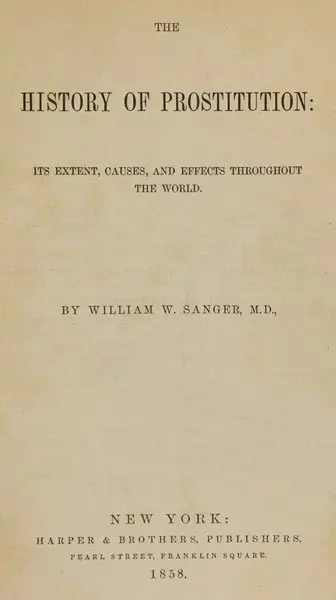
THE CLASSIC COLLECTION · 1858
"The History of Prostitution: Its Extent, Causes, and Effects throughout the World" by William W. Sanger, M.D. is a historical account written in the mid-19th century. The book examines the widespread phenomenon of prostitution, its historical contexts, and its social implications, specifically addressing the factors that contribute to its existence and persistence across societies. It offers an extensive analysis of prostitution from ancient times to modern practices, aiming to raise awareness about the issue and provoke discussion on potential solutions. At the start of the volume, Sanger outlines the gravity of prostitution as a societal plague, emphasizing its historical presence and the necessity of discussing it openly. He critiques the tendency of society to ignore the issue and its consequences, arguing for a need to understand its roots and impacts. The introduction sets the stage for his investigation, revealing his intention to delve into the origins, evolution, and regulation of prostitution throughout history. Sanger touches upon various civilizations, starting with ancient Jewish customs and legislation, indicating that prostitution has always been intertwined with societal norms and moral frameworks.
Introduction adapted from the source catalogue; source summaries may be automatically generated.
Free to read · English · 274,600 words · No account needed
MAKE TIME FOR A GOOD BOOK
On by default. Untick to stop anonymous reading totals. Each page counts after 10 seconds in view. How this works.
Anonymous counting is on unless you have switched it off.
Ancient Legislation.--Ulm.--Legislation from 1483 to 1764.--French Revolution, and its effects on Morals.--Abendroth's Ordinance in 1807.--Police Ordinance in 1811.--Additional Powers in 1820.-- Hudtwalcker.--Present Police Regulations.--Number of Registered Women.--Tolerated Houses.--Illegitimacy.--Age and Nativity of Prostitutes.--The Hamburger Berg and its Women.--Physique, Peculiarities, and Diseases of Prostitutes.--Dress.--Food.-- Intellectual Capacity.--Religion.--Offenses.--Procuresses.-- Inscription.--Locality of Brothels.--Brothel-keepers.-- Dance-houses.--Sunday Evening Scene.--Private Prostitutes.-- Street-walkers.--Domestic Prostitution.--Unregistered Prostitution.-- Houses of Accommodation.--Common Sleeping Apartments.--Beer and Wine Houses.--Effect of Prostitution on Generative Organs.--General Maladies.--Forms of Syphilis.--Syphilis in Sea-ports.--Severity of Syphilis among unregistered Women.--The "Kurhaus" and general Infirmary.--Male Venereal Patients.--Sickness in the Garrison.-- Treatment.--Mortal Diseases of Hamburg Prostitutes.--Hamburg Magdalen Hospital.
The ancient legislative enactments respecting prostitution in Hamburg seem to have been of the same character, and based upon the same principles, as in other Continental cities, namely, a partial toleration of a necessary evil for the sake of preventing injurious excesses. This may be traced in the oldest extant law on the subject, dated in 1292. In the public account-books for 1350 are entries of charges which imply that public brothels were built by the corporation, though we find no satisfactory information as to whether they were managed by an appointed official as in Cologne, Strasbourg, or Avignon, or were leased by the city to an individual as in Ulm. It will be interesting to give a sketch of the regulations of prostitution in the latter city before proceeding with the investigation concerning Hamburg.
The laws of the city of Ulm in 1430, or at least that portion of them called "woman house" laws, provided that the houses should be leased, and the lessee, on becoming tenant, swore to serve the city faithfully; to prevent all foul play or concealment of suspicious goods in his house; to provide clean, healthy women, and never to keep less than fourteen. He was bound to observe a fixed dietary scale; the daily meals were to be "of the value of sixpence;" on meat days every woman was to have two dishes, soup with meat and vegetables, and a roast or boiled joint, as most convenient. On fast-days and in Lent they were to have the same number of dishes, which (out of Lent) might consist of eggs and baked meat. As a change to this, they might have herrings and eggs; or fishes (probably fresh-water fish), which they could cook for themselves, and to which the keeper must add white bread. If a woman refused the food provided, he was bound to give her something of the value of sixpence; he was also to sell them wine "when they required it." If a woman was pregnant, he was to put her out of the house. In the "woman's house" there was a chest for general purposes, and a money-box for the accounts between the host and the women. Every woman who kept company with a man at night must pay the keeper a kreutzer, the remainder of the fee being her own property. All money the women obtained in the day was to be put into the general chest; the third of this belonged to the host; the balance was paid to the women at the end of the week, less any debts they had contracted in the mean time. A woman resided in every house who made financial arrangements between inmates and visitors. If a woman received a present in addition to the stipulated fee, she was at liberty to spend it on clothes, shoes, or personal matters to which nobody could lay claim. The keeper could not supply the women with clothes, etc., without the knowledge and consent of the Master of the Beggars (a local functionary who seems to have combined the supervision of brothels, and of known vagrants and beggars). The host was required to provide, at his own cost, a cook and a cook's maid. Girls or women could, with their own consent, be apprenticed to the "women keeper" by their parents or husbands; but if one was apprenticed against her will, and she, or her friends, wished to cancel the agreement, the keeper was bound to release her without requiring the repayment of any money he might have disbursed for her. If a woman who had accumulated a guilder of her own wished to quit her sinful life, she was allowed to tender it to the keeper in discharge of all her liabilities, and must then be permitted to leave the house, wearing the clothes she wore when she entered it, or, if they were worn out, in her common "Monday clothes." A woman who desired might leave without this payment if she had nothing to give, but if subsequently detected in any other house the keeper could enforce his demands against her, the discharge not affecting his claim under such circumstances. Every Monday each woman had to contribute one penny, and the host twopence, to the money-box to purchase tapers for the Virgin and the saints, to be offered in the Cathedral on Sunday nights. If any of the women were sick or could not support themselves, they were to be provided with necessaries from the money-box, to which (for greater security) there were two keys, one kept by the host and the other by the Master of the Beggars. Each woman had to spin daily for the keeper two hanks of yarn, or, in default, to pay three hellers for each hank. On Sunday, Lady-day, and Twelfth-day, after vespers, and in Passion Week, the house was not to be opened. If the keeper broke any of these regulations the council could dismiss him. The oath taken by the Master of the Beggars required him to visit the women-houses every quarter day; to read the laws to the women; and to report to the council any offenses he found existing.[263]
Your reading position is saved on this browser. Take it to another device with a library code. Reading pages adapt to text, rather than matching a printed edition.
BEHIND THE BOOK
This eBook is for the use of anyone anywhere in the United States and most other parts of the world at no cost and with almost no restrictions whatsoever. You may copy it, give it away or re-use it under the terms of the Project Gutenberg License included with this eBook or online at www.gutenberg.org. If you are not located in the United States, you will have to check the laws of the country where you are located before using this eBook. Read the source licence.
The original source file, including credits and licence, is retained by this library. Request an original-format copy at no charge. Please include the book title and Project Gutenberg identifier #41873.
KEEP YOUR CURIOSITY GOING
Cécile Tormay

Moritz Busch
John L. Ransom
Frances Wright
Cécile Tormay

Mabel Potter Daggett