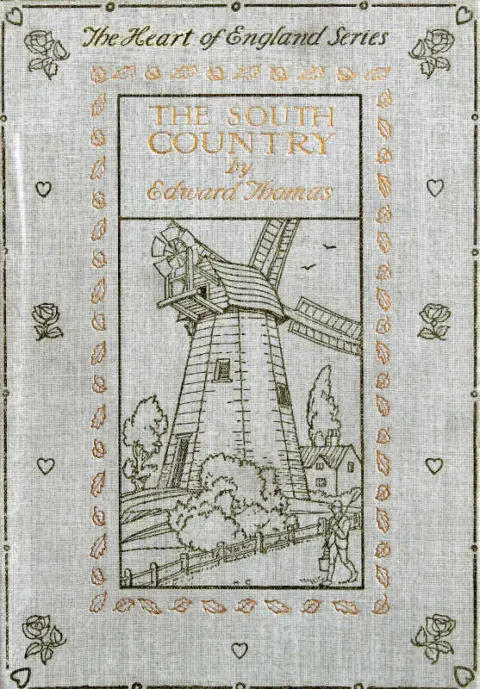
The South Country
Edward Thomas
THE CLASSIC COLLECTION · 1913
"The Happy-go-lucky Morgans" by Edward Thomas is a novel written in the early 20th century. The story centers around the lives of the Morgan family and their home, Abercorran House, in Balham, which is characterized by a lively, chaotic atmosphere filled with both family members and various animals. The narrative captures themes of nostalgia, childhood adventures, and the bittersweet passage of time as the narrator reflects on a family steeped in Welsh culture while facing inevitable changes. At the start of the novel, we are introduced to Abercorran Street, where the Morgans reside. The narrator reminisces about the family, revealing vivid details about their lively household, the various rooms, and the gardens that once thrived, invoking a sense of warmth and familiarity. As memories unfold, the narrator hints at the family's decline and the shifting dynamics as children grow up and move away, leaving behind only echoes of their past laughter and chaos. Ann, the devoted servant, remains a constant presence, connecting the past to the present. This opening portion sets the stage for a reflection on the Morgans’ unique way of life and the impending changes that loom over them.
Introduction adapted from the source catalogue; source summaries may be automatically generated.
Free to read · English · 63,704 words · No account needed
MAKE TIME FOR A GOOD BOOK
On by default. Untick to stop anonymous reading totals. Each page counts after 10 seconds in view. How this works.
Anonymous counting is on unless you have switched it off.
It was a winter of storm: men could not hear themselves speak for the roaring of sea, wind, and rain, and the invisible armies of the air. With every tide bodies of men and of the strange birds that had set out over the sea were washed up. Men were not glad to see Ivor and his dark companions at last departing in the mended ship. The granaries were full, and no one starved, but time passed and no more ships arrived. No man could work. The castle stood empty of anything but leaves, and in their old cottages men did not love life. The Spring was an ill one; nothing was at work in the world save wind and rain; now the uproar of the wind drowned that of the rain, now the rain drowned the wind, and often the crying of women and children drowned both. Men marked the differences, and hoped for an end which they were powerless to pursue. When the one ship returned, its cargo was of birds and beasts such as had escaped in the falling of the leaves. Ivor alone was glad of them. He had few followers--young men all of them--up to the castle. Others came later, but went down again with loads of corn. It was now seen that the granaries would some day be emptied. People began to talk without respect of Ivor. They questioned whence his wealth had come, by what right he had built the castle, why he had concealed his birth. The young men living with him quarrelled among themselves, then agreed in reproaching the master. At last they left the castle in twos and threes, accusing him of magic, of causing them to forget their gratitude to God. In the villages everyone was quarrelling except when the talk turned to blaming Ivor. He made no reply, nor ever came down amongst them, but stayed in the inmost apartment with his remaining birds. One of the complaints against him was that he fed the birds on good grain. Yet the people continued to go up to the granaries at need. The beggars and robbers of the mountains were beginning to contest their right to it, and blood was shed in many of the rooms and corridors. No one saw the master. They said that they did not care, or they said that he was dead and buried up in leaves; but in truth they were afraid of his white hair, his quiet eye, and the strange birds and beasts. Between them, the robbers and the young men who had served him plundered the house. Some even attempted to carry off the masonry, but left most of it along the roadside where it lies to this day. At length, nothing worth a strong man’s time had been overlooked. A few beggars were the latest visitors, cursing the empty granary, trembling at the footsteps of leaves treading upon leaves in all the rooms. They did not see Ivor, sitting among leaves and spiders’ webs. A pack of hounds, hunting that way, chased the stag throughout the castle but lost it; for it entered the room where Ivor was sitting, and when the horn was blown under the new moon the hounds slunk out bloodless yet assuaged, and the hunter thrashed them for their lack of spirit, and cursed the old man for his magic, yet ventured not in search of him along those muffled corridors. The very road up to the castle was disappearing. The master, it was believed, had died. The old men who had known him were dead; the young men were at the wars. When a white-haired beggar stumbled into Abercorran from the hills few admitted, though all knew in their hearts, that it was Ivor ap Cadogan. For a year or two he was fed from door to door, but he wearied his benefactors by talking continually about his birds that he had lost. Some of the rich remembered against him his modesty, others his ostentation. The poor accused him of pride; such was the name they gave to his independent tranquillity. Perhaps, some thought, it was a judgment--the inhabitants of the Castle of Ophir had been too idle and too happy to think of the shortness of this life and the glory to come. So he disappeared. Probably he went to some part where he was not known from any other wandering beggar. “Wonderful long white beards,” said Ann, “men had in those days--longer than that old harper’s, and to-day there are none even like him. Men to-day can do a number of things which the old ages never dreamed of, but their beards are nothing in comparison to those unhappy old days when men with those long white beards used to sit by the roadsides, looking as if they had come from the ends of the earth, like wise men from the East, although they were so old that they sat still with their beards reaching to the ground like roots. Ivor ap Cadogan was one of these.”
Your reading position is saved on this browser. Take it to another device with a library code. Reading pages adapt to text, rather than matching a printed edition.
Edward Thomas
Edward Thomas
Edward Thomas
Edward Thomas
BEHIND THE BOOK
This eBook is for the use of anyone anywhere in the United States and most other parts of the world at no cost and with almost no restrictions whatsoever. You may copy it, give it away or re-use it under the terms of the Project Gutenberg License included with this eBook or online at www.gutenberg.org. If you are not located in the United States, you will have to check the laws of the country where you are located before using this eBook. Read the source licence.
The original source file, including credits and licence, is retained by this library. Request an original-format copy at no charge. Please include the book title and Project Gutenberg identifier #63268.
KEEP YOUR CURIOSITY GOING
Coulson Kernahan

Maurice Baring
Frances Wright
Cécile Tormay

Frederic Jesup Stimson

W. H. P. (William Henry Pope) Jarvis