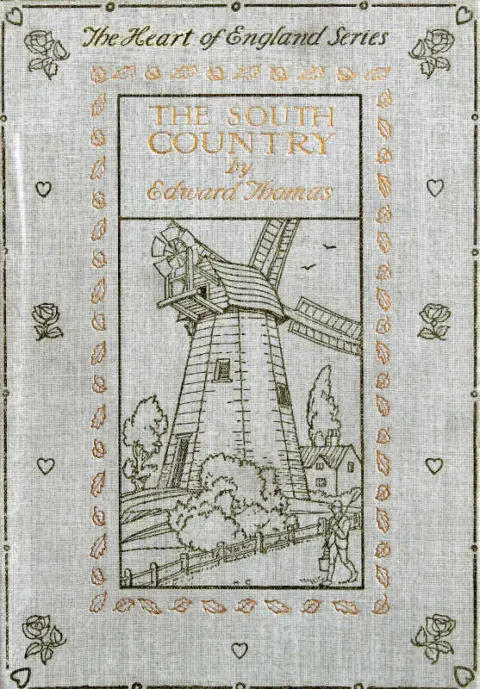
The South Country
Edward Thomas
THE CLASSIC COLLECTION · 1913
"The Happy-go-lucky Morgans" by Edward Thomas is a novel written in the early 20th century. The story centers around the lives of the Morgan family and their home, Abercorran House, in Balham, which is characterized by a lively, chaotic atmosphere filled with both family members and various animals. The narrative captures themes of nostalgia, childhood adventures, and the bittersweet passage of time as the narrator reflects on a family steeped in Welsh culture while facing inevitable changes. At the start of the novel, we are introduced to Abercorran Street, where the Morgans reside. The narrator reminisces about the family, revealing vivid details about their lively household, the various rooms, and the gardens that once thrived, invoking a sense of warmth and familiarity. As memories unfold, the narrator hints at the family's decline and the shifting dynamics as children grow up and move away, leaving behind only echoes of their past laughter and chaos. Ann, the devoted servant, remains a constant presence, connecting the past to the present. This opening portion sets the stage for a reflection on the Morgans’ unique way of life and the impending changes that loom over them.
Introduction adapted from the source catalogue; source summaries may be automatically generated.
Free to read · English · 63,704 words · No account needed
MAKE TIME FOR A GOOD BOOK
On by default. Untick to stop anonymous reading totals. Each page counts after 10 seconds in view. How this works.
Anonymous counting is on unless you have switched it off.
To Mr Stodham, I think, Mr Torrance’s books were the man. He--perhaps he alone in England--possessed a full set of the thirty-three volumes produced by Mr Torrance under his own name in thirteen years. “It is wonderful,” said Ann once, “that the dancing of a pen over a sheet of paper can pay the rent and the baker’s bill, and it hardly seems right. But, still, it appears there are people born that can do nothing else, and they must live like the rest of us.... And I will say that Mr Torrance is one of the best of us, though he has that peculiarity.”
Mr Stodham could not trust himself to speak. He really liked Ann: furthermore, he knew that she was wiser than he: finally, everyone at that moment had something better to think of, because Jack and Roland had put on the gloves. Mr Stodham, consequently, quoted George Borrow:
“There’s the wind on the heath, brother; if I could only feel that, I would gladly live for ever. Dosta, we’ll now go to the tents and put on the gloves; and I’ll try to make you feel what a sweet thing it is to be alive, brother.”
Jack overheard him, and at the end of the round said, “What was that, Mr Stodham? say it again.” When the words of Jasper had been repeated, “Jolly good,” said Jack, “but what puzzles me is how a man who knew that could bother to write a book. There must have been something the matter with him. Perhaps he didn’t really believe what he wrote.” And so they had another round.
Mr Stodham liked everything at Abercorran House. Liking was his chief faculty, and there it had unstinted exercise. Probably he liked the very wife whom he escaped by going either to the country or to Abercorran House. An accident had first brought him among the Morgans. One day as he happened to be passing down the farm lane a child threw a ball unintentionally over into the Wilderness. After it went Mr Stodham in an instant, not quite missing the nails at the top of the fence. The long grass of the Wilderness and his own bad sight kept the ball hidden until the child went away in despair, unknown to him, for he continued the search. There perhaps he would have been searching still, if the Wilderness had not been built over, and if Roland had not come along and found man and ball almost in the same moment. Here the matter could not end. For Mr Stodham, unawares, had been reduced by a nail in the fence to a condition which the public does not tolerate. It seems that he offered to wait for nightfall when Roland had pointed out his misfortune. He was stubborn, to the verge of being abject, in apologising for his presence, and, by implication, for his existence, and in not wishing to cause any trouble to Roland or the family. Gently but firmly Roland lured him upstairs and gave him a pair of trousers beyond reproach. On the following day when he reappeared, bearing the trousers and renewed apologies, the family, out in the yard, was in full parliament assembled. He made a little speech, cheered by everyone but Higgs. Presumably he was so fascinated by the scene that the cheering did not disconcert him. He could not get away, especially as his stick had been seized by Spot the fox-terrier, who was now with apparently no inconvenience to himself, being whirled round and round on the end of it by Jack. Ann came out with his own trousers thoroughly reformed, and she had to be thanked. Lastly, Mr Morgan carried him off before the stick had been recovered. Next day, therefore, he had to come again in search of the stick, a priceless favourite before Spot had eaten it. Mr Morgan consoled him and cemented the acquaintance by giving him an ash stick with a handle formed by Nature in the likeness of a camel’s head. Mr Morgan said that the stick had been cut on Craig-y-Dinas--the very place where the ash stick was cut, which a certain Welshman was carrying on London Bridge when he was espied by a magician, who asked to be taken to the mother tree, which in as long as it takes to walk three hundred miles was done, with the result that a cave was found on Craig-y-Dinas, full of treasure which was guarded by King Arthur and his knights, who were, however, sleeping a sleep only to be disturbed by a certain bell, which the Welshman by ill luck did ring, with the predicted result, that the king and his knights rose up in their armour and so terrified him that he forgot the word which would have sent them to sleep again, and he dropped all his treasure, ran for his life, and could never more find cave, stick, or magician for all his seeking. Mr Stodham responded in a sententious pretty speech, saying in effect that with such a stick he needed no other kind of treasure than those it would inevitably conduct him to--the hills, rivers, woods, and meadows of the home-counties, and some day, he hoped, to Craig-y-Dinas itself.
Your reading position is saved on this browser. Take it to another device with a library code. Reading pages adapt to text, rather than matching a printed edition.
Edward Thomas
Edward Thomas
Edward Thomas
Edward Thomas
BEHIND THE BOOK
This eBook is for the use of anyone anywhere in the United States and most other parts of the world at no cost and with almost no restrictions whatsoever. You may copy it, give it away or re-use it under the terms of the Project Gutenberg License included with this eBook or online at www.gutenberg.org. If you are not located in the United States, you will have to check the laws of the country where you are located before using this eBook. Read the source licence.
The original source file, including credits and licence, is retained by this library. Request an original-format copy at no charge. Please include the book title and Project Gutenberg identifier #63268.
KEEP YOUR CURIOSITY GOING
Coulson Kernahan

Maurice Baring
Frances Wright
Cécile Tormay

Frederic Jesup Stimson

W. H. P. (William Henry Pope) Jarvis