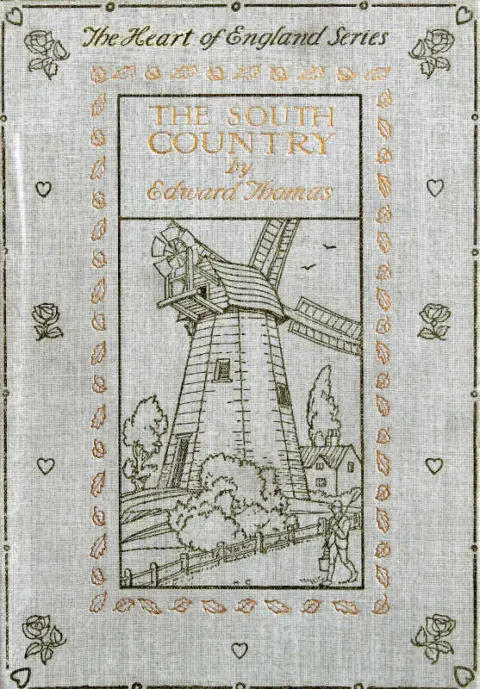
The South Country
Edward Thomas
THE CLASSIC COLLECTION · 1913
"The Happy-go-lucky Morgans" by Edward Thomas is a novel written in the early 20th century. The story centers around the lives of the Morgan family and their home, Abercorran House, in Balham, which is characterized by a lively, chaotic atmosphere filled with both family members and various animals. The narrative captures themes of nostalgia, childhood adventures, and the bittersweet passage of time as the narrator reflects on a family steeped in Welsh culture while facing inevitable changes. At the start of the novel, we are introduced to Abercorran Street, where the Morgans reside. The narrator reminisces about the family, revealing vivid details about their lively household, the various rooms, and the gardens that once thrived, invoking a sense of warmth and familiarity. As memories unfold, the narrator hints at the family's decline and the shifting dynamics as children grow up and move away, leaving behind only echoes of their past laughter and chaos. Ann, the devoted servant, remains a constant presence, connecting the past to the present. This opening portion sets the stage for a reflection on the Morgans’ unique way of life and the impending changes that loom over them.
Introduction adapted from the source catalogue; source summaries may be automatically generated.
Free to read · English · 63,704 words · No account needed
MAKE TIME FOR A GOOD BOOK
On by default. Untick to stop anonymous reading totals. Each page counts after 10 seconds in view. How this works.
Anonymous counting is on unless you have switched it off.
Mr Torrance openly objected to Ann’s epitaph for David Morgan, preferring his own choice of one from Shelley’s “Mont Blanc”:
“And what were thou, and earth, and stars, and sea,
If to the human mind’s imaginings
Silence and solitude were vacancy?”
“But” said Mr Morgan, “Shelley was born only a hundred years ago, and died at thirty, I think that in the matter of mountains an older man is better.”
“But, father,” said Roland, “how do you know that Jeremiah was not drowned at thirty with a copy of ‘Ecclesiastes’ clasped to his bosom?”
“You read and see, my son,” answered Mr Morgan. “Shelley could not pass himself off as an old man, though you know he did once claim to be eighty-nine, and Jeremiah would not have pretended to be thirty. That is only my opinion. I prefer the prophet, like Ann.”
Mr Torrance muttered that anyone who preferred Jeremiah to Shelley had no right to an opinion. It was just like Mr Torrance. He was always saying foolish things and fairly often doing them, and yet we felt, and Mr Morgan once declared, that he had in him the imperishable fire of a divine, mysterious wisdom. After walking the full length of the Abbey Road, where he lived, to discover him smiling in his dark study, was sufficient proof that he had a wisdom past understanding.
Abbey Road was over two miles long. At its south end was a double signboard, pointing north “To London,” south “To Forden, Field, and Cowmore”; at its north end it ran into pure London. Every year the horse-chestnut branches had to be shortened in May because their new leaf smothered the signboard. As if anyone who had reached that point could wish to be directed to London! Almost as few could wish to know the way in order to avoid it. But the horse-chestnut had to suffer. It was fortunate in not being cut down altogether and carried away. The cemetery saved it. The acute angle between the Abbey Road and another was filled by a large new cemetery, and the tree was the first of a long line within its railings. Even had the signboard been on the other side of the road it would have been as badly off among the tall thorns and stunted elms of the hedges. Behind this hedge was a waste, wet field, grazed over by a sad horse or two all through the year; for on account partly of the cemetery, partly of the factory which manufactured nobody quite knew what except stench, this field could not be let or sold. Along its far side ran a river which had no sooner begun to rejoice in its freedom to make rush and reed at pleasure on the border of the field than it found itself at the walls of the factory. Northward, past the cemetery and the factory, began the houses of Abbey Road, first a new house, occupied but with a deserted though not wild garden, and next to it a twin house, left empty. Then followed a sluttery of a few pairs or blocks of small houses, also new, on both sides of the road--new and yet old, with the faces of children who are smeared, soiled, and doomed, at two. They bordered on the old inn, “The Woodman’s Arms,” formerly the first house, having a large kitchen garden, and masses of dahlias and sunflowers behind. It lay back a good space from the road, and this space was gravel up to the porch, and in the middle of it stood a stone drinking trough. Often a Gypsy’s cart and a couple of long dogs panting in the sun were to be seen outside, helping the inn to a country look, a little dingy and decidedly private and homely, so that what with the distance between the road and the front door, and the Gypsy’s cart, the passer-by was apt to go on until he came to an ordinary building erected for the sale of beer and spirits, and for nothing else. Such a one lay not much further on, beyond a row of cottages contemporary with “The Woodman’s Arms.” These had long narrow gardens behind wooden posts and rails--gardens where everything tall, old-fashioned, and thick grew at their own sweet will, almost hiding the cottages of wood covered in creeper. You could just see that some were empty, their windows smashed or roughly boarded up, and that others were waiting for some old woman to die before they also had their windows smashed or boarded up. The dahlias, the rose-of-Sharon, the sweet rocket, the snow-on-the-mountains, the nasturtiums, the sunflowers, flourished too thick for weeds to make headway, and so probably with small help from the inhabitants, the gardens earned many a wave of the whip from passing drivers. The row of cottages meant “the first bit of country,” with a sweep at one end, a rat-catcher at the other, announced in modest lettering. Between the last of them and the new public-house a puddled lane ran up along old and thick, but much broken, hedges to the horse-slaughterer’s. “The Victoria Hotel” was built in the Jubilee year of that sovereign, and was a broad-faced edifice of brick with too conspicuous stone work round the windows and doorways and at the corners. The doors were many and mostly of glass. The landlord of “The Victoria” had no time to stand on his doorstep--whichever was his--like the landlord of “The Woodman”; moreover, all his doorsteps were right on the road, and he could have seen only the long row of cottages, by the same builder, which looked as if cut off from a longer, perhaps an endless row, with a pair of shears; while from the old inn could be seen grass sloping to the willows of the river, and a clump of elms hiding the factory chimneys. All the glass and brass of the “Victoria” shone spotless as if each customer out of the regiments in the crowded straight streets gave it a rub on entering and leaving.
Your reading position is saved on this browser. Take it to another device with a library code. Reading pages adapt to text, rather than matching a printed edition.
Edward Thomas
Edward Thomas

Edward Thomas
Edward Thomas
BEHIND THE BOOK
This eBook is for the use of anyone anywhere in the United States and most other parts of the world at no cost and with almost no restrictions whatsoever. You may copy it, give it away or re-use it under the terms of the Project Gutenberg License included with this eBook or online at www.gutenberg.org. If you are not located in the United States, you will have to check the laws of the country where you are located before using this eBook. Read the source licence.
The original source file, including credits and licence, is retained by this library. Request an original-format copy at no charge. Please include the book title and Project Gutenberg identifier #63268.
KEEP YOUR CURIOSITY GOING
Coulson Kernahan

Maurice Baring
Frances Wright
Cécile Tormay

Frederic Jesup Stimson

W. H. P. (William Henry Pope) Jarvis