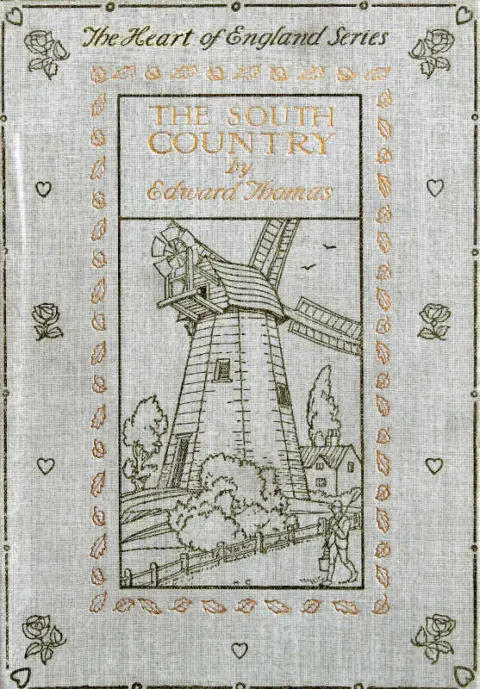
The South Country
Edward Thomas

THE CLASSIC COLLECTION · 1913
"The Happy-go-lucky Morgans" by Edward Thomas is a novel written in the early 20th century. The story centers around the lives of the Morgan family and their home, Abercorran House, in Balham, which is characterized by a lively, chaotic atmosphere filled with both family members and various animals. The narrative captures themes of nostalgia, childhood adventures, and the bittersweet passage of time as the narrator reflects on a family steeped in Welsh culture while facing inevitable changes. At the start of the novel, we are introduced to Abercorran Street, where the Morgans reside. The narrator reminisces about the family, revealing vivid details about their lively household, the various rooms, and the gardens that once thrived, invoking a sense of warmth and familiarity. As memories unfold, the narrator hints at the family's decline and the shifting dynamics as children grow up and move away, leaving behind only echoes of their past laughter and chaos. Ann, the devoted servant, remains a constant presence, connecting the past to the present. This opening portion sets the stage for a reflection on the Morgans’ unique way of life and the impending changes that loom over them.
Introduction adapted from the source catalogue; source summaries may be automatically generated.
Free to read · English · 63,704 words · No account needed
MAKE TIME FOR A GOOD BOOK
On by default. Untick to stop anonymous reading totals. Each page counts after 10 seconds in view. How this works.
Anonymous counting is on unless you have switched it off.
I do not remember ever to have seen Ann talking to her mistress, and no doubt she did without her. Mrs Morgan was not to be seen about the house, and her room was perfectly respected. She sat at the window looking on to the yard and watched the boys as she sewed, or read, or pretended to read. Sometimes Jessie sat with her, and then I have seen her smiling. She had large eyes of a gloomy lustre which looked as if they had worn their hollows in the gaunt face by much gazing and still more musing. The boys were silent for a moment as they went past her door. I do not know when she went out, if she ever did, but I never saw her even in the yard. Nor did I see her with Mr Morgan, and it was known that he was never in her sitting-room. She seemed to live uncomplaining under a weight of gloom, looking out from under it upon her strong sons and their busy indolence, with admiration and also a certain dread.
Jessie was the favourite child of father and mother, but I used to think that it was to avoid her father that she was so often in her mother’s room. Why else should such a child of light and liberty stay in that quietness and dark silence which breathed out darkness over the house? Outside that room she was her brothers’ equal in boldness, merriment and even in strength. Yet it once struck me with some horror, as she sat up at the window, that she was like her mother--too much like her--the dark eyes large, the cheeks not any too plump, the expression sobered either by some fear of her own or by the conversation; it struck me that she might some day by unimaginable steps reach that aspect of soft endurance and tranquilly expectant fear. At fifteen, when I best remember her, she was a tall girl with a very grave face when alone, which could break out with astonishing ease into great smiles of greeting and then laughter of the whole soul and body as she was lured to one group or another in the yard. She mixed so roughly and carelessly with every one that, at first, I, who had false picture-book notions of beauty and looked for it to have something proud and ceremonious in itself and its reception, did not see how beautiful she was. She took no care of her dress, and this made all the more noticeable the radiant sweetness of her complexion. But I recognised her beauty before long. One Saturday night she was shopping with Ann, and I met her suddenly face to face amidst a pale crowd all spattered with acute light and shadow from the shops. I did not know who it was, though I knew Ann. She was so extraordinary that I stared hard at her as people do at a foreigner, or a picture, or an animal, not expecting a look in answer. Others also were staring, some of the women were laughing. There could be no greater testimony to beauty than this laughter of the vulgar. The vulgar always laugh at beauty; that they did so is my only reason for calling these women by that hateful name. Jessie did not heed them. Then she caught sight of me, and her face lightened and blossomed with smiles. I shall not forget it, and how I blushed to be so saluted in that vile street. There was another reason why I should remember. Some of the big boys and young men--boys just leaving the Grammar School or in their first year at an office--winked at her as they passed; and one of them, a white-faced youth with a cigarette, not only winked but grinned as if he were certain of conquest. Jessie’s face recovered its grave look, she gave Ann her basket, and at the fullness of his leer she struck him in the mouth with all her force, splashing her small hand and his face with blood. I trembled and winced with admiration. Jessie burst into tears. The crowd was quiet and excited. Everybody seemed to be looking for somebody else to do they could not tell what. The crush increased. I saw Ann wiping Jessie’s hand. They were saved by a big red-faced working woman, who had a little husband alongside of her. She pushed very slowly but with great determination through the crowd, using her husband rather as an addition to her weight than as a brother in arms, until she came to the cluster of moody youths. Between us and them she stood, and hammering in her words with a projecting chin, told them to “Get home, you chalk-faced quill-drivers, and tell your mothers to suckle you again on milk instead of water. Then you can ask leave to look at girls, but not the likes of this beautiful dear, not you. Get home....” They laughed awkwardly and with affected scorn as they turned away from that face on fire; and it was laughing thus that they realised that they were blocking the traffic, and therefore dispersed muttering a sort of threats, the woman keeping up her attack until it could not be hoped that they heard her. As we hurried home we were hooted by similar boys and by some of the young women who matched them.
Your reading position is saved on this browser. Take it to another device with a library code. Reading pages adapt to text, rather than matching a printed edition.
Edward Thomas

Edward Thomas

Edward Thomas
Edward Thomas
BEHIND THE BOOK
This eBook is for the use of anyone anywhere in the United States and most other parts of the world at no cost and with almost no restrictions whatsoever. You may copy it, give it away or re-use it under the terms of the Project Gutenberg License included with this eBook or online at www.gutenberg.org. If you are not located in the United States, you will have to check the laws of the country where you are located before using this eBook. Read the source licence.
The original source file, including credits and licence, is retained by this library. Request an original-format copy at no charge. Please include the book title and Project Gutenberg identifier #63268.
KEEP YOUR CURIOSITY GOING
Coulson Kernahan

Maurice Baring
Frances Wright
Cécile Tormay

Frederic Jesup Stimson

W. H. P. (William Henry Pope) Jarvis