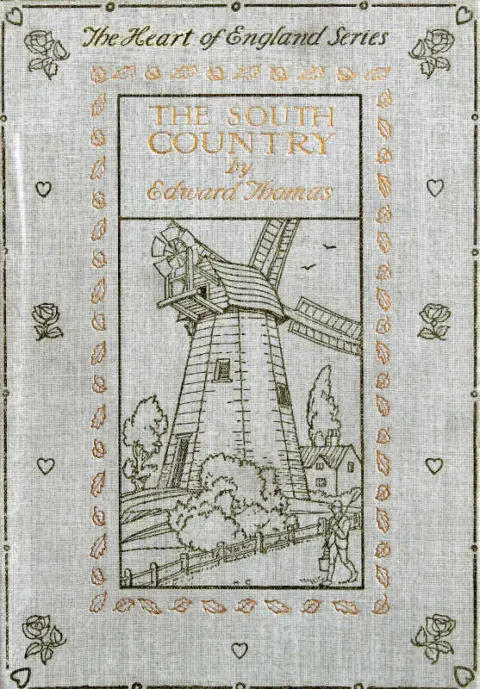
The South Country
Edward Thomas
THE CLASSIC COLLECTION · 1913
"The Happy-go-lucky Morgans" by Edward Thomas is a novel written in the early 20th century. The story centers around the lives of the Morgan family and their home, Abercorran House, in Balham, which is characterized by a lively, chaotic atmosphere filled with both family members and various animals. The narrative captures themes of nostalgia, childhood adventures, and the bittersweet passage of time as the narrator reflects on a family steeped in Welsh culture while facing inevitable changes. At the start of the novel, we are introduced to Abercorran Street, where the Morgans reside. The narrator reminisces about the family, revealing vivid details about their lively household, the various rooms, and the gardens that once thrived, invoking a sense of warmth and familiarity. As memories unfold, the narrator hints at the family's decline and the shifting dynamics as children grow up and move away, leaving behind only echoes of their past laughter and chaos. Ann, the devoted servant, remains a constant presence, connecting the past to the present. This opening portion sets the stage for a reflection on the Morgans’ unique way of life and the impending changes that loom over them.
Introduction adapted from the source catalogue; source summaries may be automatically generated.
Free to read · English · 63,704 words · No account needed
MAKE TIME FOR A GOOD BOOK
On by default. Untick to stop anonymous reading totals. Each page counts after 10 seconds in view. How this works.
Anonymous counting is on unless you have switched it off.
Thus, Mr Stodham began to be interwoven with that fellowship. I was perhaps too old for his romantic tales, but I have heard him telling Mr Morgan what he considered interesting in his own life. Whatever it was, it revealed his shyness, or his excitability, or his innocence. Once he gave a long explanation of how he came to set an uncommon value on a certain book which he was lending to Mr Morgan. Some winters before, something caused him to wake at midnight and sit up to listen, in spite of the usual powerful inclination to sleep again. At a sharp noise on the pane he threw up the window. All the flints of the road were clear in an unusual light. The white face of a policeman was looking up at him, and he heard the words “Fire!... Come down.” Rapidly half dressing as if executing an order which he did not understand, he was outside on the pavement in a minute. It was next door. The building was losing all resemblance to a barber’s shop; like mad birds the flames flew across it and out at the shuttered windows. The policeman was hammering at the door, to waken those who were in their beds above the fire. Heavily they slept, and some minutes passed before a man came down carrying an umbrella, a woman arranging her hair. The shriek of a cat followed them out of the door, but so also did the flames. Soon the shop was an oblong box containing one great upright body of fire, through which could be seen the twisted skeleton remains of iron bedsteads. Quietly the street had become packed with onlookers--curious neighbours, passers-by, and a few night-wanderers who had souls above merely keeping warm by standing against the walls of bakeries. There were three fire engines. With a low hum the jets of water yielded themselves to the fire and were part of it. Suddenly a fireman noticed that Mr Stodham’s own window was lit from within, thought that the flames had penetrated so far, and was about to direct the hose on it when Mr Stodham shook off the charm of the tumultuous glare to explain that he had left a lamp burning. The man went with him into the house, but could find no fire. Left alone in his room Mr Stodham noticed that it was hot, pleasantly hot for a January midnight. The wall that he leaned against was pleasant until he remembered the fire on the other side. He made haste to save his papers. Instead of sorting them roughly there, he proposed to remove, not the separate drawers, but the whole desk. He forgot that it had only entered the house, in the first place, after having the castors detached, and omitting to do this now, he wedged it firmly between the walls and so barricaded the main passage of the house. He took out all the contents of all the drawers, deposited them with a neighbour whom he had never before seen. Then he returned to his room. He was alone with his books, and had to choose among them, which he should take and save. They numbered several hundred, including a shelf of the very first books he had read to himself. A large proportion consisted of the books of his youth. Having been lived through by the eager, docile Stodham, these poems, romances, essays, autobiographies, had each a genuine personality, however slight the difference of its cover from its neighbour’s. Another class represented aspirations, regrets, oblivions: half cut, dustier than the rest, these wore strange, sullen, ironical, or actually hostile looks. Some had been bought because it was inevitable that a young man should have a copy. Others, chiefly volumes in quarto or folio, played something like the parts of family portraits in a house of one of the new-rich. An unsuspecting ostentation had gone with some affection to their purchase. They gave a hint of “the dark backward and abysm of time” to that small room, dingy but new.... He leaned against the hot wall, receiving their various looks, returning them. Several times he bent forward to clutch this one or that, but saw another which he could not forsake for it, and so left both. He moved up close to the rows: he stood on tip-toe, he knelt. Some books he touched, others he opened. He put each one back. The room was silent with memory. He might have put them all in safety by this time. The most unexpected claims were made. For example, there was a black-letter “Morte d’Arthur” in olive calf. He had paid so much for it that he had to keep its existence secret: brown paper both concealed and protected it. He did, in fact, put this with a few others, chosen from time to time, on a chair. Only a very few were without any claims--histories and the like, of which there are thousands of copies, all the same. The unread and never-to-be-read volumes put in claims unexpectedly. No refusal could be made without a qualm. He looked at the select pile on the chair dissatisfied. Rather than take them only he would go away empty. “You had better look sharp, sir,” said a fireman, vaulting over the desk. Mr Stodham looked at the mute multitude of books and saw all in a flash. Nevertheless not one could he make up his mind to rescue. But on the mantelpiece lay a single book until now unnoticed--a small eighteenth century book in worn contemporary binding, an illustrated book of travels in Africa by a Frenchman--which he had long ago paid twopence for and discontinued his relations with it. He swiftly picked up this book and was, therefore, able to lend it to Mr Morgan for the sake of the plates. But after all he saved all his other books also. The fire did not reach his house, and the one thing damaged was the desk which the firemen had to leap on to and over in passing through to the back of the house.
Your reading position is saved on this browser. Take it to another device with a library code. Reading pages adapt to text, rather than matching a printed edition.
Edward Thomas
Edward Thomas
Edward Thomas
Edward Thomas
BEHIND THE BOOK
This eBook is for the use of anyone anywhere in the United States and most other parts of the world at no cost and with almost no restrictions whatsoever. You may copy it, give it away or re-use it under the terms of the Project Gutenberg License included with this eBook or online at www.gutenberg.org. If you are not located in the United States, you will have to check the laws of the country where you are located before using this eBook. Read the source licence.
The original source file, including credits and licence, is retained by this library. Request an original-format copy at no charge. Please include the book title and Project Gutenberg identifier #63268.
KEEP YOUR CURIOSITY GOING
Coulson Kernahan

Maurice Baring
Frances Wright
Cécile Tormay

Frederic Jesup Stimson

W. H. P. (William Henry Pope) Jarvis