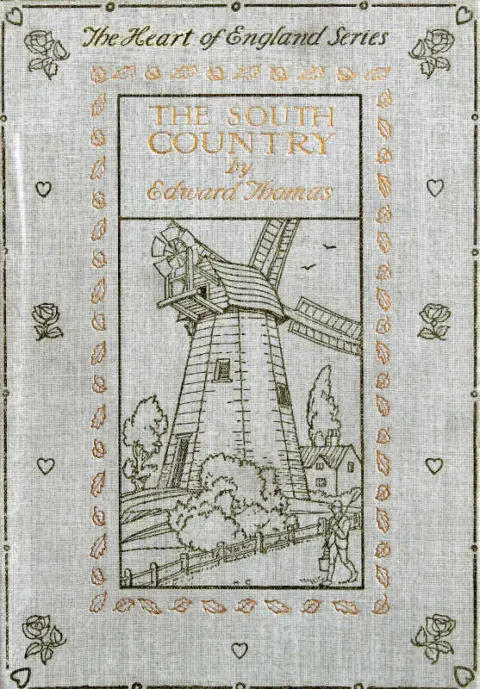
The South Country
Edward Thomas
THE CLASSIC COLLECTION · 1913
"The Happy-go-lucky Morgans" by Edward Thomas is a novel written in the early 20th century. The story centers around the lives of the Morgan family and their home, Abercorran House, in Balham, which is characterized by a lively, chaotic atmosphere filled with both family members and various animals. The narrative captures themes of nostalgia, childhood adventures, and the bittersweet passage of time as the narrator reflects on a family steeped in Welsh culture while facing inevitable changes. At the start of the novel, we are introduced to Abercorran Street, where the Morgans reside. The narrator reminisces about the family, revealing vivid details about their lively household, the various rooms, and the gardens that once thrived, invoking a sense of warmth and familiarity. As memories unfold, the narrator hints at the family's decline and the shifting dynamics as children grow up and move away, leaving behind only echoes of their past laughter and chaos. Ann, the devoted servant, remains a constant presence, connecting the past to the present. This opening portion sets the stage for a reflection on the Morgans’ unique way of life and the impending changes that loom over them.
Introduction adapted from the source catalogue; source summaries may be automatically generated.
Free to read · English · 63,704 words · No account needed
MAKE TIME FOR A GOOD BOOK
On by default. Untick to stop anonymous reading totals. Each page counts after 10 seconds in view. How this works.
Anonymous counting is on unless you have switched it off.
“Our house was a square one of stone and tiles, having a porch and a room over it, and all covered up in ivy, convolvulus, honeysuckle, and roses, that mounted in a cloud far over the roof and projected in masses, threatening some day to pull down all with their weight, but never trimmed. The cherry-tree stretched out a long horizontal branch to the eaves at one side. In front stood two pear-trees, on a piece of lawn which was as neat as the porch was wild, and around their roots clustered a thicket of lilac and syringa, hiding the vegetable-garden beyond. These trees darkened and cooled the house, but that did not matter. In no other house did winter fires ever burn so brightly or voices sound so sweet; and outside, the sun was more brilliant than anywhere else, and the vegetable-garden was always bordered by crimson or yellow flowers. The road went close by, but it was a hollow lane, and the heads of the passers-by did not reach up to the bottom of our hedge, whose roots hung down before caves that were continually being deepened by frost. This hedge, thickened by traveller’s joy, bramble, and ivy, entirely surrounded us; and as it was high as well as thick you could not look out of it except at the sky and the hills--the road, the neighbouring fields, and all houses being invisible. The gate, which was reached by a flight of steps up from the road, was half-barricaded and all but hidden by brambles and traveller’s joy, and the unkempt yew-tree saluted and drenched the stranger--in one branch a golden-crested wren had a nest year after year.
“Two trees reigned at the bottom of the garden--at one side an apple; at the other, just above the road, a cypress twice as high as the house, ending in a loose plume like a black cock’s tail. The apple-tree was old, and wore as much green in winter as in summer, because it was wrapped in ivy, every branch was furry with lichen and moss, and the main boughs bushy with mistletoe. Each autumn a dozen little red apples hung on one of its branches like a line of poetry in a foreign language, quoted in a book. The thrush used to sing there first in winter, and usually sang his last evening song there, if it was a fine evening. Yet the cypress was my favourite. I thought there was something about it sinister to all but myself. I liked the smell of it, and when at last I went to the sea its bitterness reminded me of the cypress. Birds were continually going in and out of it, but never built in it. Only one bird sang in it, and that was a small, sad bird which I do not know the name of. It sang there every month of the year, it might be early or it might be late, on the topmost point of the plume. It never sang for long, but frequently, and always suddenly. It was black against the sky, and I saw it nowhere else. The song was monotonous and dispirited, so that I fancied it wanted us to go, because it did not like the cheerful garden, and my father’s loud laugh, and my mother’s tripping step: I fancied it was up there watching the clouds and very distant things in hope of a change; but nothing came, and it sang again, and waited, ever in vain. I laughed at it, and was not at all sorry to see it there, for it had stood on that perch in all the happy days before, and so long as it remained the days would be happy. My father did not like the bird, but he was often looking at it, and noted its absence as I did. The day after my sister died he threw a stone at it--the one time I saw him angry--and killed it. But a week later came another, and when he heard it he burst into tears, and after that he never spoke of it but just looked up to see if it was there when he went in or out of the porch. We had taller trees in the neighbourhood, such as the wych-elms and the poplars by the brook, but this was a solitary stranger and could be seen several miles away like a black pillar, as the old cherry could in blossom-time, like a white dome. You were seldom out of sight of it. It was a station for any bird flying to or from the hills. A starling stopped a minute, piped and flew off. The kestrel was not afraid to alight and look around. The nightjar used it. At twilight it was encircled by midges, and the bats attended them for half an hour. Even by day it had the sinister look which was not sinister to me: some of the night played truant and hid in it throughout the sunshine. Often I could see nothing, when I looked out of my window, but the tree and the stars that set round it, or the mist from the hills. What with this tree, and the fruit-trees, and the maples in the hedge, and the embowering of the house, I think the birds sometimes forgot the house. In the mornings, in bed, I saw every colour on the woodpigeon, and the ring on his neck, as he flew close by without swerving. At breakfast my father would say, ‘There’s a kestrel.’ We looked up and saw nothing, but on going to the window, there was the bird hovering almost above us. I suppose its shadow or its blackening of the sky made him aware of it before he actually saw it.
Your reading position is saved on this browser. Take it to another device with a library code. Reading pages adapt to text, rather than matching a printed edition.
Edward Thomas
Edward Thomas

Edward Thomas
Edward Thomas
BEHIND THE BOOK
This eBook is for the use of anyone anywhere in the United States and most other parts of the world at no cost and with almost no restrictions whatsoever. You may copy it, give it away or re-use it under the terms of the Project Gutenberg License included with this eBook or online at www.gutenberg.org. If you are not located in the United States, you will have to check the laws of the country where you are located before using this eBook. Read the source licence.
The original source file, including credits and licence, is retained by this library. Request an original-format copy at no charge. Please include the book title and Project Gutenberg identifier #63268.
KEEP YOUR CURIOSITY GOING
Coulson Kernahan

Maurice Baring
Frances Wright
Cécile Tormay

Frederic Jesup Stimson

W. H. P. (William Henry Pope) Jarvis