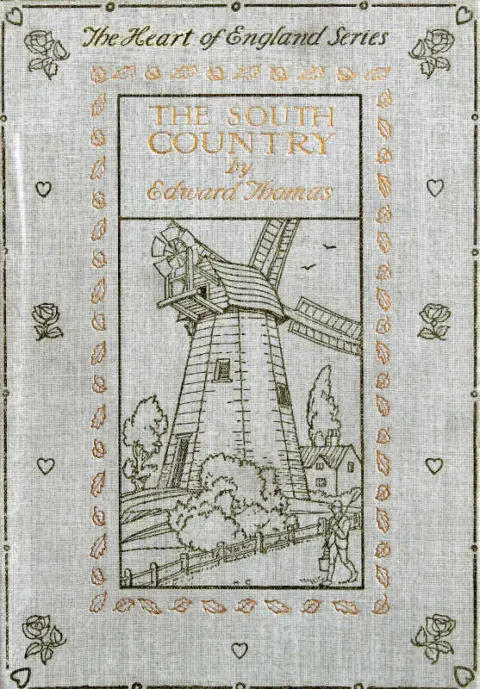
The South Country
Edward Thomas
THE CLASSIC COLLECTION · 1913
"The Happy-go-lucky Morgans" by Edward Thomas is a novel written in the early 20th century. The story centers around the lives of the Morgan family and their home, Abercorran House, in Balham, which is characterized by a lively, chaotic atmosphere filled with both family members and various animals. The narrative captures themes of nostalgia, childhood adventures, and the bittersweet passage of time as the narrator reflects on a family steeped in Welsh culture while facing inevitable changes. At the start of the novel, we are introduced to Abercorran Street, where the Morgans reside. The narrator reminisces about the family, revealing vivid details about their lively household, the various rooms, and the gardens that once thrived, invoking a sense of warmth and familiarity. As memories unfold, the narrator hints at the family's decline and the shifting dynamics as children grow up and move away, leaving behind only echoes of their past laughter and chaos. Ann, the devoted servant, remains a constant presence, connecting the past to the present. This opening portion sets the stage for a reflection on the Morgans’ unique way of life and the impending changes that loom over them.
Introduction adapted from the source catalogue; source summaries may be automatically generated.
Free to read · English · 63,704 words · No account needed
MAKE TIME FOR A GOOD BOOK
On by default. Untick to stop anonymous reading totals. Each page counts after 10 seconds in view. How this works.
Anonymous counting is on unless you have switched it off.
Up in his tower Morgan came to believe his own father one of this people, and resolved to take a woman from amongst them for a wife. Angharad, the shy, the bold, the fierce dark Angharad whose black eyes radiated light and blackness together, was one of them. She became his wife and went up with him to the tower. After that these things only were certainly known; that she was unhappy; that when she came down to the village for food she was silent, and would never betray him or fail to return; and that he himself never came down, that he also was silent and with his unshorn hair looked like a wild man. He was seen at all hours, usually far off, on the high paths of the mountains. His hair was as black as in boyhood. He was never known to have ailed, until one day the wild wife knocked at a farm-house door near Abercorran, asking for help to bring him where he might be looked after, since he would have no one in the tower but her. The next day Mrs Morgan travelled down to see her son. When she asked me to accompany her I did so with some curiosity; for I had already become something of a stranger at Abercorran House, and had often wondered what had become of David Morgan up on his tower. His mother talked readily of his younger days and his stay in London. Though he had great gifts, some said genius, which he might have been expected to employ in the study, he had applied himself to direct social work. For a year he laboured “almost as hard,” he said, “as the women who make our shirts.” But gradually he formed the opinion that he did not understand town life, that he never could understand the men and women whom he saw living a town life pure and simple. Before he came amongst them he had been thinking grandly about men without realising that these were of a different species. His own interference seemed to him impudent. They disgusted him, he wanted to make them more or less in his own image to save his feelings, which, said he, was absurd. He was trying to alter the conditions of other men’s lives because he could not have himself endured them, because it would have been unpleasant to him to be like them in their hideous pleasure, hideous suffering, hideous indifference. In this attitude, which altogether neglected the consolations and even beauty and glory possible or incident to such a life, he saw a modern Pharisaism whose followers did not merely desire to be unlike others, but to make others like themselves. It was, he thought, due to lack of the imagination and sympathy to see their lives from a higher or a more intimate point of view, in connection with implicit ideals, not as a spectacle for which he had an expensive seat. Did they fall farther short of their ideals than he from his? He had not the power to see, but he thought not; and he came to believe that, lacking as their life might be in familiar forms of beauty and power, it possessed, nevertheless, a profound unconsciousness and dark strength which might some day bring forth beauty--might even now be beautiful to simple and true eyes--and had already given them a fitness to their place which he had for no place on earth. When it was food and warmth which were lacking he never hesitated to use his money, but beyond satisfying these needs he could not feel sure that he was not fancifully interfering with a force which he did not understand and could not overestimate. Therefore, leaving all save a little of his money to be spent in directly supplying the needs of hungry and cold men, he escaped from the sublime, unintelligible scene. He went up into the tower that he had built on a rock in his own mountains, to think about life before he began to live. Up there, said his mother, he hoped to learn why sometimes in a London street, beneath the new and the multitudinous, could be felt a simple and a pure beauty, beneath the turmoil a placidity, beneath the noise a silence which he longed to reach and drink deeply and perpetuate, but in vain. It was his desire to learn to see in human life, as we see in the life of bees, the unity, which perhaps some higher order of beings can see through the complexity which confuses us. He had set out to seek at first by means of science, but he thought that science was an end, not a means. For a hundred years, he said, men had been reading science and investigating, as they had been reading history, with the result that they knew some science and some history. “So he went up into his tower, and there he has been these twelve years,” said Mrs Morgan, “with Angharad and no comforts. You would think by his letters that his thoughts had become giddy up there. Only five letters have I had from him in these twelve years. This is all,” she added, showing a small packet in her handbag. “For the last six years nobody has heard from him except Ann. He wished he had asked Ann to go with him to the tower. She would have gone, too. She would have preserved him from being poetical. It is true he was only twenty-five years old at the time, but he was too poetical. He said things which he was bound to repent in a year, perhaps in a day. He writes quite seriously, as actors half seriously talk, in tones quite inhumanly sublime.” She read me scraps from these old letters, evidently admiring as well as disapproving:
Your reading position is saved on this browser. Take it to another device with a library code. Reading pages adapt to text, rather than matching a printed edition.
Edward Thomas
Edward Thomas

Edward Thomas
Edward Thomas
BEHIND THE BOOK
This eBook is for the use of anyone anywhere in the United States and most other parts of the world at no cost and with almost no restrictions whatsoever. You may copy it, give it away or re-use it under the terms of the Project Gutenberg License included with this eBook or online at www.gutenberg.org. If you are not located in the United States, you will have to check the laws of the country where you are located before using this eBook. Read the source licence.
The original source file, including credits and licence, is retained by this library. Request an original-format copy at no charge. Please include the book title and Project Gutenberg identifier #63268.
KEEP YOUR CURIOSITY GOING
Coulson Kernahan

Maurice Baring
Frances Wright
Cécile Tormay

Frederic Jesup Stimson

W. H. P. (William Henry Pope) Jarvis